
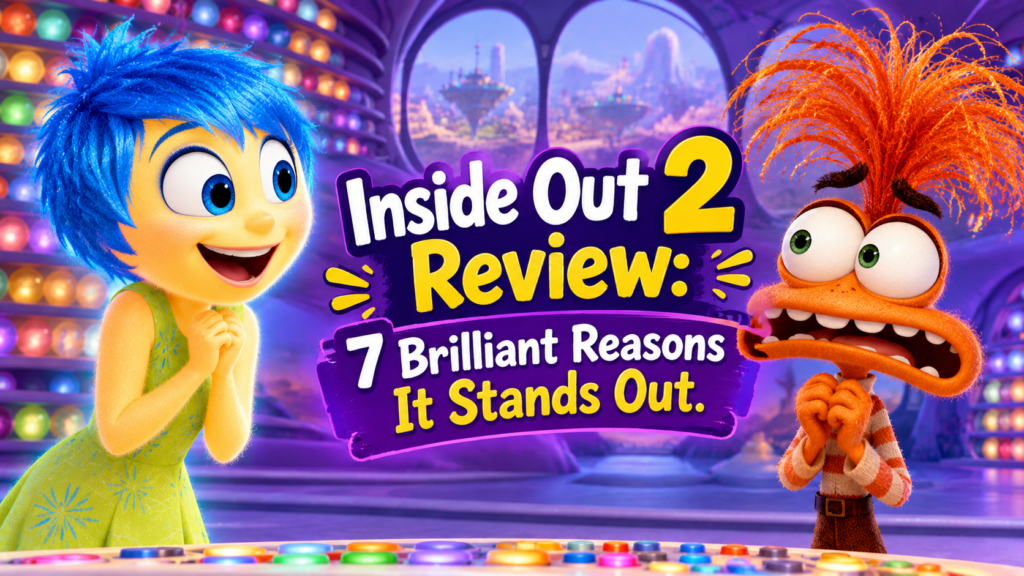
Growing up is a messy, unpredictable business, a reality Pixar captured with visual genius back in 2015. Nine years later, director Kelsey Mann takes the helm to navigate the perilous waters of early adolescence in this ambitious sequel. In our Inside Out 2 review, we look closely at how the film expands Riley’s emotional landscape as she turns 13 and enters high school, facing a complete overhaul of her central headquarters.
When a construction crew abruptly invades Headquarters to clear space for new emotions, Joy, Sadness, Anger, Fear, and Disgust find themselves outmaneuvered by a sophisticated newcomer: Anxiety. Voiced with frantic brilliance by Maya Hawke, Anxiety isn’t a villain; she is an over-prepared protector driven by the desperate desire to ensure Riley’s future success. Anyone reading an Inside Out 2 review will quickly realize that Pixar hasn’t just recycled its old formula here—it has deepened it.
As Riley attends a crucial three-day hockey camp, the struggle between keeping her core self intact and building an entirely new identity forms the narrative engine of the film. Any detailed Inside Out 2 review must highlight how Pixar delivers a sequel that not only matches the thematic depth of the original but offers parents and young viewers a compassionate, visual vocabulary for modern mental health.
Table of Contents
- Quick Facts
- Story and Premise
- Animation and Visuals
- Voice Cast and Characters
- Direction and Writing
- Music and Sound
- Themes and Messages
- What Works Best
- What Could Improve
- Family Viewing Guide
- Final Verdict
- ToonTycoon Rating
- Frequently Asked Questions
Quick Facts
| Detail | Information |
| Movie | Inside Out 2 |
| Release Year | 2024 |
| Studio | Pixar Animation Studios / Walt Disney Pictures |
| Director | Kelsey Mann |
| Writers | Meg LeFauve, Dave Holstein |
| Producers | Mark Nielsen, Pete Docter (Executive) |
| Genre | Animated Comedy / Family / Coming-of-Age |
| Runtime | 96 minutes |
| Rating | PG (for some action/peril and thematic elements) |
| Main Cast | Amy Poehler, Maya Hawke, Kensington Tallman, Liza Lapira, Tony Hale, Lewis Black, Ayo Edebiri |
| Main Character | Riley Andersen / Joy / Anxiety |
Story and Premise
Inside Out 2 opens on the eve of Riley’s 13th birthday. Having settled into her life in San Francisco, Riley has built a strong sense of self anchored by belief structures Joy carefully curated: “I am a good person.” As noted in this Inside Out 2 review, her original emotional core—Joy, Sadness, Anger, Fear, and Disgust—operates like a well-oiled machine.
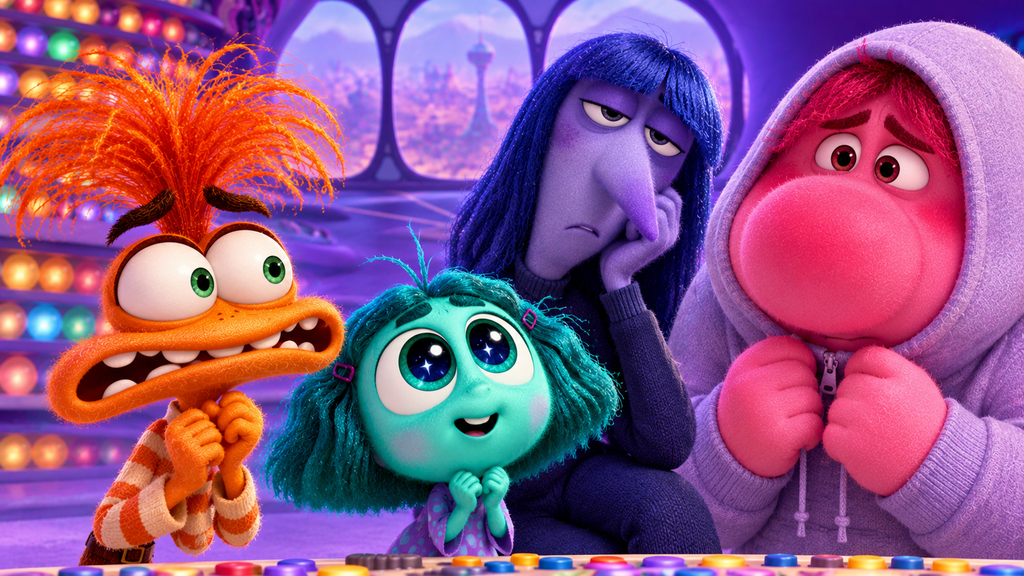
That stability shatters overnight with the arrival of Puberty. A literal wrecking ball smashes through Headquarters, bringing in a brand-new console and a fresh squad of complex emotions: Anxiety, Envy, Embarrassment, and Ennui (boredom).
The central conflict ignites during an elite high school hockey camp. With her best friends revealing they will be attending a different school in the fall, Riley faces an existential dilemma. As we examine in this Inside Out 2 review, Anxiety takes control, suppressing Joy and the original crew to rebuild Riley’s identity around self-preservation and social perfectionism. The story becomes a dual journey: Joy trying to navigate the mind’s backyards to recover Riley’s original Belief System, and Riley attempting to navigate social pressure in the real world.
Animation and Visuals
Pixar continues to set the industry standard for world-building and character design. In this Inside Out 2 review, we must praise how the film expands the internal geography of the human mind with creative flair:
- The Belief System: A stunning visual space below Headquarters featuring glowing strings of memory that radiate up into a luminous tree of identity.
- Stream of Consciousness: Rendered as a literal moving river filled with floating thoughts, wordplay, and visual puns that every Inside Out 2 review will celebrate.
- The Vault: A dark security zone where suppressed secrets, old embarrassing memories, and cartoon crushes are locked away, rendered in distinct visual styles including 2D cell animation and low-poly video game graphics.
- Anxiety’s Swarm: Anxiety’s frantic energy is translated into rapid frame movements, sharp lighting shifts, and a storm of projected future scenarios that vividly visualize an anxiety attack.
The contrast between the soft, tactile textures of the inner world and the grounded, realistic lighting of the external real-world hockey rink creates a rich visual rhythm throughout the 96-minute runtime, a point worth emphasizing in any Inside Out 2 review.
Voice Cast and Characters
The voice performances breathe genuine warmth and comedy into complex psychological concepts, a key highlight of our Inside Out 2 review:
- Joy (Amy Poehler): Poehler returns with unwavering energy, but gives Joy a subtle, desperate undertone this time as she confronts the painful reality that keeping Riley happy might not be what Riley needs.
- Anxiety (Maya Hawke): Hawke delivers a standout performance, capturing the erratic, fast-talking, well-meaning nature of anxiety without turning the emotion into a traditional villain.
- Riley (Kensington Tallman): Tallman captures the vulnerability, social awkwardness, and sudden emotional shifts of an actual 13-year-old with great authenticity.
- Envy (Ayo Edebiri) & Ennui (Adèle Exarchopoulos): Edebiri brings starry-eyed urgency to Envy, while Exarchopoulos steals scenes as the phone-glued, lounge-chair-bound French emotion Ennui.
- Embarrassment (Paul Walter Hauser): A mostly non-verbal giant in a hoodie whose quiet gestures provide significant comedy and heart.
Replacing Bill Hader and Mindy Kaling, Tony Hale (Fear) and Liza Lapira (Disgust) blend seamlessly with the returning cast, maintaining the group’s established comedy dynamics as noted in this Inside Out 2 review.
Direction and Writing
Director Kelsey Mann and screenwriters Meg LeFauve and Dave Holstein demonstrate a strong understanding of adolescent development. As our Inside Out 2 review observes, the narrative avoids easy answers. Rather than villainizing Anxiety, the script acknowledges that every emotion serves a purpose.
The pacing moves swiftly without feeling rushed. The humor operates on multiple levels—slapstick physical comedy for younger viewers and sharp visual puns about teenage psychology for adults (such as a literal “Sar-chasm” opening up in the mind). The emotional climax does not rely on a physical showdown, but rather on an act of emotional surrender and acceptance, proving in this Inside Out 2 review that Pixar has lost none of its narrative magic.
Music and Sound
Composer Michael Giacchino’s themes return, augmented by new musical motifs that reflect Riley’s maturing inner world. In this Inside Out 2 review, we note how the score transitions from bright, bouncy orchestral arrangements during Joy’s reign to fast, synth-driven, driving rhythms as Anxiety assumes control. The sound design during the film’s panic attack sequence subtly drops ambient noise down to heartbeats and shallow breathing, creating an empathetic, immersive experience.
Themes and Messages
Every thoughtful Inside Out 2 review must tackle how the movie handles nuanced emotional themes with striking clarity:
- Embracing All Parts of Yourself: True identity cannot be built by cherry-picking only positive memories. We need our mistakes, embarrassments, and fears to form a complete, honest sense of self.
- The Danger of Over-Control: As highlighted in our Inside Out 2 review, Joy’s attempt to keep Riley strictly “good” is just as damaging as Anxiety’s attempt to make Riley “prepared.”
- The Complexity of Teenage Friendship: Navigating loyalty to old friends while trying to fit in with new peers is a universal rite of passage.
- Self-Compassion: Learning to say “I am flawed, but I am still worthy” is the ultimate step toward maturity.
What Works Best
- Maya Hawke’s Performance: Captures the multi-faceted nature of anxiety with nuance and heart, a major positive in this Inside Out 2 review.
- Visual Representation of Mental Health: Gives families a shared vocabulary to talk about anxiety, panic attacks, and self-esteem.
- The Vault Scene: Features hilarious cameos from a 2D cartoon character and a blocky video game hero.
- The Belief System Concept: A brilliant visual metaphor for how memories form core values, praised throughout our Inside Out 2 review.
- Balanced Humor: Successfully balances existential teenage drama with lighthearted slapstick.
What Could Improve
- Familiar Narrative Structure: As this Inside Out 2 review points out, the core quest structure (Joy stranded outside Headquarters needing to travel back) mirrors the first film closely.
- Underutilized New Emotions: Envy and Ennui take a back seat once Anxiety assumes total command.
- Quick Pacing: Certain mental landscapes are passed through so quickly that viewers barely have time to absorb the world-building details, a minor critique in our Inside Out 2 review.
Family Viewing Guide
- Recommended Age: 6+ (Best appreciated by kids aged 8–14 and parents).
- Violence and Action: Minor sports action and slapstick physical comedy inside the mind; no graphic violence.
- Scary or Intense Scenes: The climax features an intense depiction of an anxiety/panic attack that may resonate deeply with sensitive or anxious children, though it resolves gently, as noted in this Inside Out 2 review.
- Language: Clean; mild thematic tension surrounding peer pressure and lying.
- Positive Messages: Strong emphasis on self-acceptance, honesty, friendship, and emotional health.
Final Verdict
To summarize this Inside Out 2 review, the film is a thoughtful, beautifully animated sequel that honors the emotional intelligence of its predecessor. By tackling anxiety with empathy, humor, and visual ingenuity, Pixar delivers a film that is as entertaining as it is therapeutic for growing families. As our Inside Out 2 review concludes, it is a triumphant coming-of-age story that proves some sequels are entirely necessary.
ToonTycoon Rating
| Category | Rating |
| Animation & Visuals | 9.5/10 |
| Story & Writing | 9.0/10 |
| Characters | 9.0/10 |
| Voice Acting | 9.5/10 |
| Music & Sound | 8.5/10 |
| Family Entertainment | 9.5/10 |
| Overall ToonTycoon Rating | 9.2/10 |
ToonTycoon Verdict: Must Watch
Frequently Asked Questions
Is an Inside Out 2 review positive overall?
Yes, almost every Inside Out 2 review praises Pixar’s sequel as one of its strongest films in years, maintaining the heart and humor of the original.
What is Inside Out 2 about?
The movie follows 13-year-old Riley as she enters puberty. Her core emotions are disrupted when new emotions, led by Anxiety, take over Headquarters right as Riley attends a critical hockey camp.
Who voices Anxiety in Inside Out 2?
Anxiety is voiced by actress Maya Hawke, known for her role in Stranger Things.
Is Inside Out 2 suitable for kids according to this Inside Out 2 review?
Yes, it is rated PG and family-friendly. However, as noted in our Inside Out 2 review, younger children under 6 might find the abstract concepts of anxiety harder to grasp compared to the colorful physical humor.
Do I need to watch the first Inside Out before reading an Inside Out 2 review or watching the movie?
While Inside Out 2 explains its premise quickly, watching the 2015 original provides valuable context for the characters and the rules of Riley’s mind.