
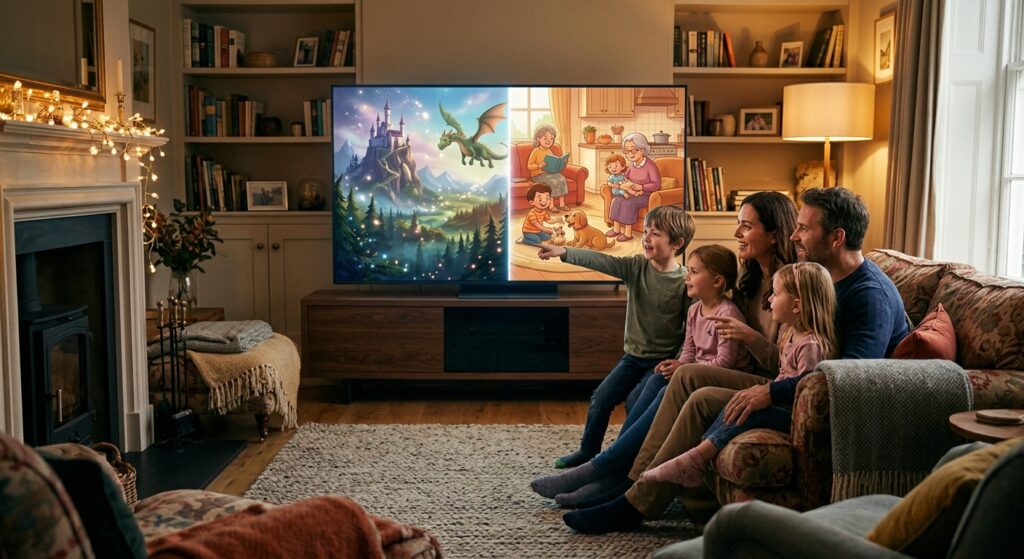
Not Every Evening Needs the Same Kind of Movie
Some evenings call for dragons, enchanted kingdoms, daring quests, and worlds where anything seems possible. On other nights, the family might prefer a gentle story about friendship, school, everyday challenges, or a character learning something new.
The difference is not simply a matter of taste. It can be about the energy in the room.
After a busy day, children may be tired, parents may have little patience left for complicated plots, and everyone may want something comforting. On a weekend afternoon, however, the same family might be ready for an imaginative adventure full of spectacular landscapes, unusual creatures, and high-stakes challenges.
That is where matching family movie night to household energy becomes a useful idea. Instead of choosing a film solely because it is popular or highly rated, families can consider their mood, attention span, available time, and the kind of experience they want to share.
High-fantasy animation and everyday realism offer different storytelling pleasures. Neither is automatically better. The right choice depends on the family, the moment, and the individual needs of everyone watching.
What Is High-Fantasy Animation?
High-fantasy animation transports viewers into worlds governed by magic, mythical creatures, imaginary kingdoms, supernatural forces, or fictional rules that differ significantly from everyday life.
A story might follow a young hero searching for a magical object, a group of companions travelling across an enchanted landscape, or a character discovering an extraordinary ability.
These films often feature:
- Elaborate imaginary worlds and detailed environments.
- Magical creatures, unusual powers, or mythical beings.
- Large-scale adventures and clearly defined challenges.
- Invented histories, kingdoms, cultures, or rules.
- Themes such as courage, loyalty, sacrifice, and belonging.
High fantasy gives storytellers room to explore familiar human experiences through extraordinary situations. A dragon may represent fear, a magical journey may reflect growing up, and a fictional kingdom may provide a setting for questions about fairness or responsibility.
For children who love imagination, this can be deeply engaging. For families watching late in the evening, however, a complicated fantasy world or an intense battle sequence may demand more attention than everyone has available.
It is worth remembering that fantasy is not always loud or overwhelming. Some fantasy films are quiet, thoughtful, and emotionally gentle. The genre alone cannot tell you how intense a movie will feel.
What Is Everyday Realism in Animation?
Everyday realism focuses on experiences that resemble ordinary life. The characters may attend school, build friendships, navigate family relationships, face disappointment, or discover how to solve familiar problems.
These stories might include a child adjusting to a new environment, siblings learning to cooperate, or friends dealing with a misunderstanding.
Everyday realism often features:
- Familiar homes, schools, neighbourhoods, and communities.
- Recognisable family or friendship dynamics.
- Problems that arise from ordinary decisions.
- Emotional changes connected to everyday experiences.
- Humour based on observation rather than magical events.
Realistic animation can help children recognise situations that resemble their own lives. A character struggling to apologise, for instance, may provide an opening to discuss what makes an apology meaningful.
Yet realism should not be confused with simplicity. A realistic story can explore grief, bullying, loneliness, conflict, or other difficult subjects. Parents should consider the film’s actual content rather than assuming that a familiar setting guarantees an easy watch.
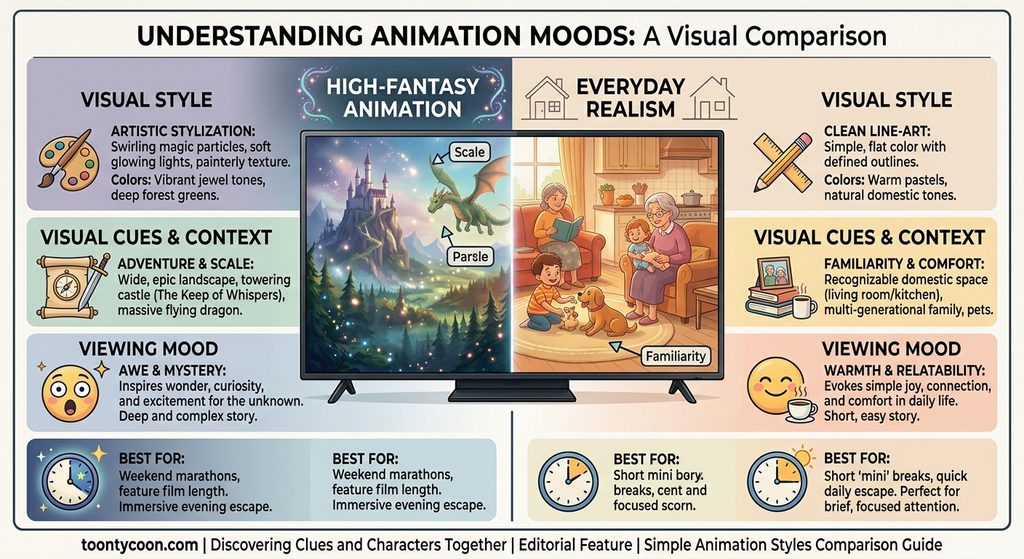
High-Fantasy vs. Everyday Realism: A Quick Comparison
The two approaches can both make excellent family entertainment, but they offer different starting points for a movie night.
| Feature | High-fantasy animation | Everyday realism |
|---|---|---|
| Setting | Imaginary worlds, magical kingdoms, extraordinary landscapes | Familiar homes, schools, communities, and everyday environments |
| Story focus | Quests, mysteries, magical challenges, and extraordinary events | Relationships, daily challenges, personal growth, and familiar situations |
| Attention demands | May require remembering invented rules, characters, or world-building | May be easier to recognise, although emotional themes can be complex |
| Typical conversation starters | “What would you do with that power?” or “How does this world work?” | “Have you experienced something similar?” or “How could they solve this?” |
| Potential appeal | Imagination, adventure, wonder, and escapism | Recognition, empathy, humour, and relatable experiences |
| Best selection criterion | The family’s interest in the story and tolerance for its intensity | The family’s interest in the theme and readiness for its emotional content |
These are general tendencies, not strict rules. A fantasy film can be relaxing, and a realistic film can be emotionally demanding. The best choice is the one that suits your household on that particular evening.
Matching Family Movie Night to Household Energy
The most useful question is not simply, “Which genre is better?” It is, “What kind of viewing experience would suit us tonight?”
Here are a few common family situations and ways to approach them.
1. After a Long School or Workday: Choose Familiar and Manageable
After a demanding day, children may have less patience for complicated plots or intense sequences. Parents may also prefer a story that does not require them to keep track of a long list of characters and fictional rules.
A gentle everyday story, a familiar favourite, or a short animated film may be a comfortable choice.
Look for clear storytelling, manageable pacing, and themes that suit the child’s current mood. If your child enjoys fantasy, a quieter adventure may work just as well as a realistic story.
The goal is not to keep every scene calm. It is to avoid adding unnecessary demands when the family is already tired.
Movie-night question: “Would we rather enjoy something familiar, or are we ready for a new adventure?”
2. On a Weekend Evening: Make Room for Imagination
When everyone has time to settle in, a high-fantasy adventure can create a memorable shared experience.
The family might explore a fictional kingdom, follow a group of unlikely heroes, or discuss how the characters solve unusual problems. Longer films can also provide opportunities to talk about world-building, character motivations, and the choices characters make under pressure.
Before pressing play, consider the film’s length and intensity. An exciting quest with frightening creatures, peril, or battle scenes may not be suitable for every child simply because it is animated.
If younger children are watching, check age guidance and content descriptions beforehand.
Movie-night question: “Are we in the mood for a big adventure, or would a shorter story be more enjoyable?”
3. When Children Seem Restless: Focus on Interest, Not Just Energy
A restless child does not necessarily need a slow film. Some children find a lively story easier to engage with, while others become more unsettled by rapid action, sudden sounds, or complicated scenes.
Rather than assuming that a high-energy child needs a high-energy movie, consider what usually helps your child settle and enjoy a story.
You might choose a familiar animated comedy, a short film with a clear central idea, or a favourite adventure that your child already understands.
If the child is repeatedly getting up, becoming upset, or losing interest, it may be better to pause the movie, take a break, or choose another activity.
Movie-night question: “Would you like something funny, something exciting, or a short film?”
4. When the Family Wants to Connect: Choose a Story That Invites Conversation
Sometimes the best movie is the one that gives everyone something to discuss afterward.
Everyday realism can create natural openings for conversations about friendships, fairness, mistakes, and family relationships. Fantasy can explore many of the same ideas through imaginary challenges and extraordinary characters.
For example, a hero refusing help can prompt a discussion about independence and teamwork. A realistic story about a misunderstanding can lead to a conversation about listening and making things right.
Do not turn the film into a lesson that children must pass. Let the conversation follow their interests, and remember that simply enjoying a story together is worthwhile.
Movie-night question: “Would we enjoy talking about a familiar situation or imagining how we would handle a completely different world?”
5. When Everyone Has Different Preferences: Look for a Shared Middle Ground
One child may want dragons and magic, another may prefer school stories, and a parent may want something short enough to finish before bedtime.
Instead of debating genres, identify the qualities everyone can agree on. Perhaps the family wants humour, an appealing main character, a manageable runtime, or a story with a satisfying ending.
Fantasy-comedy, realistic adventure, or a collection of animated shorts may provide a useful compromise.
You can also alternate who chooses the movie, provided the selection remains appropriate for everyone watching.
Movie-night question: “What are two things our movie should have so that everyone can enjoy it?”
A Simple Household-Energy Check Before Choosing
You do not need a complicated rating system to select a movie. A quick family check-in can help you make a sensible choice.
Consider these five questions:
- How tired is everyone? A long, complicated film may not be ideal when several people are exhausted.
- How much time do we have? Check the runtime and allow room for settling in and getting ready for bed.
- What mood are we looking for? Comedy, adventure, comfort, wonder, or an opportunity to talk?
- What can the youngest viewer comfortably handle? Consider frightening imagery, emotional intensity, sudden sounds, and other content.
- Does everyone want to watch? If someone is not interested, a shorter film or another shared activity may be a better option.
The answers do not have to point toward one genre. They simply help the family make a more thoughtful decision.
How to Evaluate a Film Beyond Its Genre
Genre is a starting point, not a complete review. Before choosing a film, look at several factors that may affect your family’s experience.
Pacing and Complexity
Some films move rapidly between action scenes and new locations. Others take their time developing characters and relationships.
A complex fantasy may require viewers to remember names, histories, and imaginary rules. A realistic drama may have a simpler plot but rely on subtle emotional changes.
Choose according to your child’s interests and ability to follow the story, rather than assuming one approach is automatically easier.
Emotional Intensity
A film can be funny, colourful, and beautifully animated while still including frightening or upsetting moments.
Look for information about peril, loss, conflict, bullying, scary creatures, and other themes that may matter to your child. Consider previous reactions to similar content.
If a child has found certain scenes distressing in the past, choose accordingly and be ready to pause or stop the film.
Sound and Visual Stimulation
Fast editing, loud sound effects, flashing imagery, or abrupt changes in volume may be uncomfortable for some viewers.
A high-fantasy film may include dramatic battles and powerful sound design, but these features are not exclusive to fantasy. Realistic animation can also use intense music or rapid sequences.
If your child seems overwhelmed, lower the volume, take a break, or choose a less intense option.
Runtime and Bedtime
A film that starts late can push bedtime later than expected, especially when the family wants to discuss the ending or watch additional content.
Check the full runtime before starting. If there is not enough time, a short animated film can provide a satisfying shared experience without rushing everyone through a feature-length story.
How to Make Family Movie Night More Enjoyable
Choosing the right film is only part of the experience. A few small habits can make movie night more comfortable for everyone.
Create a relaxed viewing space. Comfortable seating, manageable volume, and fewer distractions can help the family focus on the story.
Agree on a stopping time. This is especially useful on school nights. Decide whether the family has time for a feature film or whether a short film is more practical.
Let children express preferences. Ask what they enjoy about a genre instead of dismissing their choices. A child’s enthusiasm for fantasy or realism can be a useful guide.
Keep snacks and breaks simple. Do not make the evening so elaborate that it becomes stressful to organise.
Avoid forcing discussion. Some children love talking about characters and endings; others prefer to enjoy the experience quietly. Both are fine.
Be willing to change plans. If the selected film is too frightening, confusing, or simply uninteresting, stopping is not a failure. Finding something more suitable is part of good family media planning.
Film Examples: Different Stories for Different Moods
The following films offer examples of how fantasy and more familiar, everyday experiences can shape animated storytelling. They are not universal recommendations for every age or household mood, so check the age rating and content guidance before viewing.
High-Fantasy and Imaginative Adventures
How to Train Your Dragon combines a richly imagined world with dragons, adventure, and relationships. It can provide conversation starters about courage, trust, and understanding someone who seems different, while also including peril and action.
Spirited Away offers a fantastical world filled with unusual creatures, mysteries, and symbolic imagery. Its imaginative setting can prompt rich discussion, but some scenes may feel frightening or intense for younger viewers.
The Lord of the Rings: The War of the Rohirrim presents a fantasy world with battles, danger, and a serious tone. It is better approached after reviewing its content and suitability for the intended audience rather than chosen solely for its animated format.
Everyday Experiences and Relatable Stories
Inside Out uses an imaginative representation of emotions to explore familiar experiences of growing up and change. Although it includes fantasy elements, its emotional themes can help families talk about feelings and transitions.
The Peanuts Movie centres on recognisable childhood experiences, friendships, confidence, and social challenges, using a light and humorous tone.
My Neighbor Totoro blends everyday family life with gentle fantasy. It can be a useful example of how ordinary experiences and imaginative elements can coexist, although families should consider the emotional context of the story.
These examples demonstrate why the distinction between high fantasy and everyday realism is a spectrum rather than a strict divide. Some of the most effective animated films combine familiar human concerns with imaginative worlds.
Frequently Asked Questions
1. What does matching family movie night to household energy mean?
It means choosing a film based on the family’s mood, tiredness, available time, interests, and comfort with the content. The aim is to make movie night enjoyable and appropriate for everyone watching.
2. Is high-fantasy animation better for weekends?
It can be a good weekend choice when the family has time for a longer or more complex story. However, some fantasy films are short and gentle, while others are intense. The film’s actual content matters more than the day of the week.
3. Is everyday realism more suitable for tired children?
A familiar, straightforward story may feel comfortable after a busy day, but not every realistic film is relaxing. Consider the pacing, emotional themes, runtime, and your child’s preferences.
4. Can fantasy films teach children about real-life emotions?
Yes. Fantasy stories often explore courage, friendship, fear, loyalty, fairness, and belonging through imaginary situations. Parents can discuss how characters respond to challenges without assuming that every story has one simple lesson.
5. How can parents choose a film when siblings have different tastes?
Look for shared qualities such as humour, a manageable runtime, appealing characters, or a balance of adventure and familiar experiences. Alternating who chooses the film can also help, as long as the content is appropriate for everyone.
6. Does animation automatically mean a film is child-friendly?
No. Animated films can include frightening imagery, violence, grief, complex themes, or intense sound and visual effects. Check age ratings and content descriptions before watching with children.
7. What should I do if a child becomes uncomfortable during a movie?
Pause the film, acknowledge the child’s reaction, and offer a break or a different activity. You do not need to persuade the child to finish a story that is making them uncomfortable.
8. How long should family movie night last?
There is no single ideal duration. Choose a runtime that fits the family’s schedule and bedtime routine. A short animated film can be just as meaningful as a feature-length movie when everyone is tired or short on time.
Final Thoughts: Choose the Experience, Not Just the Genre
A successful family movie night is not measured by how elaborate the story is, how popular the film has become, or how many adventures unfold on screen. It is measured by whether the experience suits the people sharing it.
High-fantasy animation can open the door to wonder, imagination, and extraordinary adventures. Everyday realism can bring familiar experiences, relationships, and emotions into focus. Both can entertain, comfort, and inspire meaningful conversations.
By matching family movie night to household energy, parents can make choices that respect the family’s mood, schedule, interests, and individual needs. Some evenings will call for dragons and distant kingdoms. Others will be better served by a gentle story about friendship or growing up.
And sometimes, the best choice is a short cartoon, a bowl of popcorn, and the simple pleasure of spending time together.
Editorial note: This article offers general family media-selection guidance. Film suitability varies by age, individual sensitivities, and content. Review age ratings and content descriptions before viewing.