
There was a time when Saturday morning felt different from every other morning of the week. The schoolbooks could wait, the alarm clock was finally silent, and the television became the centre of the household. For millions of children growing up during the 1970s and 1980s, Saturday morning retro cartoons were more than a way to pass a few hours. They were a weekly tradition, a shared cultural experience, and, for some, the first appointment of the weekend.
You woke up early, found something to eat, settled in front of the television, and waited for the familiar theme music to begin. One show led to another, each with its own heroes, villains, jokes, colourful worlds, and unforgettable opening sequences. There was no pause button, no personalised recommendation list, and no promise that an episode would be waiting whenever you wanted it. If you missed your favourite cartoon, you might have to wait an entire week to see it again.
That sense of anticipation helped make Saturday morning retro cartoons a defining part of childhood in the United States and an enduring influence on television animation around the world.
The era also had a commercial side. Television networks wanted young viewers, advertisers wanted their attention, and toy companies increasingly recognised that an animated series could turn a fictional character into a household name. The relationship between cartoons, advertising, toys, and television became one of the most important features of the period.
Looking back today, it is easy to remember only the colourful characters and catchy songs. Yet the story of Saturday morning retro cartoons is also a story about changing technology, business decisions, family habits, and the way entertainment reaches an audience.
At ToonTycoon.com, we are revisiting that remarkable chapter of animation history: the shows that defined the weekend, the studios behind them, the merchandise that followed, and the reasons the traditional Saturday morning cartoon block eventually disappeared.
Table of Contents
- The Architecture of the Saturday Morning Broadcast
- The Rise of the Merchandise-Driven Franchise Era
- Why the Saturday Morning Ritual Disappeared and Where It Lives Today
- Quick Facts and Summary Table
- Frequently Asked Questions
The Architecture of the Saturday Morning Broadcast
A television schedule built around childhood
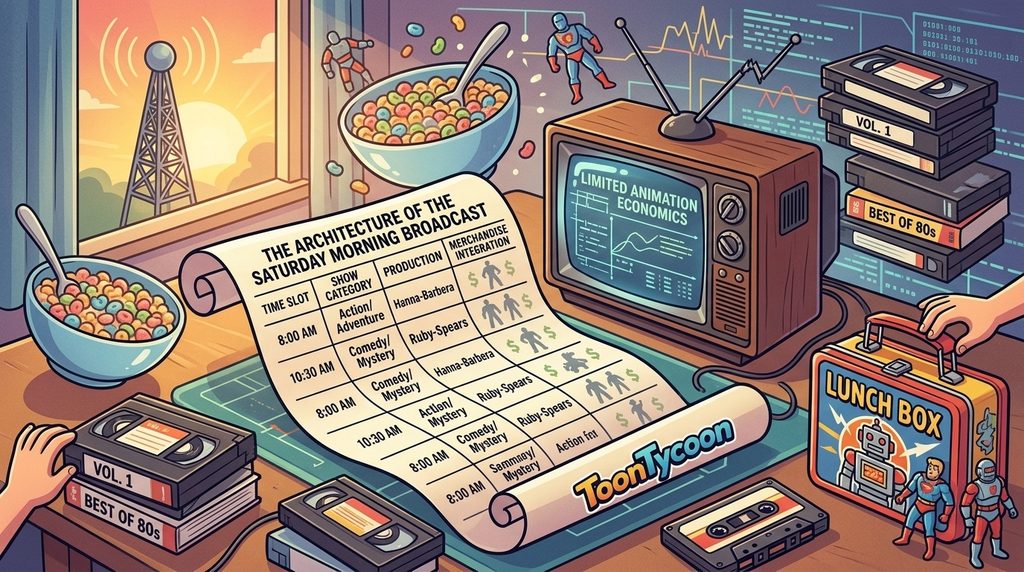
Before streaming services and on-demand libraries, television was organised around schedules. Viewers tuned in at particular times to catch particular programmes. For children, Saturday mornings became a natural home for animated entertainment because many were free from school and could spend several hours watching television.
Broadcasters assembled blocks of cartoons that could keep young viewers watching from early morning into lunchtime. The precise schedule differed by network, season, and year, but the formula was familiar: an energetic opening, a sequence of animated adventures, a few comic breaks, and another show waiting just around the corner.
The experience was part of the appeal. Saturday morning retro cartoons gave children a predictable weekend ritual, while the changing line-up offered something new every half-hour or hour.
A child might begin with a superhero adventure, move on to a talking-animal comedy, and finish with a science-fiction story. Parents could make breakfast, the family could gather in the living room, and friends could discuss the previous week’s episode when they met again.
There was also a particular magic in the limitations. If a programme aired only once a week, its opening music and favourite scenes could become deeply familiar. Viewers remembered not just what happened in an episode but where they were sitting when they watched it.
The studios that shaped the Saturday morning sound
American television animation relied on a mixture of established theatrical studios, television-focused production houses, and collaborations between broadcasters and outside producers.
Hanna-Barbera became one of the most recognisable names in television cartoons. Founded by William Hanna and Joseph Barbera, the studio built a large catalogue of animated series, including The Flintstones, The Jetsons, Scooby-Doo, Where Are You! and The Smurfs for television audiences across different eras.
Filmation developed a strong identity through adventure, superhero, fantasy, and action-oriented series. Its productions included Fat Albert and the Cosby Kids, He-Man and the Masters of the Universe, and She-Ra: Princess of Power.
Ruby-Spears, founded by former Hanna-Barbera writers and producers Joe Ruby and Ken Spears, also became a significant force in television animation. Meanwhile, Marvel Productions helped bring comic-book heroes and toy-based properties to television, including Spider-Man and His Amazing Friends and The Transformers.
These studios did not all operate in the same way, and their programmes did not all belong to the same decade. Together, however, they helped establish the visual language of classic television cartoons.
What made the classic format work?
The appeal of Saturday morning retro cartoons came from a combination of creative storytelling, production realities, broadcast scheduling, and audience habits.
| Defining feature | How it worked | Cultural impact |
|---|---|---|
| Weekly cartoon blocks | Networks grouped animated shows into scheduled morning slots | Created a shared weekend routine |
| Short, repeatable stories | Many episodes used familiar structures and self-contained plots | Made programmes easy to follow |
| Recognisable theme songs | Opening music introduced characters and established the mood | Songs became part of childhood memory |
| Distinct character designs | Heroes, villains, costumes, and silhouettes were easy to recognise | Characters remained memorable outside the screen |
| Limited animation | Reused drawings, held poses, and economical movement controlled costs | Allowed studios to produce television animation on tight budgets |
| Toy and merchandise connections | Some shows were linked to figures, vehicles, games, and other products | Extended fictional worlds into children’s bedrooms |
| Network scheduling | Episodes aired at a set time rather than whenever viewers chose | Encouraged anticipation and repeat viewing |
Limited animation: making more television with less
One of the most important, and often misunderstood, features of Saturday morning retro cartoons was limited animation.
The term refers to production techniques that reduce the amount of new movement drawn for each scene. Animators might reuse backgrounds, hold a character’s pose, cycle a walk, or animate only a mouth while dialogue continued. Camera movement, editing, sound effects, and expressive voices helped keep scenes lively without requiring every frame to be completely redrawn.
This approach was partly an economic necessity. Producing animation for television on a regular schedule was expensive, and a studio needed a workable system for delivering episodes consistently.
Limited animation did not automatically mean poor animation. It meant that artists had to make deliberate choices about where movement mattered most. A strong voice performance, an effective visual gag, a distinctive character, or a well-timed musical cue could carry a scene that used relatively little motion.
The technique also had limitations. Some shows looked stiff compared with theatrical animation, and repeated cycles could become obvious. But television animation developed its own strengths: quick storytelling, memorable dialogue, clear character personalities, and imaginative premises.
In other words, the production method influenced the style. What began as a way to control costs became part of the familiar look of many classic television cartoons.
The theme songs that did half the storytelling
Ask fans about Saturday morning retro cartoons, and the conversation will often turn to music before it turns to plot.
A few notes could take viewers straight back to a particular programme. The opening of The Jetsons sounded futuristic and playful. Scooby-Doo, Where Are You! established its mystery-comedy mood through a catchy theme. The Super Friends announced a world of superheroes, while He-Man and the Masters of the Universe used bold music and narration to create an epic atmosphere.
Theme songs were practical, too. They helped identify a programme immediately, introduced characters, and gave young viewers something to sing after the television had been switched off.
Some openings were essentially miniature introductions to a fictional universe. They explained who the heroes were, what they could do, and what sort of adventure lay ahead. Others relied on rhythm, comedy, or a memorable refrain.
In an age when children might not have seen an episode for another week, the theme song served as a familiar doorway back into the series.
That is one reason retro cartoon theme songs continue to circulate through online videos, fan playlists, convention performances, and nostalgic discussions. The music was never merely background decoration. It was part of the identity of the show.
The Rise of the Merchandise-Driven Franchise Era
When a cartoon became a product universe
The relationship between animation and merchandise did not begin in the 1980s. Licensed character products and cartoon-related toys had existed for decades. What changed during the late 1970s and 1980s was the prominence of television series built around recognisable properties, action figures, vehicles, playsets, and other products.
For toy manufacturers, an animated show could help children understand how a toy was meant to be used. A character on television had a personality, friends, enemies, and a fictional world. The toy gave the viewer a way to recreate that world away from the screen.
For broadcasters and producers, a popular property could generate a dependable audience and create licensing opportunities. For children, it could mean that the adventure continued after the programme ended.
The growth of Saturday morning retro cartoons therefore cannot be separated from the expanding relationship between entertainment and consumer products.
The toy-line animated show takes centre stage
Several well-known franchises illustrate how closely cartoons and toys became connected.
He-Man and the Masters of the Universe helped turn fantasy action figures into characters with an elaborate fictional setting. The series introduced Eternia, Castle Grayskull, heroic allies, and the villainous Skeletor to a broad television audience.
The Transformers brought transforming robots, vehicles, rival factions, and an expanding cast of characters to television. Its animated series helped give a narrative identity to toys that could change between robot and vehicle forms.
G.I. Joe: A Real American Hero connected military-themed action figures with an ongoing conflict between G.I. Joe and Cobra. Its animated adventures gave children recurring characters, missions, and a recognisable fictional world.
She-Ra: Princess of Power expanded the world associated with He-Man while presenting a heroine and a fantasy setting of its own. The series also became part of the growing market for character-led toys and merchandise.
These shows differed in their origins, production arrangements, and relationship with their respective toy lines. It would be too simple to say that every episode was merely a commercial. They were television programmes with writers, voice actors, directors, and audiences who cared about the stories.
Still, their commercial connections were unusually visible. Characters appeared in catalogues, toy aisles, lunchboxes, clothing, and playsets. A child could watch an episode in the morning and then spend the afternoon recreating the adventure with figures on the bedroom floor.
The business model behind the fantasy
The commercial system varied from one property to another, but several interests often overlapped:
- Toy manufacturers wanted products that children recognised and wanted to collect.
- Production companies wanted funding, distribution, and opportunities to develop successful properties.
- Broadcasters wanted programmes that attracted a reliable audience.
- Advertisers wanted to reach viewers and promote products to families.
- Licensing partners wanted to extend a character’s identity into other markets.
The result was a business environment in which a successful animated series could become part of a much larger entertainment franchise.
Toy-linked programmes also encouraged continuity across different forms of media. A child might encounter a character in a cartoon, see the same character on packaging, read about the adventure in a comic, and then play out a new story at home.
This approach influenced later multimedia franchises, where films, games, streaming series, collectibles, and social media all support a shared fictional universe.
Did toy companies control every cartoon?
Not exactly. The history is more complicated than the idea that all cartoons were made to sell toys.
Some series began as comic-book adaptations, some grew out of existing characters, and others were developed primarily as television entertainment. Merchandise could be an important part of a show’s commercial life without being its sole creative purpose.
Regulations and broadcasting standards also shaped the relationship between children’s programming and advertising. In the United States, concerns about commercial influence in children’s television became a recurring public-policy issue. The rules changed over time, and the precise requirements depended on the period and type of programme.
It is more accurate to say that toy-linked cartoons became a major part of the television landscape, rather than claiming every programme followed one universal formula.
For many fans, that commercial side is inseparable from the memories. The toys were not separate from the story; they were how the story continued when the television was off.
A decade-by-decade guide to classic television animation
The following table highlights representative series and their wider cultural significance. It is not an exhaustive list, and some programmes ran across several years or were first broadcast outside Saturday-morning slots before becoming associated with the broader cartoon era.
| Decade | Representative shows | Production house or origin | Cultural impact |
|---|---|---|---|
| 1970s | The Scooby-Doo Show, Super Friends, Fat Albert and the Cosby Kids | Hanna-Barbera; Filmation | Established recurring mystery, superhero, and socially themed cartoon formats |
| Late 1970s | The All-New Super Friends Hour, Battle of the Planets | Hanna-Barbera; Japanese series adapted for international audiences | Expanded superhero ensembles and introduced more science-fiction action |
| Early 1980s | The Smurfs, He-Man and the Masters of the Universe | Hanna-Barbera; Filmation | Helped turn character worlds and fantasy settings into major children’s entertainment properties |
| Mid-1980s | The Transformers, G.I. Joe: A Real American Hero | Marvel Productions and associated studios; Sunbow and associated production partners | Connected ongoing action stories with popular toy lines |
| Mid-to-late 1980s | She-Ra: Princess of Power, ThunderCats | Filmation; Rankin/Bass and associated animation partners | Made fantasy adventure, distinctive character designs, and collectible heroes central to the era |
| Late 1980s | DuckTales, Teenage Mutant Ninja Turtles | Disney Television Animation; Murakami-Wolf-Swenson and associated partners | Helped bridge traditional broadcast cartoons and the next generation of globally recognised franchises |
The range is important. Not every classic cartoon was a toy advertisement, and not every show was originally designed for the Saturday morning schedule. The broader phenomenon emerged from the interaction of network programming, syndication, international animation, licensing, and changing audience expectations.
Hanna-Barbera classics and the art of memorable characters
Any discussion of Saturday morning retro cartoons must give special attention to Hanna-Barbera.
The studio became known for a large catalogue of animated television series that balanced recognisable characters with economical production. Its programmes ranged from prehistoric family comedy to futuristic adventure and mystery-solving animals.
The Flintstones demonstrated that an animated series could work as a prime-time family sitcom. The Jetsons imagined a future filled with household robots, flying cars, and automated conveniences. Scooby-Doo, Where Are You! combined comedy, suspense, and a recurring mystery structure that made it easy for audiences to return each week.
These programmes were not all produced exclusively for Saturday mornings. Their significance lies in how they helped establish television animation as a sustainable form of entertainment and later became fixtures of reruns and family viewing.
Hanna-Barbera’s legacy also illustrates the value of character design. Scooby’s expressive face, the Flintstones’ stone-age domestic world, and the Jetsons’ futuristic machines could communicate a show’s premise almost instantly.
The stories were accessible, the characters were easy to recognise, and the worlds were broad enough to support repeated adventures. Those qualities helped the studio’s creations remain familiar long after their original broadcasts.
The cultural reach of the cartoon block
The appeal of Saturday morning retro cartoons extended beyond individual programmes. The schedule itself created a common reference point.
Children could compare favourite heroes at school, trade toys, draw characters in notebooks, and imitate theme songs. In households where siblings had different tastes, the morning could become a friendly argument over which show deserved the best time slot.
There were also meaningful differences in representation and storytelling. Some programmes offered educational messages, environmental themes, or stories about friendship and responsibility. Others focused on slapstick, action, fantasy, or comedy.
Not every series aged equally well. Some relied on stereotypes or dated assumptions that modern audiences may question. Revisiting the period honestly means appreciating its creative achievements while recognising that children’s media reflects the values and limitations of the time in which it was produced.
That combination of nostalgia and critical distance makes classic television animation worth exploring today.
Why the Saturday Morning Ritual Disappeared and Where It Lives Today
The schedule began to lose its power
The traditional Saturday morning cartoon block did not disappear overnight, and there was no single cause. Instead, several changes gradually weakened the model.
Cable television gave children more opportunities to watch cartoons throughout the day. Dedicated children’s channels offered animation outside the traditional weekend window, reducing the importance of one morning schedule.
Home video also changed viewing habits. Families could buy or rent recordings, allowing children to revisit favourite episodes without waiting for a broadcast. Video games, later digital media, and the expansion of children’s entertainment choices further fragmented audiences.
At the same time, broadcasters faced changing economics, regulatory requirements, and competition from other forms of programming. In the United States, rules and expectations around children’s educational television and advertising also influenced network schedules. Their effects varied by period and broadcaster, so they should be understood as part of a larger transition rather than the sole explanation.
By the time on-demand streaming became widespread, the idea of waiting for a specific morning to watch cartoons had become much less necessary.
From appointment television to entertainment on demand
The old model asked viewers to fit their morning around the television schedule. The modern model allows viewers to select a programme, season, or episode whenever they want.
That change brought real advantages. Children can revisit older series, discover animation from other countries, and explore shows that may never appear on a local broadcast schedule. Families can watch together at different times, and niche programmes can find audiences beyond their original markets.
But something has changed, too.
A scheduled broadcast created a shared moment. Viewers could expect that many other children were watching the same episode at roughly the same time. The conversation continued at school, in the playground, and among friends.
Streaming makes access easier, but it can divide the audience across different services and viewing habits. One child may be watching an old superhero cartoon, another a contemporary comedy, and another short-form videos. The shared schedule is no longer the default.
This is why Saturday morning retro cartoons can inspire such strong nostalgia. People are often remembering not only the shows but the social routine surrounding them.
Where the ritual lives today
The spirit of the classic cartoon morning has not vanished. It has moved into different places.
Streaming libraries make older series available to new audiences, although availability varies by country and changes as licensing agreements expire or move between services.
Official studio channels and digital releases sometimes provide clips, theme songs, trailers, and selected episodes. Viewers should look for authorised uploads where possible, particularly when sharing material with children.
DVD and Blu-ray collections remain useful for fans who want a physical archive that is not dependent on a streaming subscription. Older releases can include episode notes, artwork, interviews, and other extras.
Retro television channels and themed programming blocks preserve some of the scheduled-viewing experience. Their availability depends on the region and provider, but they offer a reminder of how television once organised the weekend.
Fan communities and animation-history websites help preserve production details, theme-song memories, artwork, and discussions about how particular series were made.
Families can also recreate the old ritual without needing an actual broadcast network. Pick a morning, choose a few episodes, prepare breakfast, and watch together without constantly jumping between recommendations. A simple routine can capture some of the old excitement.
Why nostalgia is about more than the cartoons
Nostalgia can make the past appear simpler than it really was. Not every child had the same access to television, and the classic Saturday schedule was most strongly associated with particular broadcasting markets, especially the United States.
Still, the emotional memory is understandable. A favourite cartoon might be connected with a parent making breakfast, a brother or sister sitting nearby, or the excitement of having no school that morning.
The theme music becomes a memory trigger. The characters recall a time when a few hours of television could feel like a major event.
That is the lasting appeal of Saturday morning retro cartoons: they preserve a record of how a generation watched, played, talked, and imagined.
What modern animation can learn from the era
The old programmes also offer lessons for today’s creators.
A distinctive character can outlast a particular animation technique. A memorable theme song can make a series instantly recognisable. A simple premise can support years of stories when the characters have clear personalities and the world has room to grow.
Modern animation has more production tools than earlier television studios could have imagined, from sophisticated 3D rendering to digital compositing and global collaboration. Yet technology alone does not guarantee a lasting show.
The strongest contemporary series still need clear storytelling, emotional connection, visual identity, and an understanding of their audience. Those fundamentals helped classic cartoons survive repeated broadcasts and continue to matter in the streaming era.
Quick Facts and Summary Table
The following overview captures the major ideas behind Saturday morning retro cartoons, from the television schedule to the merchandise boom and the rise of on-demand viewing.
| Topic | Quick fact | Why it matters |
|---|---|---|
| Core period | The 1970s and 1980s are especially associated with the classic Saturday cartoon experience | These decades combined network cartoon blocks with expanding children’s franchises |
| Broadcast model | Programmes aired at scheduled times, often in multi-show blocks | Viewers built weekend routines around the line-up |
| Production style | Limited animation helped control television production costs | Studios could deliver regular episodes on tight schedules |
| Theme music | Short, recognisable openings helped establish each show’s identity | Songs became enduring parts of cartoon nostalgia |
| Toy-linked franchises | Series such as He-Man and The Transformers connected stories with merchandise | The fictional world continued through toys and licensed products |
| Influential studio | Hanna-Barbera produced many of television animation’s best-known series | Its catalogue helped define the look and rhythm of TV cartoons |
| Other major producers | Filmation, Ruby-Spears, Marvel Productions, and other partners shaped the period | The television animation landscape was larger than any single studio |
| Changing viewing habits | Cable, home video, and later streaming reduced dependence on one weekly slot | Viewers gained flexibility but lost some shared scheduling |
| Modern legacy | Classic cartoons remain available through selected digital, physical, and broadcast releases | New generations can discover the shows beyond their original era |
Essential shows to revisit
These selections offer a useful starting point for anyone exploring Saturday morning retro cartoons. They represent different styles and periods rather than a definitive ranking.
| Show | Era or debut | Associated studio or production | What makes it memorable |
|---|---|---|---|
| Scooby-Doo, Where Are You! | 1969 | Hanna-Barbera | A mystery-solving gang, comic scares, and a formula that invited viewers to guess the culprit |
| Super Friends | 1973 | Hanna-Barbera | A team-based superhero adventure built around cooperation and familiar DC heroes |
| The Smurfs | 1981 | Hanna-Barbera | A colourful village, an ensemble cast, and stories built around friendship and mischief |
| He-Man and the Masters of the Universe | 1983 | Filmation | Fantasy battles, dramatic narration, and the world of Eternia |
| G.I. Joe: A Real American Hero | 1983 | Sunbow and associated production partners | Military-themed missions and an expanding cast of heroes and villains |
| The Transformers | 1984 | Sunbow and associated production partners | Robots with distinct identities, transforming vehicles, and a continuing conflict |
| She-Ra: Princess of Power | 1985 | Filmation | A fantasy heroine, a magical setting, and a world of allies and adversaries |
| DuckTales | 1987 | Disney Television Animation | Adventure, humour, treasure hunts, and a memorable musical identity |
| Teenage Mutant Ninja Turtles | 1987 | Murakami-Wolf-Swenson and associated production partners | Martial-arts action, comedy, and a team of instantly recognisable heroes |
Note: Premiere years and production credits identify representative origins. A programme’s original debut, its later reruns, and its association with Saturday mornings are not always the same thing.
Frequently Asked Questions
1. What are Saturday morning retro cartoons?
Saturday morning retro cartoons are classic animated television series associated with the scheduled children’s programming blocks that aired on Saturday mornings, particularly in the United States during the 1970s and 1980s. The category includes a wide range of styles, from comedy and mystery to superheroes, science fiction, fantasy, and toy-linked action adventures.
Popular examples include Scooby-Doo, Where Are You!, Super Friends, He-Man and the Masters of the Universe, The Transformers, and The Smurfs. Not every title originated in the same decade or aired exclusively on Saturdays, but each is associated with the wider history of classic children’s television animation.
The defining feature was not one particular studio or animation technique. It was the experience of discovering animated programmes through a scheduled television block and returning to familiar characters week after week.
2. Why did 1980s Saturday morning animation use limited animation?
80s Saturday morning animation often relied on limited animation because producing television cartoons was expensive and studios needed to deliver episodes on a regular schedule. Reusing backgrounds, holding poses, cycling movements, and limiting the number of newly drawn frames helped control costs and production time.
This did not mean that every show used the same approach or that artists ignored quality. Strong writing, voice acting, editing, music, and character design could make a scene effective even when the movement was economical.
Limited animation became a recognisable feature of many retro TV cartoons, but it should be understood as a practical production method rather than a complete measure of a show’s artistic value.
3. How did toy lines influence classic Saturday morning cartoons?
Toy lines influenced some animated series by creating a close relationship between characters, stories, and licensed products. Shows such as He-Man and the Masters of the Universe, G.I. Joe: A Real American Hero, and The Transformers gave toys fictional identities, rivalries, settings, and adventures that children could continue in their own play.
This model benefited toy manufacturers, licensing partners, and entertainment companies, while helping viewers form attachments to a growing cast of characters. However, the business relationships differed between franchises, and not every cartoon was originally created to sell toys.
The lasting lesson is that a compelling animated world can extend beyond the screen. Whether through action figures, comics, games, or modern digital experiences, fans often want to spend more time with characters they love.
The Lasting Magic of Saturday Morning Television
The story of Saturday morning retro cartoons is not simply a list of old programmes. It is the story of a particular relationship between television and childhood.
The weekly schedule created anticipation. Limited animation encouraged studios to find efficient ways to tell stories. Theme songs gave each series an identity, while toy-linked franchises carried fictional worlds into children’s homes. Then cable, home video, changing broadcasting practices, and streaming gradually transformed the way audiences watched.
The old ritual may no longer dominate the weekend, but its influence is still visible. Contemporary animated franchises continue to build distinctive worlds, memorable characters, recognisable music, and stories that invite audiences to return.
For longtime fans, revisiting a classic show can feel like opening a small window into the past. For younger viewers, it offers a chance to discover the creativity and ambition behind an earlier generation of television animation.
That is why these cartoons still matter. Their production methods may look dated, and some storytelling conventions belong firmly to their time, but their best characters and ideas have proved remarkably durable.
The next time a familiar theme song plays, remember that the magic was never only in the animation. It was in the anticipation, the shared laughter, the toys scattered across the floor, and the feeling that Saturday morning belonged to you.
At ToonTycoon.com, the Saturday morning retro cartoons era remains an essential chapter in the story of animation: a colourful reminder that even a modest television screen can open the door to an enormous world of imagination.