
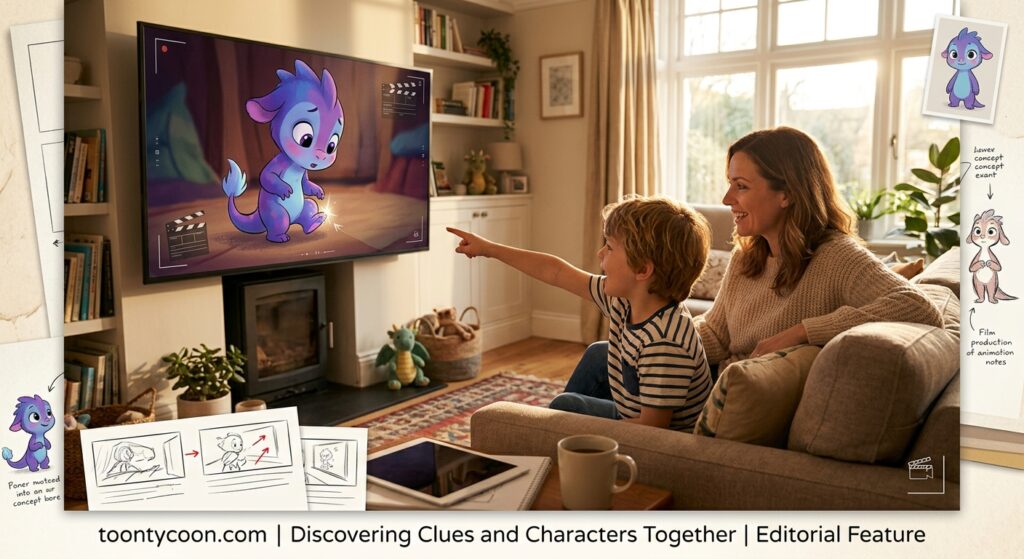
Introduction: When Pictures Speak Louder Than Words
Some animated stories can make us laugh, cry, feel suspense, or experience wonder without saying very much at all.
A tiny character navigating a huge world, a lonely robot discovering friendship, or a simple facial expression that reveals a hidden emotion can communicate more than a lengthy conversation. Through movement, colour, music, timing, and visual detail, animation can tell stories that cross language barriers and connect with audiences of different ages.
For families, this kind of storytelling offers something special. Parents and children can enjoy the same film even when they have different vocabulary levels, interests, or cultural backgrounds. Younger viewers may respond to the physical comedy, while older children and adults notice symbolism, emotional subtext, or details that become meaningful later in the story.
That is why dialogue-light animation for family co-viewing deserves a place in conversations about quality family entertainment. It can encourage children to observe carefully, interpret visual clues, recognise emotions, and discuss what a story means—all while giving families an opportunity to enjoy a shared experience.
The magic is not simply that a film uses fewer words. It is that the images invite viewers to participate in the storytelling.
What Is Dialogue-Light Animation?
Dialogue-light animation is animated storytelling that relies heavily on visual action, expressions, sound design, music, and atmosphere rather than spoken dialogue.
Some films contain almost no speech. Others use only a few words, brief exchanges, invented languages, or dialogue that plays a secondary role to the images.
This approach is not the same as silent cinema, although the two share an emphasis on visual communication. A modern dialogue-light animated film can use sophisticated sound effects, an expressive musical score, and carefully designed environmental sounds to communicate information without relying on conversation.
Consider a character standing outside a closed door. The character looks at the handle, hesitates, glances behind, and slowly reaches forward. Even without a single spoken word, the audience may understand that the character feels nervous or uncertain.
The viewer has to interpret the scene.
That small act of interpretation is part of what makes visual storytelling so engaging.
Why Visual Storytelling Works Across Generations
Family movie nights often bring together people with different needs and expectations. A preschooler may focus on colourful movement, a school-age child may follow the character’s goal, and a parent may appreciate the emotional complexity or visual craftsmanship.
Dialogue-light animation can provide several points of connection.
1. It Reduces Dependence on Language
Spoken language can be a barrier when viewers have different language skills or when a family watches a film in a language that is not everyone’s first language.
Visual storytelling can make the central action easier to follow. A character’s goal, an obstacle, or a moment of surprise may be communicated through body language and movement rather than a long explanation.
This does not mean that every dialogue-light film is easy for every child to understand. Some rely on abstract symbolism, unusual pacing, or complex emotional situations. But the reduced dependence on speech can make many stories more accessible to a wider range of viewers.
2. It Gives Children Room to Interpret
When a character explains every feeling and decision aloud, viewers have fewer opportunities to infer what is happening. Visual storytelling can leave some meaning unstated.
A child might notice that a character keeps a distance from others, hides an object, or repeatedly looks toward a window. These details can prompt questions about motivation and emotion.
Parents can support this process without immediately supplying an answer. Asking, “What do you think the character wants?” invites a child to make an interpretation and explain the clues behind it.
The point is not to guess the filmmaker’s intended answer perfectly. It is to practise noticing, thinking, and explaining.
3. It Creates Shared Emotional Moments
A well-timed gesture, a sudden change in music, or a character’s hesitant smile can communicate emotion to viewers of different ages.
Parents may recognise a familiar human experience in a scene, while children respond to the character’s immediate feelings. Afterward, families can compare what they noticed and discover that the same moment affected them in different ways.
These conversations can help children practise describing emotions and considering another person’s perspective. They should remain relaxed and age-appropriate rather than becoming a test of emotional understanding.
4. It Encourages Repeat Viewing
Visually rich animation often rewards a second look. A background object that seemed unimportant at first may later reveal a clue. A recurring gesture may signal a change in a character’s feelings. An early visual detail might take on a new meaning near the ending.
Rewatching gives children a chance to notice details they missed the first time.
Parents can make this experience playful by asking children to find a recurring colour, identify a character’s changing expression, or spot an object that appears in several scenes.
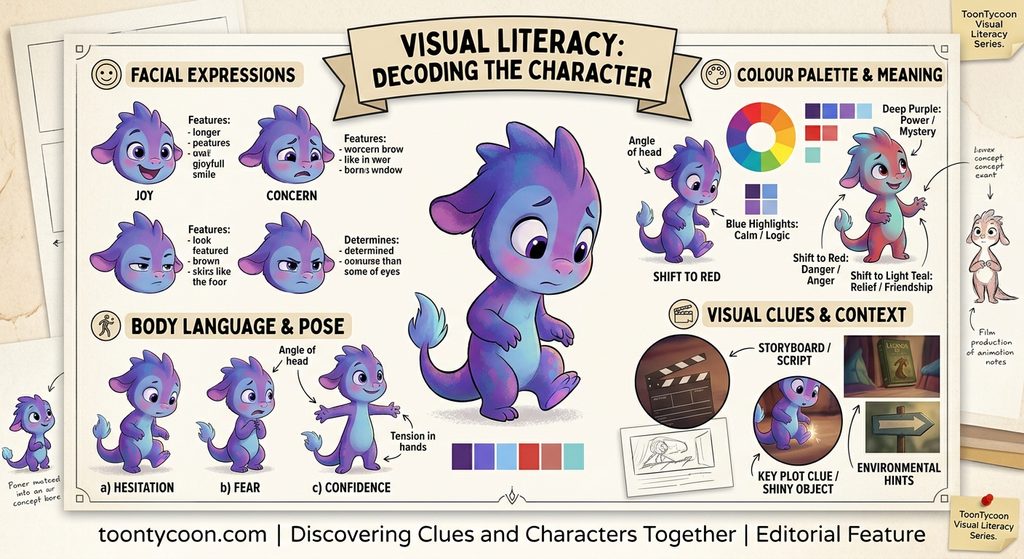
Visual Literacy: Learning to Read Images
Children learn to interpret the world through more than words. They read facial expressions, recognise familiar objects, follow gestures, and notice how people and environments relate to one another.
Visual literacy builds on this ability. It involves interpreting, evaluating, and making meaning from visual information.
In animation, visual literacy can include noticing:
- Facial expressions: How eyes, eyebrows, and mouths communicate feelings.
- Body language: How posture, movement, and distance suggest confidence, fear, affection, or uncertainty.
- Colour and lighting: How a scene’s appearance may influence its mood.
- Composition: Where a character is placed in the frame and what that placement draws attention to.
- Visual patterns: How repeated shapes, colours, objects, or movements may carry meaning.
- Cause and effect: How one action changes what happens next.
These observations do not require formal film studies. A parent can introduce them through ordinary conversation.
For example, if a character appears very small against a vast landscape, ask what that makes the child think about the character’s situation. If the same room looks warm in one scene and cold in another, ask what may have changed.
Children gradually discover that images are not merely decorative. They are part of how a story communicates.
How Parents Can Make Co-Viewing More Meaningful
Watching together does not mean explaining every scene or pausing the film every few minutes. Too much commentary can interrupt the very experience that makes visual storytelling effective.
Instead, use a light-touch approach that leaves room for enjoyment.
Before the Film: Set Up a Simple Viewing Mission
Give your child one playful thing to look for. It could be a character’s facial expressions, changes in colour, or clues that reveal what someone wants.
For younger children, keep the prompt concrete: “Let’s see how the little character shows that they’re happy.”
Older children might enjoy a more open question: “Can you tell what the main character is thinking before they show it?”
Avoid turning the viewing mission into homework. If your child forgets about it and becomes absorbed in the story, that is perfectly fine.
During the Film: Let the Story Breathe
Allow the film to unfold. Children need time to watch, process, and form their own ideas.
If a moment naturally prompts a question, a brief exchange may help. Otherwise, save most of the discussion for afterward.
Pay attention to your child’s comfort as well as their interest. A dialogue-light film may still contain frightening imagery, intense music, sudden action, or emotionally difficult scenes. Limited dialogue does not automatically mean that a film is suitable for very young viewers.
After the Film: Invite Interpretation
Once the credits roll, begin with an open question rather than a quiz.
Try asking:
- “Which moment did you remember most clearly?”
- “How could you tell what the character was feeling?”
- “Was there a scene where the pictures told us something the character never said?”
- “What do you think changed between the beginning and the end?”
- “Did you and I understand any moment differently?”
Give children time to answer. Their interpretations may surprise you, and different answers can be an opportunity to explore how people notice different things.
Five Easy Activities to Build Visual Literacy
A good family film can inspire simple activities long after viewing ends. These ideas work particularly well with stories that communicate through images, gestures, and visual patterns.
1. The Emotion Detective
Choose a character from the film and ask your child to identify a moment when the character’s feelings changed.
Invite them to explain the clues: Did the character look away, move closer, lower their head, or change the way they walked?
For younger children, offer two or three possible emotions to choose from. Older children can describe more complicated feelings, such as embarrassment, uncertainty, or relief.
Remind them that body language offers clues, not absolute proof. The same gesture can mean different things depending on the situation.
2. Tell the Scene Without Words
Ask your child to choose a favourite moment and act it out without speaking. Other family members can guess what is happening.
This game encourages children to think about which movements and expressions communicate the most information.
It also works in reverse: parents can act out a simple event, such as losing a toy and finding it again, while children interpret the sequence.
3. Make a Visual Storyboard
Fold a sheet of paper into four or six sections. Ask your child to draw the beginning, middle, and end of a simple story.
The drawings do not need to be polished. Stick figures, arrows, and basic shapes are enough.
Then ask whether someone could understand the story without captions. If not, what visual clue could make the action clearer?
This activity introduces sequencing, cause and effect, and the idea that storytellers choose which information the audience sees.
4. Find the Hidden Clues
After watching a film, ask your child to remember an object, colour, or movement that appeared more than once.
If the film is available for another viewing, look for the detail together. Discuss whether it appears to have a purpose or simply adds atmosphere.
The aim is to encourage careful observation, not to assume every background detail contains a secret message.
5. Change the Music, Change the Mood
Draw three simple pictures of the same character in the same situation. Play or hum three different short musical moods—cheerful, mysterious, and sad—while showing the drawings.
Ask your child how the music changes the way the scene feels.
This helps children notice that sound and images work together to shape an audience’s experience. It also demonstrates that music can influence interpretation without changing the visible action.
Keep the activity light and use music at a comfortable volume.
Choosing Dialogue-Light Animation for Different Ages
The right film depends on more than the amount of dialogue. Consider pacing, emotional intensity, frightening scenes, themes, and your child’s individual sensitivities.
| Viewer | What to look for | Co-viewing approach |
|---|---|---|
| Preschoolers | Clear actions, recognisable emotions, manageable pacing | Name visible feelings and describe simple actions when useful |
| Ages 5–7 | Stories with understandable goals and visible cause and effect | Ask what a character might do next |
| Ages 8–12 | More layered visual clues, character development, and symbolism | Compare interpretations and discuss visual details |
| Teens and adults | Ambiguous storytelling, visual metaphors, and subtle emotional changes | Explore themes, filmmaking choices, and alternative readings |
These are general suggestions rather than strict age rules. A film with few spoken words can still be emotionally intense, confusing, or unsuitable for a particular viewer.
Parents should check age ratings and content descriptions, especially when a film includes peril, loss, frightening imagery, or themes that may require additional context.
Dialogue-Light Animation and Accessibility
Visual storytelling can offer advantages for families who prefer less dialogue or who watch across different language backgrounds. It may also create opportunities for children to communicate their understanding through drawing, gestures, or pointing rather than giving a long verbal explanation.
However, visual storytelling is not universally accessible in the same way to everyone. Some viewers rely on spoken explanations, audio description, captions, or other accessibility features to understand what is happening.
When choosing a film, consider the needs of everyone watching. Captions can help viewers follow meaningful sound cues or occasional dialogue, while audio description can communicate important visual information for blind or low-vision viewers.
The most inclusive family viewing experience is not necessarily the film with the fewest words. It is the one that allows each viewer to participate as comfortably as possible.
Popular Examples of Dialogue-Light Storytelling
Families can explore dialogue-light storytelling in a range of animated shorts and feature films. The following are useful starting points for discussing how images communicate meaning.
Shaun the Sheep uses physical comedy, expressive movement, and visual timing to carry much of its humour. Families can look at how characters communicate plans or reactions without relying on extensive speech.
WALL-E combines expressive character animation, environmental details, sound, and music to communicate emotion and develop its story. Parents can discuss how viewers learn about the characters through their actions.
The Red Turtle uses minimal dialogue and carefully composed images to tell a reflective story. It may be more suitable for older children or families comfortable discussing ambiguity and emotionally mature themes.
Piper, Pixar’s short film, follows a young bird learning to approach the ocean. Its visual action and expressive animation provide opportunities to talk about fear, curiosity, persistence, and learning through experience.
These examples differ in tone, complexity, and emotional intensity. Check age guidance and content details before selecting one for younger viewers, and remember that dialogue-light storytelling does not automatically mean a film is designed specifically for children.
Common Mistakes to Avoid During Family Co-Viewing
Co-viewing is most useful when children have space to enjoy a story and form their own responses. A few well-intentioned habits can make the experience less comfortable.
Explaining every visual detail. Children do not need a running commentary. Give them time to notice things independently.
Treating every question like a test. Ask open-ended questions and accept that a child may interpret a scene differently from you.
Assuming fewer words mean less complexity. A dialogue-light film may use abstract images, symbolism, suspense, or mature themes.
Demanding a moral from every story. Some films invite reflection without delivering a simple lesson. It is fine to enjoy the images, humour, or atmosphere without reaching a single conclusion.
Ignoring individual preferences. Some children love quiet, visually expressive films; others prefer dialogue, music, or more direct storytelling. Both preferences are valid.
Using the film to force a conversation. If a child is tired or not interested in discussing the story, let the conversation wait. Shared enjoyment is valuable on its own.
Frequently Asked Questions
1. What is dialogue-light animation for family co-viewing?
It is animation that relies primarily on visual storytelling, expressions, movement, sound, and music rather than spoken dialogue. Families can watch together and discuss the visual clues, emotions, and story events they notice.
2. Does dialogue-light animation help children develop visual literacy?
It can provide opportunities to practise visual interpretation. Children may observe facial expressions, body language, colour, composition, and cause and effect. The experience becomes more reflective when parents invite children to describe what they notice without demanding a single correct interpretation.
3. Is dialogue-light animation suitable for toddlers?
Some films and shorts may be appropriate, but the absence of dialogue is not enough to determine suitability. Parents should consider age guidance, pacing, sound levels, frightening imagery, and emotional content.
4. How can I discuss a dialogue-light film with my child?
Begin with open questions such as, “What did you notice?” or “How could you tell how the character felt?” Listen to your child’s answer and invite them to point out the visual clues that shaped their interpretation.
5. Can dialogue-light films help families who speak different languages?
They can reduce dependence on spoken language, making some stories easier to share across language differences. However, visual storytelling can still contain cultural references, abstract themes, or emotional situations that benefit from explanation.
6. What is the difference between visual literacy and simply watching a cartoon?
Watching is the experience; visual literacy involves interpreting how images communicate meaning. It includes noticing expressions, framing, colour, visual patterns, and the relationship between actions and consequences.
7. Are dialogue-light animated films always calm or relaxing?
No. A film can contain little dialogue yet still feature intense action, frightening images, sudden sounds, suspense, or emotionally difficult material. Parents should review the content and consider their child’s individual needs.
8. Should parents pause a film to explain what is happening?
Usually, it is best to let the story flow. Pause when your child asks a question or seems confused or uncomfortable. Save broader discussions for afterward so that viewing remains enjoyable.
Final Thoughts: Learning to See the Story
Some of animation’s most memorable moments happen when nobody speaks. A character hesitates before taking a step, a landscape changes with the mood, or a small gesture reveals a feeling that words could never quite capture.
These moments give families an opportunity to experience a story together while noticing different things within it. Children can practise reading expressions, following visual clues, and describing emotions. Parents can discover how their children interpret a scene—and sometimes learn to see the film differently themselves.
With dialogue-light animation for family co-viewing, the goal is not to analyse every frame. It is to make room for curiosity, conversation, and shared enjoyment.
Choose a film that suits your family, watch together, and let the images do their work. When the story ends, a simple question—“What did you notice that I might have missed?”—may open the door to a surprisingly rich conversation.
Editorial note: Film suitability varies by age, individual sensitivity, and content. Review age ratings and content descriptions before family viewing.