
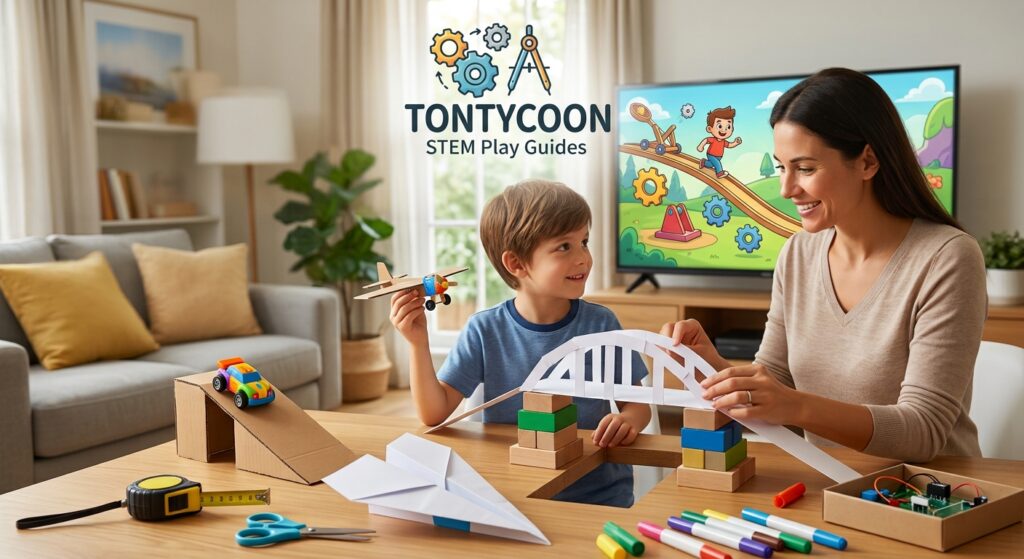
When Cartoon Science Comes to Life
A cartoon character builds a towering tower from almost nothing. A superhero leaps across a canyon. A clever inventor creates a flying machine in minutes, while another character solves a complicated mechanical problem with a few gears, a spring, and a little imagination.
For children, animated stories can make the laws of science feel less like lessons in a textbook and more like adventures waiting to happen.
Of course, animation does not always follow the rules of real-world physics. Characters survive impossible falls, machines work without realistic power sources, and gravity occasionally seems to take a holiday. Yet these creative liberties can open the door to something valuable: curiosity.
Parents can use these moments to introduce simple scientific questions. Why did the character’s vehicle move faster downhill? What made the tower collapse? Could we build a paper bridge strong enough to hold a toy? What would happen if we changed the shape of a paper airplane?
This is the heart of translating animated physics into hands-on STEM play: taking an exciting idea from a screen and turning it into a real-world experiment involving science, technology, engineering, and mathematics.
The aim is not to reproduce every cartoon invention perfectly. It is to encourage children to observe, predict, build, test, and improve. With a few everyday household materials, an ordinary afternoon of watching cartoons can become an opportunity for meaningful discovery.
What Is STEM Play, and Why Do Animated Stories Help?
STEM stands for Science, Technology, Engineering, and Mathematics. These subjects are connected in everyday life, even when children do not recognise them as separate academic disciplines.
A paper airplane, for example, brings several STEM ideas together:
- Science: Air resistance, gravity, and forces.
- Technology: Tools and materials used to design and test the plane.
- Engineering: Changing the design to improve flight.
- Mathematics: Measuring distances, comparing results, and identifying patterns.
Animated stories can provide a memorable starting point for these activities. Children often become invested in characters, challenges, inventions, and fictional worlds. That emotional connection can make them eager to explore the ideas behind what they see.
A cartoon’s collapsing bridge might inspire a construction challenge. A character’s rocket could lead to a discussion about thrust. A chase scene involving a rolling object might encourage an investigation into slopes and motion.
The key is to follow the child’s curiosity rather than turning every viewing session into a formal lesson.
Translating Animated Physics into Hands-On STEM Play
The most effective activities begin with a simple question. Instead of explaining every scientific principle in advance, invite children to make a prediction and discover what happens through experimentation.
Here are several practical ways to turn animated adventures into engaging home activities.
1. Cartoon Gravity: Explore Falling Objects and Motion
Gravity appears in countless animated scenes. Characters jump from rooftops, objects tumble from shelves, and fictional heroes sometimes float through the air before suddenly remembering that gravity exists.
These scenes offer a natural opportunity to explore falling objects and movement.
The activity: The Great Falling Challenge
<text>What you’ll need:</text>
- Two lightweight objects of different shapes or sizes
- A soft landing area, such as a carpet or folded towel
- Paper and a pencil for recording observations
How to do it:
- Ask your child to predict what will happen when the two objects are released from the same height.
- Drop them together over a clear, soft landing area.
- Repeat the test several times.
- Discuss what happened and whether the result matched the prediction.
- If appropriate, compare a flat sheet of paper with the same paper crumpled into a loose ball.
What children can learn
Gravity pulls objects toward Earth, but air resistance can affect how they fall. A flat sheet of paper experiences more air resistance than a crumpled sheet, so the two may fall differently.
This is an excellent moment to explain that cartoons sometimes exaggerate falling, floating, and bouncing for comic effect.
Parent’s conversation starter: “Why do you think the crumpled paper reached the floor before the flat paper?”
Keep the activity at a low height and never use heavy, sharp, hot, or fragile objects.
2. Animated Engineering: Build a Bridge That Works
Animated characters frequently cross enormous bridges, construct elaborate towers, or invent ways to travel across difficult terrain. Children can explore the engineering behind these scenes using simple materials.
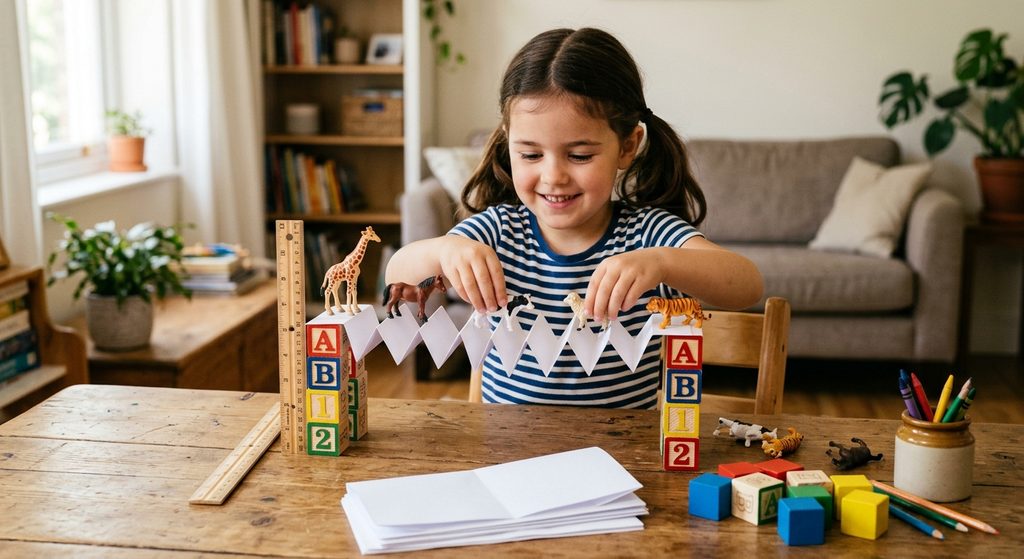
The activity: The Paper Bridge Challenge
<text>What you’ll need:</text>
- Several sheets of paper
- Two stacks of books to serve as supports
- A ruler
- Small, lightweight toys or counters
How to do it:
- Place the two stacks of books a short distance apart.
- Lay a flat sheet of paper across them to form a bridge.
- Carefully add lightweight objects one at a time and observe how much the bridge bends.
- Fold another sheet into an accordion shape or a series of ridges.
- Test the new design using the same gap and similar objects.
- Compare the results and ask your child why one design may have performed better.
What children can learn
The shape and structure of a material can affect how it carries a load. Folds and ridges can make a sheet of paper more resistant to bending.
Young engineers quickly discover that a successful design is not always the biggest or most complicated one. Small structural changes can make a significant difference.
Parent’s conversation starter: “If you could change one thing about your bridge, what would you try next?”
Encourage redesign rather than treating the first attempt as a failure. Engineering involves testing ideas, learning from results, and improving a solution.
3. Cartoon Vehicles: Investigate Ramps, Friction, and Motion
From racing cars to runaway carts, animated adventures often involve objects travelling at extraordinary speeds. A toy car and a homemade ramp provide a safer way to investigate some of the physics behind these scenes.
The activity: Ramp Racers
<text>What you’ll need:</text>
- A toy car
- A sturdy piece of cardboard
- Books to raise one end of the cardboard
- A measuring tape or ruler
- A smooth floor and a small piece of carpet
How to do it:
- Make a gentle ramp using cardboard supported by books.
- Release the toy car from a marked starting point without pushing it.
- Measure how far it travels beyond the ramp.
- Raise the ramp slightly and repeat the test.
- Keep the starting point and release method consistent.
- If safe, compare the car’s movement on a smooth surface and a carpeted surface.
What children can learn
A toy car released from a higher starting point generally has more gravitational potential energy available to become motion. Friction between the car and the surface can affect how far it travels.
The experiment also introduces fair testing. If several conditions change at once, it becomes harder to identify what caused the difference.
Parent’s conversation starter: “What should we keep the same so that we can fairly compare our two ramps?”
Avoid steep ramps, stairs, roads, and setups that could send toys into people or breakable objects.
4. Cartoon Flight: Make and Test Paper Airplanes
Flying machines are a favourite feature of animated adventures. Although a paper airplane cannot behave exactly like a cartoon aircraft, it can demonstrate how design influences flight.
The activity: Flight Design Lab
<text>What you’ll need:</text>
- Several sheets of ordinary paper
- A ruler or measuring tape
- A clear indoor space
- Paper for recording results
How to do it:
- Fold a simple paper airplane.
- Make a prediction about how far it will travel.
- Launch it gently from the same starting point each time.
- Measure the flight distance.
- Change one design feature, such as the wing width or nose fold.
- Test the new design and compare the results.
What children can learn
Flight depends on several interacting factors, including lift, drag, gravity, and the way the plane is launched. A small change in wing shape may affect stability or distance, although the result depends on the overall design.
Children also learn that repeated tests can produce different outcomes. This is an opportunity to discuss why scientists and engineers test designs more than once.
Parent’s conversation starter: “Do you think wider wings will always make the airplane fly farther, or might other things matter too?”
Use a clear launch area, aim away from faces, and avoid throwing paper airplanes near stairs or ceiling fans.
5. Cartoon Machines: Discover Gears, Levers, and Simple Mechanisms
Animated inventors often create elaborate machines using wheels, pulleys, levers, and gears. These mechanisms may be exaggerated for storytelling, but the underlying concepts are part of real engineering.
You do not need a complicated construction kit to introduce the basic idea that machines can help us move objects or change the direction of a force.
The activity: Make a Lever
<text>What you’ll need:</text>
- A sturdy ruler
- A rounded pencil or similar stable pivot
- A small, lightweight object
How to do it:
- Place the pencil beneath the ruler to create a simple lever.
- Put the lightweight object near one end of the ruler.
- Press down gently on the opposite end.
- Move the pivot closer to the object and repeat.
- Compare how the lever feels and how its movement changes.
What children can learn
A lever rotates around a pivot, also called a fulcrum. Changing the positions of the load, effort, and fulcrum affects how the lever behaves.
Children can later spot similar principles in seesaws, bottle openers, and other familiar tools.
Parent’s conversation starter: “What happens when we move the pivot closer to the object?”
Keep the object light, use a stable setup, and never use fingers as the pivot or place faces above the moving ruler.
6. Cartoon Rockets: Explore Air Pressure Safely
Animated rocket launches are exciting, but real rockets are complex machines. A simple balloon experiment offers a child-friendly introduction to how escaping air can create motion.
The activity: Balloon Rocket
<text>What you’ll need:</text>
- A balloon
- A long piece of string
- A drinking straw
- Tape
- Two secure supports for the string
How to do it:
- Thread the string through the straw.
- Stretch the string between two supports, keeping it clear of walkways.
- Inflate the balloon without tying its neck.
- Tape the balloon to the straw, with its opening pointing backward along the string.
- Hold the balloon, then release it.
- Observe which direction the balloon travels and discuss why.
What children can learn
Air escaping backward helps push the balloon forward. This provides a simplified demonstration of action and reaction, a principle relevant to rocket propulsion.
The balloon experiment is not a complete model of a real rocket, which operates under much more complex conditions.
Parent’s conversation starter: “What do you think would happen if we changed the amount of air in the balloon?”
Adult supervision is essential. Keep balloons away from young children who might choke on broken pieces, and avoid balloons if a child has a latex allergy. Do not use fire, chemicals, pressurised containers, or homemade explosive mixtures.
A Quick Guide to Animated STEM Activities
Use this table to choose an activity based on the type of cartoon scene that caught your child’s attention.
| Animated scene | Real-world activity | Main STEM concept |
|---|---|---|
| A character falls or jumps | Falling-object experiment | Gravity and air resistance |
| A bridge collapses | Build a paper bridge | Structures and load distribution |
| A racing vehicle speeds downhill | Toy-car ramp test | Motion, energy, and friction |
| A character flies an aircraft | Paper airplane design | Forces and flight |
| An inventor builds a machine | Make a simple lever | Forces and mechanisms |
| A rocket blasts off | Balloon rocket | Air pressure and action–reaction |
These activities are starting points rather than formal science lessons. Adjust the difficulty to match your child’s age, interests, and abilities.
How to Turn Cartoon Watching into a STEM Learning Routine
The secret to translating animated physics into hands-on STEM play is not to eliminate screen time or demand a scientific explanation after every scene. It is to create a natural connection between imagination and exploration.
A simple routine can help.
Step 1: Notice the Interesting Moment
Choose a scene that naturally invites a question. A collapsing tower, a flying vehicle, or a character using a clever tool can all become useful starting points.
Let your child choose the scene whenever possible. Interest is a powerful motivator.
Step 2: Ask Before Explaining
Try questions such as:
- “Do you think that would work in real life?”
- “What made the object move?”
- “Could we build something similar?”
- “What would happen if we changed one part?”
Give children time to think. Their first answers do not have to be scientifically accurate.
Step 3: Make a Prediction
Before beginning the experiment, ask your child to predict what will happen.
Younger children can explain their predictions verbally or draw a picture. Older children may write down an expected result or estimate a measurement.
Step 4: Test the Idea
Use simple materials and keep the experiment manageable. Change one variable at a time when possible, and repeat the test if practical.
The goal is not to make the experiment look impressive. It is to give children a chance to observe a result.
Step 5: Reflect and Improve
Ask what worked, what surprised your child, and what they would change next time.
Sometimes the experiment will not produce the expected result. That is part of learning. A failed design can reveal more than an activity in which everything works immediately.
Matching STEM Activities to Your Child’s Age
Children develop different abilities at different stages, so the best activity is one that provides an appropriate challenge without creating frustration.
| Age group | Suitable approach | Examples |
|---|---|---|
| Preschoolers | Short, supervised exploration with simple observations | Dropping paper shapes, rolling a soft ball, stacking blocks |
| Ages 5–7 | Simple predictions and basic comparisons | Paper airplanes, gentle ramps, simple building challenges |
| Ages 8–10 | Repeated tests, measuring, and design changes | Bridge-strength challenges, lever experiments, flight-distance records |
| Ages 11 and above | More detailed investigations and design constraints | Comparing variables, graphing results, improving structures, researching real engineering |
These are flexible suggestions, not developmental rules. A younger child may enjoy a more advanced activity with help, while an older child may prefer a simple experiment that connects to a favourite story.
For younger children, adults should handle cutting tools and any small parts that could pose a choking hazard.
When Cartoon Science Does Not Match Real Science
One of the most useful lessons parents can teach is that fictional science and real science serve different purposes.
Animation is designed to entertain. A character might survive a dramatic fall, construct a complicated machine instantly, or travel through the air without a realistic source of lift or thrust. These moments make stories exciting, but they should not be treated as instructions for real-world behaviour.
Rather than criticising the cartoon, help your child distinguish between the fictional scene and the scientific principle it brings to mind.
For example:
Cartoon idea: A character builds a bridge from a few loose planks and crosses a huge gap.
Real-world question: What makes a bridge stable, and how do engineers test its strength?
Cartoon idea: A character flies by flapping their arms.
Real-world question: What forces allow birds and aircraft to stay in the air?
Cartoon idea: A vehicle accelerates dramatically down a hill.
Real-world question: How do slope, friction, and energy affect a toy car’s movement?
This approach protects the fun of the story while encouraging children to ask sensible questions about the real world.
Keeping STEM Play Safe, Affordable, and Enjoyable
A home STEM activity does not need expensive kits, specialist equipment, or a dedicated laboratory. Ordinary household materials are often enough.
Keep these principles in mind:
- Start small. Choose activities that can be completed with a few materials and minimal preparation.
- Supervise actively. Consider your child’s age, coordination, and ability to follow safety instructions.
- Avoid dangerous imitations. Never recreate cartoon stunts involving heights, traffic, fire, electricity, sharp tools, or explosive effects.
- Use safe materials. Avoid choking hazards, unstable structures, and objects that may break into sharp pieces.
- Let children lead. Offer guidance without taking over the construction or experiment.
- Celebrate questions. Curiosity and thoughtful observation matter more than getting the right answer immediately.
- Respect individual interests. A child who loves vehicles may enjoy ramps, while another who prefers fantasy worlds may be fascinated by bridges, pulleys, or imaginary inventions.
It is also fine to stop when a child loses interest. The purpose is to make learning inviting, not to turn a favourite cartoon into homework.
A Simple One-Week Cartoon-to-STEM Challenge
If you want to make hands-on learning a regular family activity, try this flexible seven-day plan. Each session can last around 10–20 minutes, depending on your child’s interest and the complexity of the experiment.
| Day | Challenge | Question to explore |
|---|---|---|
| Monday | Drop two paper shapes | How does shape affect falling? |
| Tuesday | Build a paper bridge | Which design supports more weight? |
| Wednesday | Test a toy-car ramp | How does ramp height affect motion? |
| Thursday | Design a paper airplane | Which design flies most consistently? |
| Friday | Make a simple lever | How does moving the pivot change the result? |
| Saturday | Try a balloon rocket | Why does the balloon move forward? |
| Sunday | Choose a favourite experiment to improve | What would you change and why? |
You do not need to complete every challenge. Skip activities that do not suit your child, repeat a favourite experiment, or invent a new one inspired by a different animated story.
The real achievement is building a habit of asking questions and exploring possible answers.
Frequently Asked Questions
1. What does translating animated physics into hands-on STEM play mean?
It means using a scene or invention from an animated film or cartoon as inspiration for a real-world activity. Children might investigate gravity by dropping paper shapes, explore engineering by building a bridge, or study motion with a toy car and ramp.
2. Can cartoons really help children learn science?
Cartoons can spark curiosity and provide memorable examples of scientific ideas. Their educational value depends on how children engage with the content and whether the activity is appropriate for their age and interests. A cartoon alone does not guarantee learning, but discussion and hands-on exploration can create useful opportunities.
3. What are the easiest STEM activities to do at home?
Paper airplanes, paper bridges, simple block structures, falling-object comparisons, and toy-car ramps are accessible starting points. Most require only everyday materials and adult supervision appropriate to the child’s age.
4. Do I need to correct every scientific mistake in a cartoon?
No. Let children enjoy the story. When a scene sparks curiosity, use it as an opportunity to explore the difference between animation and reality. Focus on interesting questions rather than interrupting every fictional moment.
5. Which age group benefits from cartoon-inspired STEM activities?
Children of many ages can participate, provided the activity matches their abilities. Younger children may enjoy observing and building, while older children can measure results, compare variables, and improve their designs.
6. How can I make STEM activities more engaging for reluctant learners?
Begin with a character, vehicle, invention, or challenge that already interests the child. Offer choices, keep the first experiment short, and let the child decide what to test next. Avoid turning the activity into a test or insisting on a particular answer.
7. What if the experiment does not work?
Treat the outcome as information. Check whether the setup was stable, repeat the test, or change one feature. Ask your child what the result suggests and what they might try next. Real scientific and engineering work often involves revision.
8. Are cartoon inventions safe to copy at home?
Not always. Animated stunts and inventions may ignore real-world hazards. Choose a safe, simplified activity inspired by the idea instead of recreating dangerous scenes involving heights, vehicles, electricity, fire, chemicals, or explosives. Adults should supervise activities and adapt materials to the child’s age.
Final Thoughts: Let Imagination Lead the Way
Children do not need a perfectly equipped science lab to begin thinking like young scientists and engineers. Sometimes, all it takes is a cartoon character attempting an impossible jump, a bridge that falls apart, or a machine that inspires a curious question.
By translating animated physics into hands-on STEM play, parents can help children connect entertainment with observation, creativity, and problem-solving. A paper bridge becomes a lesson in structure. A toy car becomes an opportunity to investigate motion. A paper airplane becomes a small experiment in design and flight.
The important part is not whether children build something impressive on the first attempt. It is whether they feel encouraged to ask questions, test ideas, learn from unexpected results, and try again.
The next time your child watches an animated adventure, listen for the question behind the excitement. “Could we make that?” might be the beginning of a wonderful learning experience.
Editorial note: This article provides general educational activity ideas, not formal engineering instruction. Adapt activities to your child’s age and abilities, supervise appropriately, and prioritise safety.