
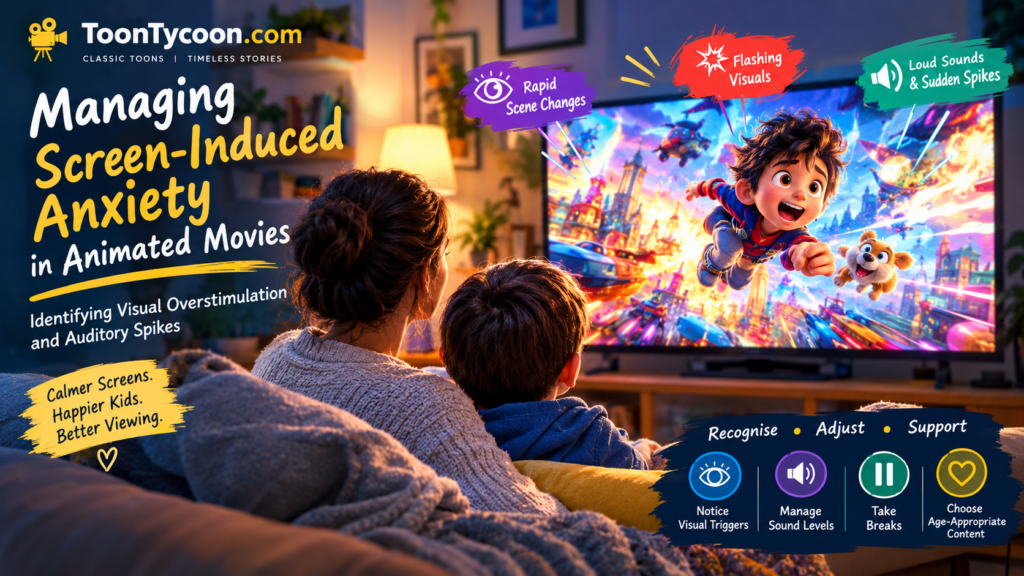
Animated movies are designed to capture attention. Bright colours, expressive characters, rapid scene changes, dramatic music, and perfectly timed sound effects can turn an ordinary story into an unforgettable experience. For children, however, the same sensory excitement can sometimes become overwhelming.
A child may cover their ears during a sudden explosion, become restless after watching fast-paced cartoons, feel uneasy when a scene flashes rapidly between images, or struggle to settle down after an intense viewing session. Other children may show no obvious reaction at all.
So, how can parents tell when an animated movie is simply exciting and when its visual or auditory intensity may be too much for a young viewer?
Managing screen-induced anxiety in animated movies begins with understanding a child’s reactions, recognising potentially overwhelming content, and making thoughtful adjustments to the viewing experience. The goal is not to make every cartoon quiet or uneventful. It is to help children enjoy animation in ways that support their comfort, development, and emotional well-being.
1. What Is Screen-Induced Anxiety in Animated Movies?
The phrase screen-induced anxiety can describe anxiety-like reactions or distress that appear during or after screen viewing. It is a descriptive term, not a medical diagnosis.
Animated entertainment can combine several attention-grabbing elements: quick cuts, sudden movements, loud sound effects, flashing transitions, suspenseful music, and emotionally intense scenes. When several of these occur together, some children may find the experience difficult to process comfortably.
For example, a cartoon character might suddenly fall from a great height while the screen shakes, the music becomes louder, and a dramatic sound effect fills the room. An adult may recognise the scene as harmless fantasy, but a young child may respond with genuine fear or physical tension.
Children’s reactions also vary considerably. One child may laugh at the same sequence that causes another to hide behind a parent.
The American Academy of Pediatrics discusses the importance of considering the pace, quality, and context of children’s media, rather than looking at screen duration alone. Its guidance also encourages parents to watch with young children and help them understand what they see.
The important distinction is that an upsetting reaction does not automatically mean a child has an anxiety disorder or that animation has harmed them. It is a reason to pay attention, explore possible triggers, and adjust the experience when necessary.
2. Understanding Visual Overstimulation in Animation
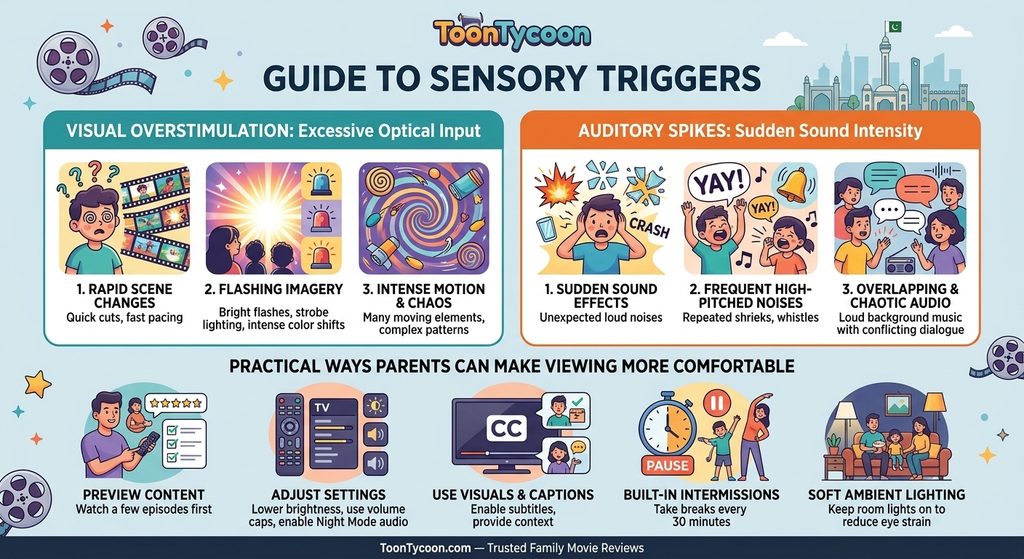
Visual overstimulation occurs when the amount, speed, or intensity of visual information becomes uncomfortable or difficult for an individual to manage.
Animation can be particularly visually dynamic because creators can control almost every detail on screen. Colours can change instantly, characters can move at extraordinary speeds, backgrounds can transform in seconds, and action sequences can move rapidly between perspectives.
These techniques can make stories exciting. They can also make some viewing experiences tiring or overwhelming, especially for younger children.
Rapid scene changes and fast-paced editing
Some animated programmes move from one action to another with very little pause. A character runs, an object explodes into colourful fragments, another character appears, and the scene changes before the viewer has much time to process what happened.
The American Academy of Pediatrics notes that rapidly changing media can be harder for young children to process than slower-paced content.
Parents may notice that a child becomes unusually restless, irritable, or excitable after watching certain programmes. These behaviours are not proof that fast editing caused a problem, but they can be useful clues when they repeatedly occur after the same type of content.
What parents can do: Try a calmer programme with longer scenes, clearer storytelling, and fewer rapid transitions. Observe whether your child seems more comfortable afterward.
Flashing lights and sudden visual effects
Animated movies sometimes use bright flashes, rapidly alternating images, lightning effects, explosions, or intense changes in brightness to communicate danger or excitement.
For some viewers, these effects may cause discomfort, headaches, eye strain, or distress. Certain flashing visual patterns can also trigger seizures in susceptible people with photosensitive epilepsy.
Not every bright scene is dangerous, and ordinary animation should not automatically be treated as a medical risk. Nevertheless, parents should take repeated discomfort or unusual physical reactions seriously.
What parents can do: Check available content warnings, pause or stop a sequence that appears to distress your child, and avoid repeatedly exposing them to a known trigger. If flashing imagery appears to provoke a seizure or other concerning neurological symptoms, seek urgent medical assessment.
Intense colours, movement, and crowded scenes
A screen filled with rapidly moving characters, colourful backgrounds, animated text, and multiple simultaneous actions can be visually demanding.
Some children enjoy this level of activity. Others may look away, become agitated, complain of discomfort, or ask for the screen to be turned off.
It is important not to assume that a child who prefers simpler animation has a sensory disorder. Personal preferences, tiredness, temperament, and the surrounding environment can all influence how a programme feels.
What parents can do: Reduce unnecessary background distractions, choose visually simpler content when appropriate, and give your child permission to look away or take a break.
3. Auditory Spikes: Why Sudden Sounds Can Be Distressing
Visual effects are only half the picture. Sound plays an equally important role in how animated stories affect their audiences.
An auditory spike is a sudden increase in sound intensity or a sharp, unexpected sound that stands out from the surrounding audio. It might be a loud crash, a shrill scream, an unexpected musical sting, or a sudden change from quiet dialogue to explosive action.
These sounds can startle viewers even when the scene contains nothing visually frightening.
Sudden volume changes
Imagine a child watching a peaceful scene when a loud crash erupts without warning. The child jumps, covers their ears, or asks for the television to be turned down.
Such a response may simply be a normal startle reaction. However, repeated sudden loud sounds can make a viewing experience uncomfortable for a child who is particularly sensitive to noise.
The American Academy of Pediatrics advises families to reduce the volume of televisions, computers, and other devices and to be mindful of excessive noise exposure.
Practical tip: Set a comfortable baseline volume before starting a film. If a programme repeatedly shifts from quiet dialogue to very loud action, consider adjusting the volume, enabling dialogue-enhancement or dynamic-range settings if available, or choosing a different programme.
High-pitched sounds and exaggerated voices
Animated characters often use exaggerated voices, shrieks, whistles, squeals, and other distinctive sounds to communicate excitement or humour.
While many children find these effects entertaining, others may find them irritating or uncomfortable. The reaction may be more noticeable in noisy surroundings or when a child is already tired.
Practical tip: Pay attention to whether your child reacts to particular sounds rather than assuming the entire movie is unsuitable. If one programme repeatedly causes discomfort, try an alternative with gentler sound design.
Background music and sustained tension
Not every distressing sound is loud. Low, ominous music, repetitive pulses, rising sound effects, and prolonged suspense can create tension even when the volume remains moderate.
A child might become uneasy before anything frightening actually appears on screen. The soundtrack may signal that something bad is about to happen.
Practical tip: For children who struggle with suspense, begin with stories that use reassuring music and clearer emotional cues. Explain that the music is helping tell the story and does not necessarily mean a real danger exists.
Headphones and personal listening devices
Children watching on tablets or phones may use headphones that deliver sound directly to their ears. This can make loud audio more intense and can prevent parents from noticing how high the volume has become.
Keep listening levels comfortable, encourage regular breaks, and follow age-appropriate hearing-safety guidance. If a child complains of ear pain, ringing, or persistent sound sensitivity, seek advice from a healthcare professional.
4. Recognising Signs That a Child May Be Overwhelmed
Children do not always have the vocabulary to explain that a movie feels too intense. Younger viewers may communicate discomfort through behaviour rather than words.
Parents should look for changes from the child’s usual behaviour and consider when those changes occur.
| Possible sign | What it might indicate |
|---|---|
| Covering ears or repeatedly lowering the volume | A sound may be too loud, sudden, or uncomfortable |
| Squinting, looking away, or shielding the eyes | Visual discomfort or a desire to avoid an intense scene |
| Restlessness, irritability, or unusual agitation | The viewing experience may be tiring or overstimulating |
| Hiding, clinging to a parent, or asking repeated safety questions | Fear, suspense, or uncertainty about what is happening |
| Complaining of a headache or feeling uncomfortable | Possible visual, auditory, or other physical discomfort |
| Difficulty settling immediately after viewing | Excitement, fear, tiredness, or difficulty transitioning away from the screen |
These signs are not diagnostic. A restless child may simply need to move, while a child who covers their ears may be responding to a particular sound rather than experiencing anxiety.
Look for patterns instead of drawing conclusions from one incident.
Does the reaction happen during fast-paced cartoons but not during slower programmes? Does it appear after loud action sequences? Does it occur mainly when the child is tired or watching close to bedtime?
Recording these observations can help parents make more informed choices.
If distress becomes persistent, interferes with sleep or everyday activities, or occurs across many situations, discuss the pattern with your child’s healthcare professional.
5. Which Children May Need Extra Consideration?
Children differ in temperament, sensory preferences, developmental stage, and previous experiences. The same animated movie can be comfortable for one child and overwhelming for another.
Toddlers and preschool children
Young children are still developing their ability to understand complex storytelling, manage emotions, and distinguish fictional situations from real-world threats.
Rapid editing, sudden sounds, and intense suspense may be particularly difficult for some viewers in this age group.
The American Academy of Pediatrics recommends high-quality, age-appropriate media and shared viewing for young children. Its guidance for children aged two to five has traditionally emphasised limiting screen use and avoiding excessively fast-paced programmes. Families should consult the latest age-specific guidance for their circumstances.
Children who are sensitive to noise or visual activity
Some children react more strongly than others to sudden sounds, bright visual effects, or busy environments. This can be an individual preference or may occur alongside a recognised developmental or sensory-related condition.
Do not label a child as having a sensory processing problem simply because they dislike loud cartoons. Focus on what makes them comfortable and seek professional guidance if their sensitivities cause substantial difficulties.
Children with autism, ADHD, migraines, or other relevant conditions
Some children with autism, attention-deficit/hyperactivity disorder (ADHD), migraine disorders, or other health conditions may have specific sensitivities or difficulties that influence their media experience.
However, these conditions affect individuals differently, and not every child with a diagnosis will be sensitive to animation or sound.
Parents who already have professional guidance for their child’s needs should apply it to screen use as appropriate. If the child’s reactions are new, severe, or increasingly disruptive, discuss them with the clinician who knows their history.
Older children and teenagers
Older viewers may understand the difference between fiction and reality more clearly, but that does not mean they are immune to discomfort.
Fast-paced editing, loud headphones, disturbing imagery, and suspenseful soundtracks can still be tiring or unpleasant. Older children should be involved in deciding what they watch and encouraged to recognise and communicate their own limits.
6. How to Make Animated Movies More Comfortable at Home
Parents do not need to eliminate animation to create a healthier viewing environment. Small, practical changes can make a meaningful difference.
Choose content for pace as well as age
Age ratings can help identify content that may not suit every viewer, but they do not always explain how fast-paced or noisy a programme will feel.
Before selecting a film, consider:
- How quickly does the action move?
- Are there frequent flashes, explosions, or abrupt transitions?
- Does the soundtrack contain repeated screams or sudden volume changes?
- Are frightening sequences brief, or does suspense continue for a long time?
- Does the story offer reassurance after an intense scene?
Read detailed parental reviews and watch a preview when you are uncertain. For younger children, a slower narrative with clear dialogue and fewer distracting effects may be a better starting point.
Adjust the room and screen
A comfortable environment can reduce unnecessary strain.
- Keep the room lighting comfortable rather than watching in complete darkness.
- Avoid positioning the screen too close to the child’s face.
- Reduce background noise from other devices.
- Use a comfortable volume and avoid excessively loud headphones.
- Make sure the child can easily move away from the screen.
- Take breaks during longer viewing sessions.
These adjustments are not a guarantee against anxiety or discomfort, but they can help create a more relaxed setting.
Watch together when possible
Co-viewing gives parents an opportunity to notice reactions and help children understand what is happening.
You might explain that a sudden crash is a sound effect, point out that an animated character is pretending to be frightened, or reassure a child when a fictional danger has passed.
For young viewers, these conversations can also support comprehension and help connect screen stories with real-life experiences.
Use breaks without making them a punishment
If a child becomes uncomfortable, pause the programme and offer a simple choice: take a break, lower the volume, or stop watching.
Avoid insisting that the child finish a movie to prove they are brave. The aim is to help them recognise discomfort and respond constructively, not to force them through an experience they find distressing.
Create a predictable ending to screen time
Some children struggle more with stopping a preferred activity than with the content itself.
Give a gentle warning before the programme ends, agree on a stopping point, and have an enjoyable alternative ready. Drawing, building with blocks, reading, outdoor play, or talking about the story can make the transition easier.
A consistent routine can also help protect sleep and other important activities.
7. A Simple Sensory Check Before Pressing Play
Parents can use this short checklist before choosing an animated movie or programme.
- Visual pace: Does the programme change scenes rapidly or show continuous action?
- Flashing effects: Are there frequent flashes, strobing effects, or abrupt changes in brightness?
- Sound intensity: Does the audio include sudden crashes, shrill screams, or dramatic volume jumps?
- Emotional tension: Does the story rely on sustained suspense, threats, or frightening situations?
- Age and maturity: Is the content appropriate for the child’s developmental stage and individual sensitivities?
- Viewing environment: Is the room comfortable, and is the sound level reasonable?
- Breaks: Can the child pause, look away, or stop without being criticised?
- After-viewing response: Has this type of content previously affected the child’s mood, comfort, or sleep?
The checklist is a practical decision aid, not a clinical screening tool. You do not need to reject every movie that contains a loud sound or an exciting sequence.
Instead, use the information to decide whether the overall experience is likely to suit your child.
8. What to Do If a Child Becomes Distressed During a Movie
When a child becomes upset, a calm response is usually more helpful than an immediate lecture about screen safety.
First, pause or turn off the content. If the child is covering their ears, crying, hiding, or asking to stop, respect that request.
Second, reduce the immediate stimulation. Lower the volume, move to a quieter space, or switch off the screen. Give the child time to settle.
Third, acknowledge the feeling. You might say, “That sound was very sudden. It startled you, didn’t it?” This validates the experience without suggesting that the fictional event was real.
Fourth, offer reassurance without pressure. Explain the scene in simple language if the child wants to talk about it. Some children prefer a brief explanation; others need quiet and comfort first.
Fifth, review the content later. If the same programme repeatedly causes distress, choose something gentler or avoid the particular scene.
Do not force a child to watch a frightening sequence again to demonstrate that it is harmless. Repeated exposure is not a universal solution for fear or sensory discomfort.
If the reaction is severe, recurring, or accompanied by significant physical symptoms, consult an appropriate healthcare professional.
Seek urgent medical help for a seizure, difficulty breathing, loss of consciousness, or another serious or sudden medical symptom. Do not assume such symptoms are simply anxiety.
9. Screen Habits Matter Beyond Individual Movies
The content itself is only one part of the viewing experience. Timing, duration, the child’s surroundings, and what happens afterward also matter.
A lively cartoon watched briefly in a comfortable setting may produce a very different response from a long session of rapidly changing videos late at night.
The American Academy of Pediatrics’ guidance on children’s digital media emphasises balancing media use with sleep, physical activity, social interaction, and other developmental activities.
Families can support that balance by:
- Establishing age-appropriate expectations for recreational screen use.
- Keeping regular opportunities for physical play and face-to-face interaction.
- Protecting bedtime routines from screen-related disruption.
- Avoiding the assumption that every moment of boredom needs a digital solution.
- Reviewing how children respond to different programmes instead of relying on duration alone.
- Revisiting family media rules as children grow and their needs change.
For children aged two to five, the AAP’s established guidance recommends no more than one hour per day of high-quality screen use, with less often preferable; parents should check current recommendations and individual advice. Older children need a balanced approach that accounts for schoolwork, sleep, physical activity, relationships, and the quality of their media experiences.
There is no single screen-time number that guarantees every child will feel comfortable. The aim is a routine that leaves room for healthy development and helps families recognise when media is no longer serving them well.
10. Where Parents Can Find Reliable Guidance
When concerns persist, parents should rely on reputable sources rather than alarming social media claims.
American Academy of Pediatrics
The AAP provides guidance on children’s media use, content selection, and noise exposure. Its resources can help families consider both the content children watch and the environments in which they watch it.
Explore AAP guidance on screening and selecting appropriate content and HealthyChildren.org’s advice on how noise affects children.
Common Sense Media
Common Sense Media offers age recommendations and parental reviews of films, television programmes, and other media. These reviews can help parents investigate frightening scenes, sound-related concerns, and other potentially challenging content.
Treat recommendations as a starting point rather than a guarantee that a programme will suit every child.
Your child’s healthcare professional
A paediatrician or other appropriate clinician can help assess persistent anxiety, headaches, sound sensitivity, sleep problems, or other symptoms that concern a family.
Detailed observations are useful: note which programmes were involved, what the child experienced, how long the reaction lasted, and whether similar symptoms occur away from screens.
This information can help distinguish a temporary response to particular content from a concern that deserves further assessment.
Frequently Asked Questions
Can animated movies cause anxiety in children?
Some children may feel frightened, overwhelmed, or unsettled by particular animated scenes, especially when rapid visuals, sudden sounds, or sustained suspense are involved. However, a child’s distress during or after viewing does not automatically establish that animation caused an anxiety disorder.
What are the signs of visual overstimulation in children?
Possible signs include looking away, squinting, becoming unusually restless, or complaining of discomfort during visually intense content. These behaviours can have many explanations, so parents should look for recurring patterns rather than treating individual signs as a diagnosis.
Why do sudden sounds scare children in cartoons?
Unexpected sounds can trigger a normal startle response. Repeated loud crashes, screams, or abrupt volume changes may also make viewing uncomfortable for some children, particularly those who are sensitive to noise.
Are fast-paced cartoons bad for children?
Not all fast-paced animation is harmful. However, the American Academy of Pediatrics notes that rapid-fire media can be harder for young children to process. Parents can try slower-paced, high-quality programmes and observe whether their child responds more comfortably.
Can flashing lights in cartoons be dangerous?
Certain flashing patterns can trigger seizures in susceptible individuals, including people with photosensitive epilepsy. Ordinary bright colours are not the same as hazardous flashing patterns. Check relevant warnings, avoid known triggers, and seek medical advice if a child experiences concerning symptoms.
How can I reduce screen-induced anxiety in animated movies?
Choose age-appropriate content, adjust volume and viewing conditions, watch with your child when possible, offer breaks, and stop a programme that causes significant distress. If symptoms continue beyond particular viewing experiences or interfere with daily life, consult a healthcare professional.
Should children use headphones while watching cartoons?
Headphones are not automatically unsuitable, but volume and listening duration matter. Keep sound at a comfortable level, supervise younger children, and follow hearing-safety advice. Consider speakers at a moderate volume if headphones make it harder to monitor the sound level.
How much screen time is appropriate for young children?
Recommendations depend on age and circumstances. The American Academy of Pediatrics’ established guidance recommends limiting high-quality screen use to one hour per day for children aged two to five, with less often preferable. Families should consult current guidance for younger children and school-aged children.
When should parents seek professional help?
Consider professional advice if distress is persistent, severe, increasingly frequent, or affecting sleep, school, relationships, or everyday activities. Sudden neurological symptoms, seizures, breathing difficulty, or other serious symptoms require urgent medical assessment rather than being attributed to screen-induced anxiety.
Final Verdict: A Better Viewing Experience Begins With Awareness
Animated movies can encourage imagination, laughter, learning, and meaningful family conversations. Their visual energy and sound design are part of what makes them engaging, but those same elements can sometimes become uncomfortable for individual children.
Managing screen-induced anxiety in animated movies is less about eliminating screens and more about understanding the child behind the screen.
Parents can make informed choices by recognising signs of discomfort, considering visual and auditory intensity, selecting suitable content, maintaining comfortable viewing conditions, and respecting a child’s need for breaks.
Most importantly, avoid assuming that every child should respond to animation in the same way. One may love a noisy adventure while another prefers a quiet, predictable story. Both preferences deserve consideration.
The next time you plan a family movie night, look beyond the age rating and the colourful trailer. Think about the pace, sound, suspense, and your child’s individual needs.
At ToonTycoon, we believe that thoughtful viewing habits can help families make room for the best of animation while responding sensibly when a viewing experience becomes too much.
Editorial note: This article provides general educational information, not medical diagnosis or treatment. Children respond differently to media, and persistent or severe symptoms should be discussed with a qualified healthcare professional.