
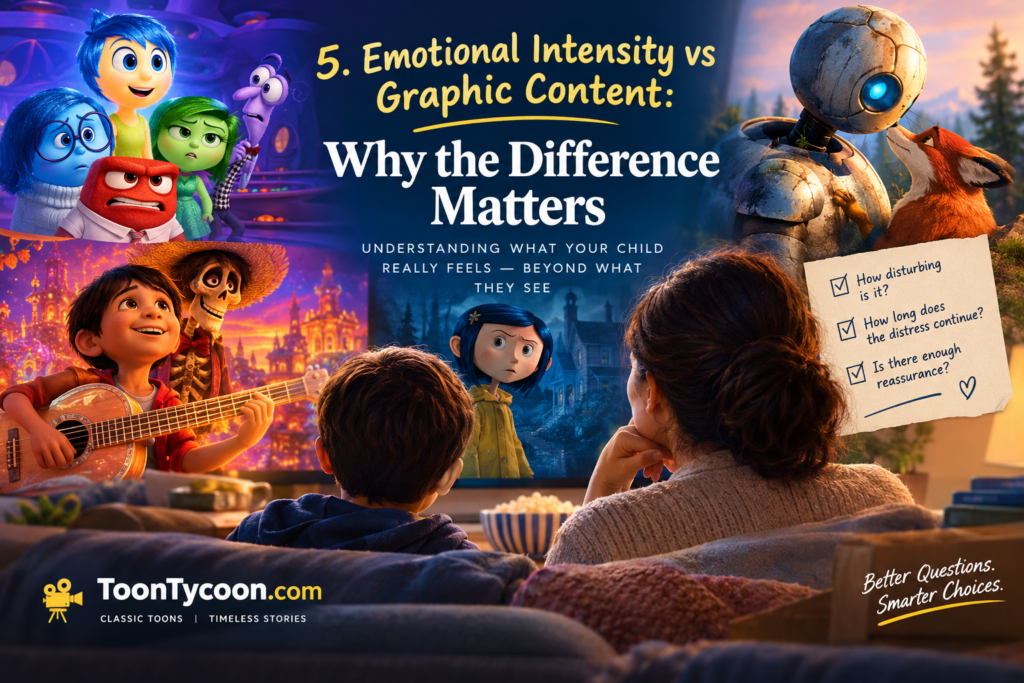
Animation has come a long way from the colourful adventures, talking animals and cheerful musical numbers that many parents associate with children’s entertainment. Today’s animated films can explore grief, loneliness, family conflict, prejudice, identity and even the fear of death. Some make audiences laugh one moment and leave them thinking about difficult questions the next.
That creative freedom has produced some of the most memorable animated films of recent years. It has also made choosing the right movie for a child more complicated.
A film carrying a PG rating may look perfectly suitable for a family movie night, but what happens when its story includes a frightening creature, the death of a beloved character or a prolonged scene of emotional distress? Will every child respond in the same way?
Of course not.
Decoding emotional intensity in animation age ratings means looking beyond the classification label to understand what a child will actually experience while watching a film. It requires parents to consider the story’s emotional weight, frightening imagery, psychological tension and the maturity needed to understand its themes.
At ToonTycoon, we believe that good movie guidance should do more than tell parents whether a film is recommended for a particular age. It should explain why certain scenes might be difficult, what makes a story emotionally powerful, and how families can make informed viewing decisions together.
Let’s look beyond the PG tag and explore what modern animation really asks of its young audience.
What Do Animation Age Ratings Actually Tell Us?
Age ratings provide a useful starting point when choosing films for children. They indicate how a movie has been classified under a particular rating system, helping parents identify content that may require closer consideration.
In the United States, the Motion Picture Association uses classifications including G, PG, PG-13, R and NC-17. Other countries use different systems, so a film’s classification may vary depending on where it is released.
A G rating generally indicates that a film contains nothing that would offend parents whose younger children watch it under the US system. PG means parental guidance is suggested because some material may not be suitable for every child. Neither rating should be treated as a universal guarantee of emotional comfort.
A G-rated film can contain sad moments, suspense or the separation of characters. A PG-rated animation may be funny, adventurous and appropriate for many families while including scenes that frighten younger viewers.
The Motion Picture Association also provides content descriptors that explain elements contributing to a rating. These can include violence, frightening images, language and thematic material. Parents can consult its official film ratings guide for further information.
The important distinction is that a classification is not a complete psychological assessment of how an individual child will react.
A rating tells you where to begin your research, not where to end it.
Why Emotional Intensity Matters More Than Parents Realise
Emotional intensity describes how strongly a film’s images, music, dialogue and story events may affect its audience.
In animation, intensity does not depend entirely on violence or horror. A quiet conversation about abandonment may upset one child more than an elaborate fantasy battle. A character saying goodbye to a parent may have a greater emotional impact than a brief chase involving monsters.
Several storytelling techniques contribute to this experience.
Frightening imagery and visual design
Animated filmmakers can exaggerate shadows, facial expressions, body movements and environments to create an unsettling atmosphere. A character’s distorted face or a creature emerging from darkness may frighten a child even when no physical violence occurs.
Music and sound
Sudden noises, dramatic music, screams and prolonged silence can increase suspense. Children may respond strongly to these cues without fully understanding why the scene feels threatening.
Attachment to characters
Young viewers often become deeply invested in animated characters. When a character they love faces danger, rejection or loss, the emotional response can feel surprisingly personal.
Uncertainty and suspense
A story becomes more intense when viewers cannot predict whether a character will survive, whether a family will reunite or whether a frightening situation will end safely.
For younger children, uncertainty itself can be difficult to process, particularly when reassurance is delayed.
Complex emotions and moral choices
Some animated films explore betrayal, guilt, injustice, sacrifice and difficult decisions. These subjects can encourage thoughtful discussion, but understanding them may require a level of emotional maturity that the film’s colourful appearance does not immediately suggest.
Emotional intensity is therefore a combination of what happens, how it is presented and how strongly viewers connect with the characters.
Why Modern Animation Can Be Darker Than Expected
Animation is a storytelling medium, not an age category.
The same medium that produces gentle preschool entertainment can also deliver psychological dramas, supernatural mysteries, dystopian adventures and sophisticated stories about growing up.
A beautifully animated film may explore war, mortality, prejudice or psychological conflict. Its artistic style does not make those subjects less serious.
This is one reason parents should avoid assuming that every animated movie was created for the same audience.
Dark themes can have a meaningful purpose
Difficult subjects are not automatically inappropriate for children. Carefully presented stories can help young viewers explore feelings and experiences that are part of everyday life.
A film about grief may help a child understand that sadness is a natural response to losing someone. A story about bullying may encourage empathy and create an opportunity to discuss kindness, boundaries and standing up for others.
However, there is an important difference between a difficult theme presented sensitively and a scene that overwhelms a particular viewer.
Presentation matters as much as subject matter
Imagine two animated films featuring a frightening creature.
In the first, the creature appears briefly, behaves comically and is quickly revealed to be harmless. In the second, it stalks a vulnerable character, threatens their family and appears repeatedly throughout the story.
The subject is similar, but the experience is very different.
Parents should consider how long a film sustains tension, whether the danger feels realistic, how vulnerable the characters appear and whether the story provides enough reassurance.
Five Dark Themes Parents Should Look For
When evaluating animated movies for children, it helps to identify the specific themes that may require preparation or discussion.
1. Death and grief
Death is one of the most emotionally powerful subjects in family cinema.
An animated film may show a character dying, losing a loved one, remembering someone who has passed away or struggling to understand permanent separation. Some stories handle loss gently, while others make it central to the plot.
For a child who has recently experienced bereavement, even a non-graphic scene may be particularly upsetting.
Parents should investigate whether death is mentioned, depicted directly or explored throughout the story.
2. Abandonment and family separation
Stories about missing parents, separation from siblings, rejection or the loss of a home can be deeply unsettling.
A young child may not fully understand the fictional circumstances. Instead, they may focus on the possibility that something similar could happen to their own family.
These stories do not necessarily need to be avoided, but parents should consider whether their child is ready to explore the subject and whether the film offers reassurance.
3. Supernatural horror and threatening creatures
Animated monsters, ghosts, witches and supernatural figures range from playful to genuinely frightening.
Their appearance is only one part of the equation. Behaviour, sound design, suspense and the vulnerability of the characters all influence the experience.
A silly monster is not equivalent to a threatening figure that repeatedly appears in dark corridors or attacks sleeping characters.
4. Violence, destruction and physical danger
Fantasy battles are common in animation, but their emotional impact depends on how they are depicted.
Consider whether characters suffer injuries, whether the danger is prolonged and whether the destruction affects characters the audience cares about.
Even bloodless fantasy violence can be distressing when a favourite character appears unlikely to survive.
5. Loneliness, rejection and psychological distress
Not all dark themes involve monsters or external threats.
A character who feels unwanted, struggles with self-worth or believes nobody understands them may trigger strong emotions in children who recognise similar feelings.
These stories can encourage empathy and conversation. However, persistent hopelessness, cruel humiliation or intense emotional breakdowns may be difficult for some viewers.
A useful parents’ guide should explain both the subject and how the film handles it rather than treating every mention of sadness as equally serious.
Emotional Intensity Versus Graphic Content
One common mistake is assuming that a lack of blood, explicit violence or adult language automatically makes a film emotionally gentle.
Graphic content and emotional intensity are different things.
Graphic content concerns what viewers see or hear in explicit detail. Emotional intensity concerns the feelings a scene creates, including fear, sadness, helplessness, suspense or distress.
An animated film may contain very little graphic material yet create considerable emotional pressure through music, character relationships and uncertainty.
Consider three examples:
| Scene | Possible emotional response | What parents should consider |
|---|---|---|
| A brief fantasy battle | Excitement or temporary fear | How serious the danger feels |
| A character saying goodbye forever | Sadness and a sense of loss | The child’s understanding of death |
| A creature stalking a frightened child | Sustained suspense and anxiety | The scene’s duration and intensity |
These examples demonstrate why parents should examine context rather than simply count frightening or violent moments.
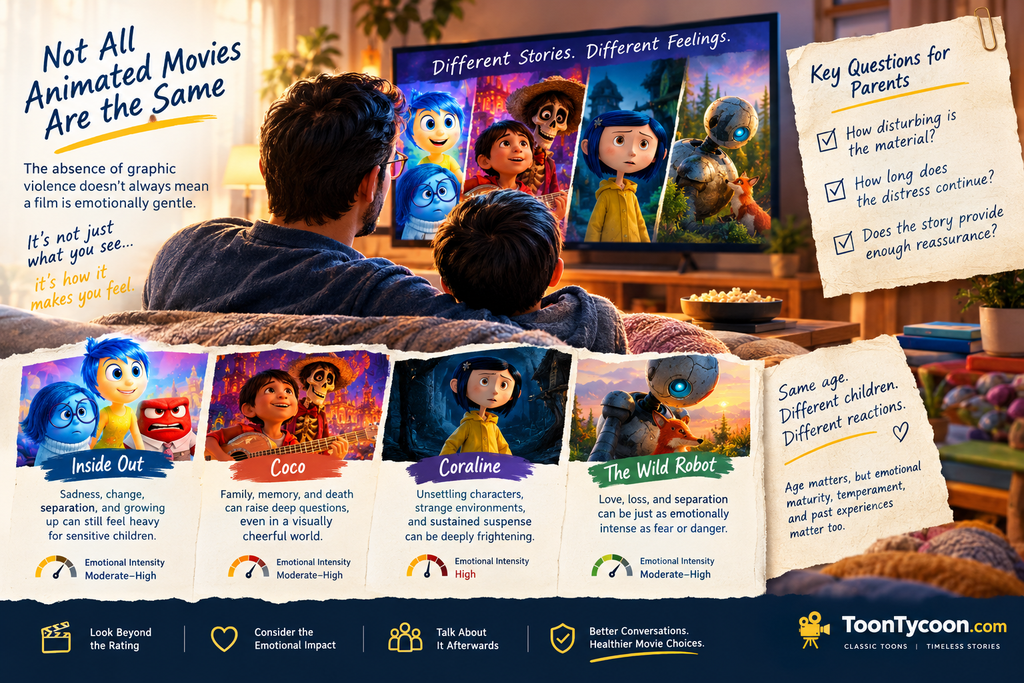
Ask three questions: How disturbing is the material? How long does the distress continue? Does the story provide enough reassurance for its intended audience?
The answers may be more useful than a rating alone.
Four Animated Movies That Illustrate Emotional Complexity
Some well-known animated films demonstrate how differently emotional intensity can appear in family entertainment. These examples are not universal age recommendations; they illustrate why parents should investigate individual films before watching them with younger children.
Inside Out and Inside Out 2: Big Feelings on Screen
Pixar’s Inside Out explores the emotional world of a young girl dealing with change, while Inside Out 2 introduces additional emotional pressures associated with growing up.
The original film is rated PG in the United States. Its imaginative presentation makes abstract emotions easier to discuss, but its themes of sadness, change and separation can still resonate strongly with sensitive children.
The sequel explores anxiety and the desire to fit in, offering a starting point for conversations about emotional regulation and self-acceptance.
The useful question is not simply whether these films are suitable for children. It is whether a child is ready to think about difficult feelings and discuss how emotions influence behaviour.
Coco: Death, Memory and Family Relationships
Pixar’s Coco centres on family, music, memory and the relationship between the living and the dead. Its colourful depiction of the afterlife contrasts with the serious subject of mortality.
The film is rated PG in the United States and includes skeleton imagery, peril and themes involving death and family history.
Some children may find the playful visuals comforting, while others may be upset by the idea of death or separation from loved ones.
Parents can use the story to discuss family traditions and remembrance without assuming every child will respond comfortably to its treatment of mortality.
Coraline: When Fantasy Becomes Frightening
Coraline offers a darker example. Its stop-motion animation, unsettling characters, strange environments and escalating danger create a much more frightening experience than its visual form might initially suggest.
The film is rated PG in the United States, but that classification does not guarantee that it will suit every young child.
Its threatening imagery and sustained suspense may be more disturbing than brief moments of conventional cartoon violence.
Parents should pay particular attention to children who dislike creepy faces, sinister characters or stories in which a seemingly safe environment gradually becomes dangerous.
The Wild Robot: Separation, Danger and Belonging
The Wild Robot explores survival, care, belonging and the relationship between a robot and the young animal it raises.
Its gentle visual storytelling sits alongside moments of danger, loss and emotional separation. The film is rated PG in the United States.
Its themes can inspire meaningful conversations about family and responsibility, although some scenes involving threatened characters may be difficult for particularly sensitive viewers.
These examples reveal a central principle: parents should investigate the emotional experience a movie offers rather than assuming that all PG animated films are interchangeable.
How Age and Emotional Maturity Affect Movie Choices
Age is important, but it is not the only consideration.
Two children of the same age may react very differently to the same film. One might enjoy suspense and quickly recover from a frightening scene. Another might remember the scene for days or become anxious about similar situations.
This variation is normal.
Preschool children: Younger viewers may struggle to separate vivid fictional threats from situations that feel possible in real life. Consider films with limited sustained suspense, clear emotional cues and reassuring resolutions.
Children aged 6–8: Many children enjoy fantasy adventures but may still find threatening creatures, family separation or the death of a favourite character overwhelming.
Children aged 9–12: Older children may be more comfortable with complex plots and moral dilemmas, but themes involving bullying, friendship problems and family conflict may feel particularly personal.
Teenagers: Teenagers may appreciate stories about identity, injustice and moral ambiguity. Nevertheless, age alone cannot predict whether a particular viewer will be comfortable with graphic violence or psychological tension.
Use classification guidance alongside your knowledge of the child. Neither should replace the other.
A Practical Checklist for Parents Before Movie Night
Parents do not need to watch every film in advance, but a few minutes of research can make a meaningful difference.
- Check the official age rating and the classification system used in your country.
- Read the rating explanation for references to violence, frightening scenes and thematic material.
- Search for detailed parental reviews rather than relying solely on star ratings.
- Investigate themes relevant to your child, including grief, abandonment, bullying or sustained fear.
- Consider how the material is presented and how long the tension continues.
- Check for spoilers when specific plot details are necessary to assess suitability.
- Think about your child’s individual sensitivities and recent experiences.
- Prepare to discuss difficult events if the movie raises questions.
- Pause or stop the film if your child becomes distressed.
This approach makes movie selection less about avoiding every difficult subject and more about choosing thoughtfully.
Where to Find Reliable Animated Movie Content Warnings
Not every movie-review website provides the same level of detail. Some focus on broad age recommendations, while others examine specific scenes and themes.
Combining several sources can help parents build a clearer picture.
Official film classification authorities
The Motion Picture Association’s ratings guide explains US film classifications and common content descriptors.
For films released in other countries, consult the relevant local classification authority. Ratings may differ between territories.
Common Sense Media
Common Sense Media publishes age recommendations and parental reviews for films and other media. Its reviews may discuss violence, frightening content and themes relevant to families.
Treat recommendations as guidance rather than inflexible rules because family preferences and children’s responses vary.
IMDb Parents Guide
IMDb provides parental-guide entries for many films. These can offer useful details, although the depth and reliability of individual entries vary.
Compare important claims with other sources when making a decision.
Streaming platform descriptions
Streaming services may display age classifications and content descriptors alongside a title. These can help identify obvious concerns quickly, but brief descriptions may not explain the context or emotional weight of a scene.
For films involving complex or potentially distressing subjects, consult a detailed parental review as well.
At ToonTycoon, our aim is to help families understand not only what a movie contains but also why particular scenes might matter.
How to Talk to Children About Dark Themes in Animation
Avoiding every difficult story is neither necessary nor realistic. A more useful approach is to help children understand what they watch and give them room to express their reactions.
Before the movie
If you know the film includes a difficult subject, introduce it in simple, age-appropriate language.
You might explain that a character will feel sad because someone important to them is gone. You do not need to reveal every plot detail; a brief explanation may help a child feel prepared.
During the movie
Pay attention to changes in behaviour.
A child who becomes unusually quiet, covers their eyes, moves closer to you or repeatedly asks whether a character will be safe may need reassurance.
Offer a pause without making them feel embarrassed about being frightened.
You might ask, “Would you like to take a break, or shall we talk about what just happened?”
After the movie
Ask open-ended questions rather than testing the child’s understanding.
- Which part of the movie made you feel happiest?
- Was there a moment that frightened or upset you?
- Why do you think the character made that decision?
- What do you think happened at the end?
- Is there anything in the story you want to ask me about?
These conversations can help children identify emotions, understand fictional storytelling and recognise different perspectives.
Let the child lead. Not every movie requires a long discussion, and not every difficult scene needs an immediate explanation.
If a child remains distressed, offer comfort and revisit the subject when they feel ready.
Common Mistakes Parents Make When Reading Movie Ratings
Even careful parents can misinterpret age classifications. Recognising a few common mistakes can make the selection process easier.
Assuming animation is automatically for children. Animation includes entertainment created for many age groups. Always examine the story and tone.
Treating PG as a universal age recommendation. PG is a classification category, not a promise that every child will be comfortable with a film.
Focusing only on violence. Fear, grief, humiliation, abandonment and psychological tension can have a strong emotional impact without graphic imagery.
Assuming a happy ending makes every scene harmless. A reassuring ending may help children process a difficult story, but it does not erase everything that came before it.
Assuming siblings will react alike. A film that works well for an older sibling may not suit a younger one.
Forcing a child to finish a movie. Children should not have to prove their maturity by enduring frightening content. Stopping a film is a reasonable response, not a failure.
The aim is to develop thoughtful viewing habits rather than establish a single rule for every movie and every child.
Is Emotional Intensity Always a Bad Thing?
Not at all.
Some of the most memorable animated films are powerful precisely because they address difficult experiences. Stories about courage, loss, forgiveness, identity and compassion can help viewers understand emotions they may not yet know how to describe.
When handled thoughtfully, emotionally challenging animation can encourage empathy, meaningful discussion and reflection.
A story about grief may help a child recognise sadness. A character who faces rejection may prompt a conversation about kindness. A narrative about fear may demonstrate that courage does not mean feeling no fear at all.
However, the potential value of a film does not mean every child is ready for it at every age.
A story can be artistically excellent and still be a poor choice for a particular family movie night. Equally, a difficult subject can be appropriate when presented sensitively and watched with a supportive adult.
Parents should consider both sides: what the film offers and what it asks of its audience.
The best choice is not necessarily the least emotional film. It is the film whose emotional demands suit the child watching it.
Frequently Asked Questions
What does emotional intensity mean in animation age ratings?
Emotional intensity refers to how strongly a film may affect viewers through frightening scenes, grief, suspense, character suffering, family separation or psychological tension. A film can be emotionally powerful without depicting explicit violence.
Does a PG rating mean an animated movie is suitable for all children?
No. Under the US classification system, PG indicates that parental guidance is suggested because some material may not be suitable for every child. Parents should consider the specific content, their child’s maturity and the classification used in their country.
Can an animated movie be too scary for a seven-year-old?
Yes. Some seven-year-olds enjoy fantasy adventures, while others find monsters, suspense or threatening situations overwhelming. Read parental reviews and consider your child’s previous reactions to similar material.
Why do some animated movies include death and grief?
These themes can help tell stories about love, family, memory, change and personal growth. Their suitability depends on how they are presented and the individual child’s readiness to understand them.
Are dark themes in animation harmful to children?
Dark themes are not automatically harmful. Age-appropriate stories can encourage empathy and discussion, but frightening or distressing material may overwhelm some children. Context, presentation, maturity and parental support all matter.
What is the difference between a movie rating and a content warning?
A movie rating places a film within a classification system. A content warning identifies specific material, such as violence, frightening imagery, death or language. Detailed warnings can help parents understand what a rating alone does not explain.
How can I find out whether a cartoon contains frightening scenes?
Check the official classification explanation, read detailed parental reviews and consult reputable movie-guidance websites. Search for specific themes relevant to your child instead of relying only on the film’s promotional description.
Should I let my child stop watching a frightening movie?
Yes. If a child becomes distressed, pause the film, offer reassurance and let them decide whether to continue. There is no need to make finishing a movie a test of courage.
Are older animated films always safer than modern animation?
No. Older films can contain frightening imagery, intense peril, stereotypes and themes that may concern contemporary families. Evaluate each title individually rather than assuming that its release date determines suitability.
How should parents choose animated movies for different ages?
Start with the official rating, examine detailed content guidance and consider the child’s emotional maturity and sensitivities. For family viewing with children of different ages, choose a film the youngest viewer is likely to handle comfortably.
Final Verdict: Look Beyond the Letters on the Screen
Age ratings remain an important tool for choosing family entertainment, but they are only one part of the decision.
Decoding emotional intensity in animation age ratings means looking beyond a PG label to understand the story’s emotional demands. Frightening imagery, grief, psychological tension, family separation and uncertainty can influence a child’s experience just as much as more obvious content.
Parents do not need to shield children from every sad or frightening moment. Instead, they can choose thoughtfully, prepare children for difficult themes and offer reassurance when a story raises questions.
The next time an animated movie catches your family’s attention, take a moment to investigate its themes as well as its rating. Read the content notes, consider your child’s temperament and decide whether the film is likely to create a rewarding experience.
After all, good family entertainment is not simply about finding movies with the right label. It is about finding stories that children can enjoy, understand and process at their own pace.
ToonTycoon recommendation: Before pressing play, look beyond the rating, understand the emotional journey and make movie night a shared experience that leaves room for both enjoyment and conversation.
Movie classifications and parental guidance can vary by country and individual viewer. Always check the current local classification and detailed content information for the specific film you plan to watch.