
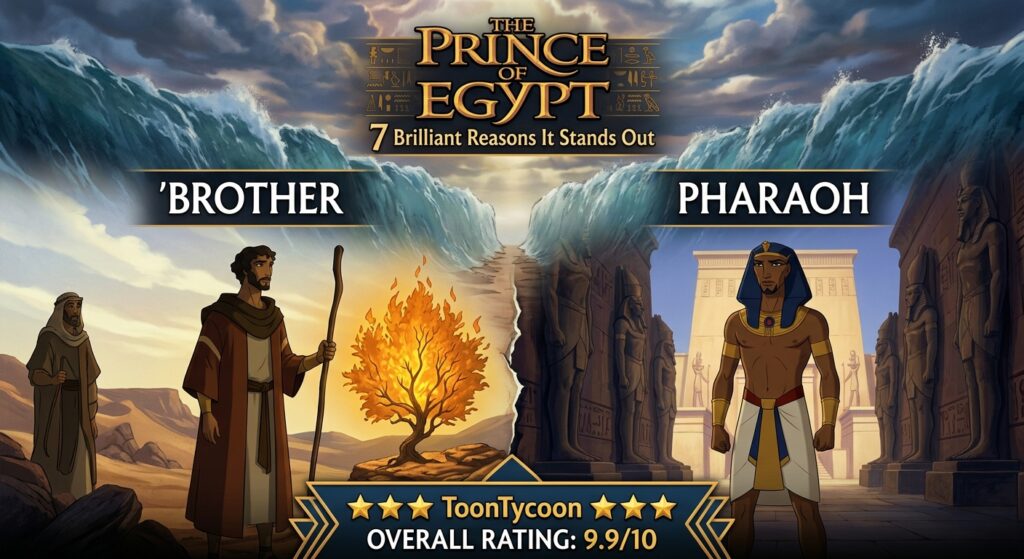
Constructing an animated biblical epic that balances grand historical reverence with deep, personal character tragedy is an extraordinary cinematic achievement. In our The Prince of Egypt review, we examine how DreamWorks Animation’s maiden 2D feature transformed the Book of Exodus into an immortal masterpiece of hand-drawn animation. Directed by Brenda Chapman, Steve Hickner, and Simon Wells, this 1998 production challenged the traditional animation landscape by delivering a mature, emotionally complex narrative that treats its audience with profound respect.
In this comprehensive The Prince of Egypt review, we analyze how a $60 million production earned over $218 million worldwide, proving that hand-drawn animation could tackle heavy thematic material without relying on cartoon sidekicks or simplified morality. Readers exploring our The Prince of Egypt review will discover why the film remains an unrivaled pinnacle of the medium. Any thorough The Prince of Egypt review must celebrate how masterfully the story centers on the tragic, broken brotherhood between Moses and Rameses.
As evaluated throughout this The Prince of Egypt review, the central emotional friction between two adopted brothers forced onto opposing sides of faith and power provides relentless dramatic weight. This The Prince of Egypt review also details how an all-star voice cast infuses gravitas into every single scene. Furthermore, our The Prince of Egypt review illustrates how breathtaking visual effects—from the Burning Bush to the Red Sea parting—push hand-drawn art to transcendent heights.
From slave-driven monuments to soaring musical anthems, the production balances historical spectacle with intense human vulnerability, an accomplishment we honor in this The Prince of Egypt review. As we emphasize throughout this The Prince of Egypt review, the legendary musical score by Hans Zimmer and original songs by Stephen Schwartz remain unmatched. In addition, our The Prince of Egypt review breaks down how the film equips families with a timeless story of freedom, duty, and faith.
Whether you are revisiting this animated milestone for its breathtaking artistry or introducing your family to a cinematic masterpiece, this detailed breakdown in our The Prince of Egypt review highlights why the film is an essential watch. Ultimately, this The Prince of Egypt review confirms that DreamWorks’ 1994 classic stands at the absolute summit of hand-drawn cinema, making every observation in our The Prince of Egypt review essential reading for movie lovers. Every section of this The Prince of Egypt review underscores the story’s immortal power, ensuring that our The Prince of Egypt review serves as your ultimate guide to this 2D masterwork.
Table of Contents
- Quick Facts
- Story and Premise
- Animation and Visuals
- Voice Cast and Characters
- Direction and Writing
- Music and Sound
- Themes and Messages
- What Works Best
- What Could Improve
- Family Viewing Guide
- Final Verdict
- ToonTycoon Rating Table
- Frequently Asked Questions
Quick Facts
| Detail | Information |
| Movie Name | The Prince of Egypt |
| Release Year | 1998 |
| Release Date | December 18, 1998 (United States) |
| Studio | DreamWorks Animation, DreamWorks Pictures |
| Director(s) | Brenda Chapman, Steve Hickner, Simon Wells |
| Writer(s) | Philip LaZebnik |
| Producers | Penney Finkelman Cox, Sandra Rabins |
| Genre | Animation, Musical, Biblical Epic, Drama, Adventure |
| Runtime | 99 minutes |
| Rating | PG (for intense depiction of thematic elements) |
| Main Cast | Val Kilmer, Ralph Fiennes, Michelle Pfeiffer, Sandra Bullock, Jeff Goldblum, Danny Glover, Patrick Stewart, Helen Mirren, Steve Martin, Martin Short |
| Main Character | Moses / Rameses |
Story and Premise
The narrative opens in ancient Egypt during a dark era of Hebrew enslavement. To save her newborn infant from Pharaoh Seti’s decree ordering the death of all male Hebrew babies, Yocheved places her infant in a woven basket and sends him floating down the Nile River. The basket is discovered by Queen Tuya, who adopts the child—naming him Moses—and raises him inside the royal palace as a prince of Egypt alongside her biological son, Rameses.
Grown into playful, reckless young men, Moses and Rameses share a deep brotherly bond. However, when Rameses is named Prince Regent and burdened with preserving Egypt’s dynasty, Moses accidentally encounters his biological siblings, Miriam and Aaron, in the city streets. Miriam reveals his true lineage, a revelation that shatters Moses’ perception of his royal upbringing.
After accidentally killing an Egyptian taskmaster while defending an elderly slave, a grief-stricken Moses flees Egypt into the Midian desert. Rescued by the nomadic tribe of Jethro, he marries Tzipporah and adopts a humble shepherd’s life. But when God speaks to Moses through a Burning Bush, he is given an impossible divine mandate: return to Egypt and demand that his brother Rameses—now Pharaoh—let the Hebrew people go.
Animation and Visuals
The visual execution in The Prince of Egypt stands as one of the grandest technical achievements in hand-drawn 2D animation:
- Monumental Architectural Scale: Background artists utilized forced perspectives and towering geometric proportions to depict Egypt’s monumental statues, temples, and palaces, making human characters feel small beneath imperial power.
- Hieroglyphic and Light Artistry: The nightmare sequence—where royal wall paintings come alive in flat hieroglyphic animation to depict the slaughter of Hebrew infants—is a masterclass in visual storytelling.
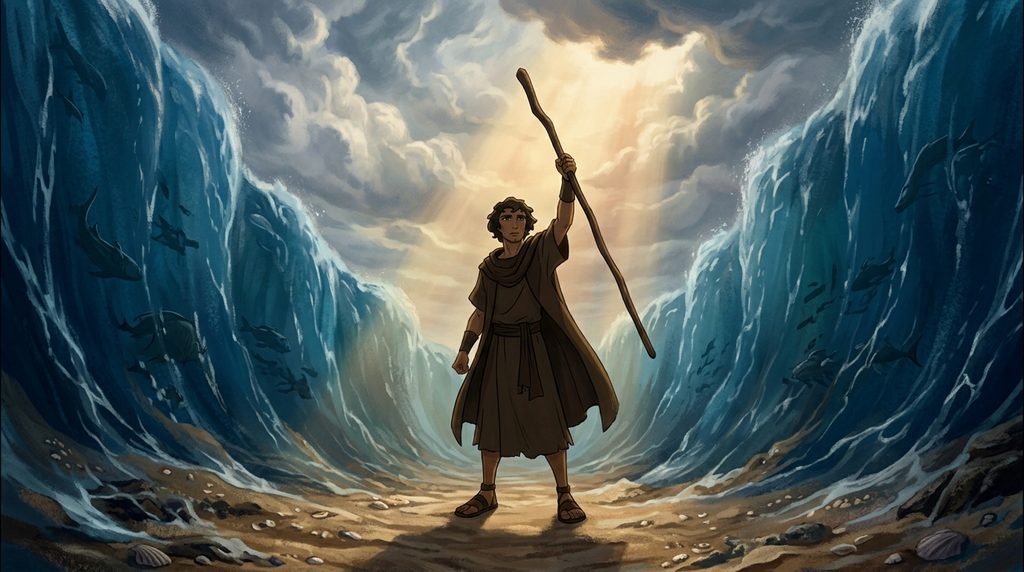
- Groundbreaking CGI Hybridization: Early computer graphics were seamlessly blended with hand-drawn character frames during complex sequences like the chariot race, the plagues, and the breathtaking parting of the Red Sea.
Voice Cast and Characters
The ensemble features one of the most prestigious voice casts ever assembled for an animated feature:
- Moses (Val Kilmer): Kilmer delivers a deeply human performance, capturing Moses’ transition from an arrogant prince to a humbled, reluctant prophet. Kilmer also provides the whisper-voice of God.
- Rameses II (Ralph Fiennes): Fiennes gives a legendary performance, imbuing Rameses not with cartoonish evil, but with tragic, stubborn pride crushed under the weight of his father’s legacy.
- Tzipporah (Michelle Pfeiffer) & Miriam (Sandra Bullock): Pfeiffer brings fierce independence to Tzipporah, while Bullock infuses Miriam with unshakeable faith.
- Pharaoh Seti (Patrick Stewart) & Queen Tuya (Helen Mirren): Stewart radiates stern, unyielding imperial authority, balanced by Mirren’s gentle maternal grace.
- Hotep & Huy (Steve Martin & Martin Short): Martin and Short deliver dark comedic relief as the opportunistic, theatrical high priests of Egypt.
Direction and Writing
Directors Brenda Chapman, Steve Hickner, and Simon Wells maintain an incredible dramatic pace across 99 minutes. Philip LaZebnik’s screenplay avoids preaching, choosing instead to focus on character psychology and emotional consequences. The writing treats both sides of the conflict with weight: Moses takes no joy in bringing plagues upon his former home, and Rameses’ refusal to yield stems from a devastating fear of breaking his family’s imperial lineage.
Music and Sound
The audio landscape is a cinematic triumph:
- Hans Zimmer’s Score: Zimmer’s Academy Award-nominated score blends traditional Middle Eastern instrumentation, massive orchestral swells, and dramatic vocal choruses arranged by Nick Glennie-Smith.
- Stephen Schwartz’s Songbook: Tracks like “Deliver Us,” “All I Ever Wanted,” “Playing with the Big Boys,” “Through Heaven’s Eyes,” and the Oscar-winning duet “When You Believe” drive the narrative forward with unmatchable emotional power.
Themes and Messages
- The Tragedy of Pride: Rameses’ stubborn refusal to compromise demonstrates how unchecked pride leads to personal and national ruin.
- Faith and Freedom: Explores the spiritual journey of standing up against tyranny for the liberation of the oppressed.
- Brotherhood Fractured by Duty: Depicts the painful cost when personal love clashes with moral and spiritual destiny.
What Works Best
- Unrivaled Hand-Drawn Art: Sets a benchmark for cinematic scale, color scripting, and visual effects in traditional animation.
- Tragic Character Focus: Framing Moses and Rameses as tragic brothers elevates the story beyond a standard religious narrative.
- Masterpiece Soundtrack: Hans Zimmer and Stephen Schwartz deliver one of the greatest musical compositions in film history.
- Phenomenal Voice Ensemble: Ralph Fiennes and Val Kilmer give career-defining vocal performances.
- Mature Storytelling: Respects the audience by refusing to tone down the emotional weight or introduce silly comic relief.
What Could Improve
- Intense Thematic Darkness for Young Kids: The plagues, enslavement, and death of the firstborn can be emotionally overwhelming for toddlers.
- Fast-Paced Historical Scope: Covering years of Moses’ life in Midian requires rapid narrative transitions.
Family Viewing Guide
- Recommended Age: 8+ years old. Suitable for older elementary children, pre-teens, and families.
- Violence and Action: Depictions of slave labor, beatings with whips, falling debris, plagues (locusts, blood rivers, hail of fire), and the atmospheric passage of the Angel of Death.
- Scary or Intense Scenes: The plague sequence and the grief of lost children carry heavy emotional intensity.
- Language: Rated PG for intense thematic elements. Completely clean, family-friendly dialogue.
- Positive Messages: Promotes freedom, courage, humility, faith, and standing against injustice.
Final Verdict
ToonTycoon Verdict: Must Watch
The Prince of Egypt is a towering artistic masterpiece. By combining grand hand-drawn visuals with a tragic human narrative and an immortal soundtrack, DreamWorks created a cinematic milestone that remains unmatched in the 2D animation canon. It earns our highest possible recommendation.
ToonTycoon Rating Table
| Category | Rating |
| Animation & Visuals | 10/10 |
| Story & Writing | 9.8/10 |
| Characters | 10/10 |
| Voice Acting | 10/10 |
| Music & Sound | 10/10 |
| Family Entertainment | 9.5/10 |
| Overall ToonTycoon Rating | 9.9/10 |
ToonTycoon Verdict: Must Watch
Frequently Asked Questions
Is The Prince of Egypt worth watching?
Yes, absolutely! As detailed in our review, it is widely considered one of the greatest hand-drawn animated films ever produced.
What is The Prince of Egypt about?
The movie adapts the Book of Exodus, following Moses as he grows up as a prince of Egypt alongside Rameses before discovering his true roots and leading the Hebrew people to freedom.
Who composed the music for The Prince of Egypt?
Hans Zimmer composed the orchestral score, while Stephen Schwartz wrote the original songs.
Is The Prince of Egypt historically accurate?
While adapted from biblical texts, the filmmakers took creative liberties with Moses and Rameses’ personal relationship to heighten the emotional tragedy of the narrative.
Where can I watch The Prince of Egypt?
The film is available for streaming across various digital platforms and home video releases via Universal Pictures Home Entertainment.