
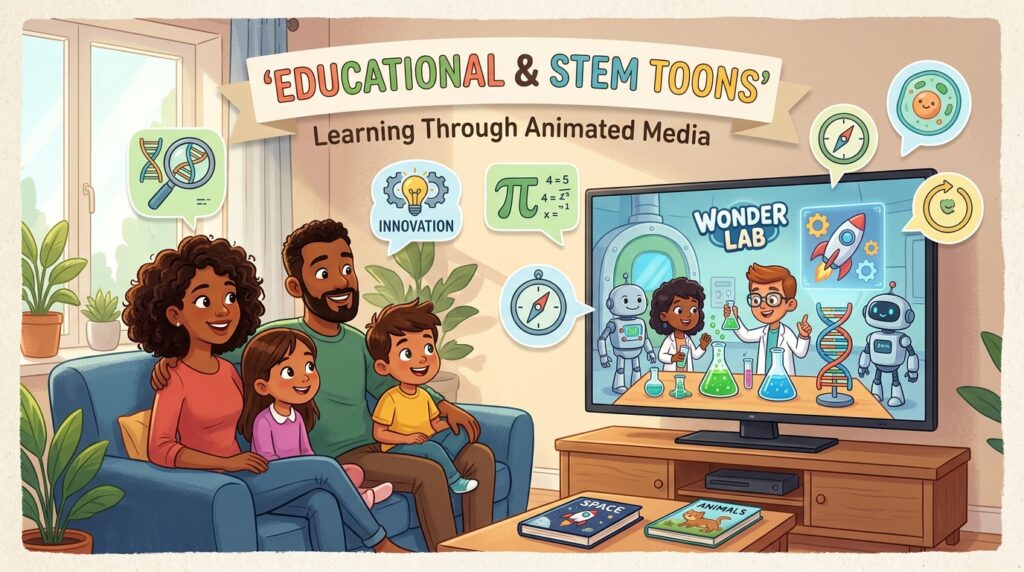
Remember sitting in a grade-school science class trying to visualize how blood cells circulate through the human body? For many of us, the textbook diagram felt dry and abstract. But if you happened to catch an episode of The Magic School Bus where Ms. Frizzle shrank the bus down to cellular size and drove right through an artery, the whole concept suddenly clicked into place forever.
That is the quiet magic of educational and STEM toons. Far from being mindless visual filler, thoughtful animated media turns complex scientific ideas, mathematical reasoning, and historical narratives into relatable stories. When dynamic visuals pair with compelling characters, abstract principles become memorable adventures that spark genuine curiosity.
Table of Contents
- The Power of Visual Storytelling in Early Learning
- Top Animated Series That Make STEM Fun and Accessible
- Balancing Screen Time with Hands-On Exploration
- Quick Facts and Summary Table
- Frequently Asked Questions
The Power of Visual Storytelling in Early Learning
Children naturally process world mechanics through observation and play. Educational and STEM toons capitalize on this developmental window by translating abstract formulas and natural phenomena into colorful visual metaphors. When a character builds a bridge or tests a hypothesis, young viewers see the scientific method play out in real time.
How Animation Enhances Cognitive Retention
Visual narrative engages multiple cognitive pathways at once. A child listening to an explanation of gravity might absorb part of the lesson, but seeing an animated astronaut float on the moon while dropping a feather and a hammer creates an instant mental benchmark.
| Learning Domain | Traditional Learning Challenge | How Educational and STEM Toons Help | Key Cognitive Outcome |
| Mathematics & Geometry | Visualizing spatial relationships and scale | Dynamic shape-shifting characters and playful scaling | Strengthens spatial reasoning and pattern recognition |
| Physical Sciences | Grasping unseen forces (gravity, magnetism) | Animated force fields, color-coded energy flows, and motion trails | Makes invisible physical concepts tangible |
| Engineering & Logic | Understanding trial, error, and structural design | Characters building prototypes, failing safely, and redesigning | Fosters problem-solving grit and sequential thinking |
| Biology & Ecology | Understanding micro-organisms and vast ecosystems | Shrink-ray narratives and vibrant animal-perspective animation | Promotes ecological empathy and biological curiosity |
By integrating narrative arcs with scientific inquiry, quality educational and STEM toons turn passive watching into an active cognitive workout.
Top Animated Series That Make STEM Fun and Accessible
Finding high-quality educational and STEM toons can feel overwhelming given the endless scroll of modern streaming platforms. To save you time, here is a curated breakdown of standout series that seamlessly weave learning into top-tier storytelling.
1. The Magic School Bus Rides Again
Building on the classic legacy, this show takes viewers on field trips into space, deep-sea trenches, and inside the human digestive tract. It remains a gold standard for science and math cartoons for kids.
2. Wild Kratts
Blending real-world zoology with animated super-suit adventures, the Kratt brothers demonstrate bio-engineering concepts by showcasing how animal adaptations solve survival challenges.
3. Cyberchase
A brilliant entry point for mathematical thinking. The series drops heroes into digital worlds where solving equations, analyzing graphs, and understanding spatial geometry are the only ways to save the day.
4. Ada Twist, Scientist
Produced with an eye on early inquiry, this series highlights young thinkers asking “why,” formulating hypotheses, and running safe home experiments. It is a fantastic choice for introducing young children to learning through animation.
5. Emily’s Wonder Lab & StoryBots
While StoryBots answers big everyday questions through catchy songs and character journeys, Emily’s Wonder Lab bridges animation with live-action demonstrations, giving kids a complete STEM toolkit.
Balancing Screen Time with Hands-On Exploration
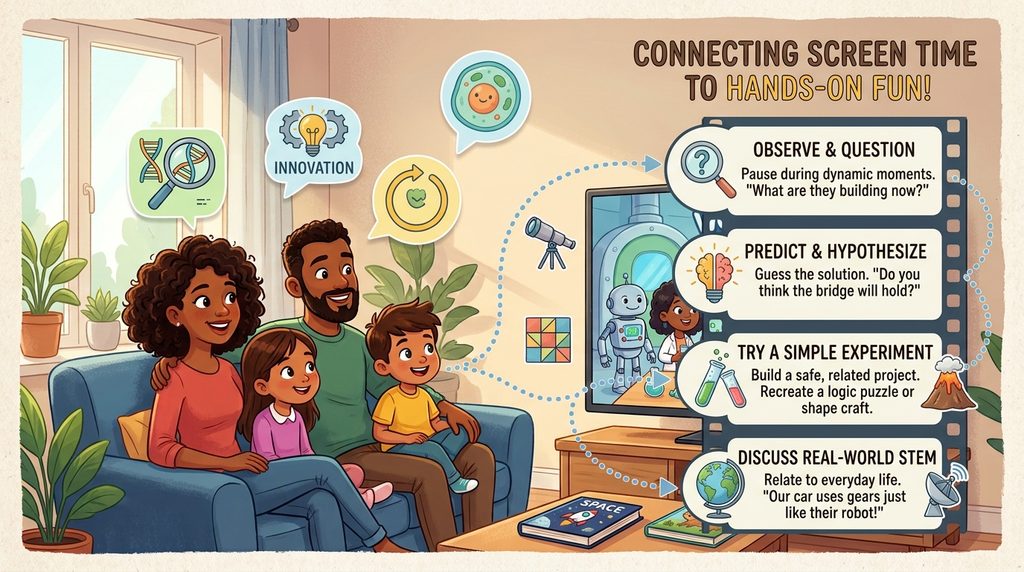
Even the best educational and STEM toons are meant to be springboards, not sit-in babysitters. The true magic happens when what kids see on screen spills over onto the living room rug or into the backyard garden.
Simple Co-Viewing Strategies
- Ask Open-Ended Questions: Pause the show during a problem-solving scene and ask: “What do you think their next experiment should be?”
- Connect Concepts to Real Life: If an episode covers magnetism, hand your child a fridge magnet and let them hunt for magnetic objects around the house.
- Keep a Science Journal: Encourage kids to draw their favorite invention or creature adaptation from the episode, adding a sentence or two about how it works.
Integrating these small habits ensures that watching educational and STEM toons leads directly to physical discovery and active creative play.
Quick Facts and Summary Table
Here is a handy STEM animated shows list and educational children’s media guide for parents seeking age-appropriate options:
| Animated Show Title | Target Age Bracket | Core Learning Outcomes | Best Used For |
| Ada Twist, Scientist | Ages 3 – 6 | Scientific inquiry, hypothesis testing, curiosity | Early childhood science introduction |
| Wild Kratts | Ages 4 – 9 | Zoology, ecology, bio-engineering adaptations | Animal lovers and nature exploration |
| Cyberchase | Ages 6 – 10 | Mathematics, logic, spatial reasoning, environmental science | Building math confidence through adventure |
| The Magic School Bus | Ages 5 – 10 | Biology, physics, astronomy, chemistry fundamentals | Comprehensive elementary science education |
| Ask the StoryBots | Ages 3 – 8 | General inquiry, how things work, human biology basics | Answering big everyday kid questions |
Bookmark this guide whenever you are building a wholesome watchlist featuring educational and STEM toons.
Frequently Asked Questions
How do educational and STEM toons help kids learn science and math?
Educational and STEM toons break complex ideas into visual, narrative-driven stories. By showing characters testing hypotheses, solving math puzzles, or exploring natural habitats, these shows make abstract concepts tangible, memorable, and fun for growing minds.
What age is best to start introducing STEM animated shows?
Children as young as three can benefit from early educational and STEM toons like Ada Twist, Scientist or StoryBots, which focus on basic curiosity and observation. As kids reach school age (5–10), series like Cyberchase and Wild Kratts introduce more advanced math, logic, and biological concepts.
How can parents complement educational and STEM toons at home?
Parents can deepen learning by talking about show themes during co-viewing, setting up simple hands-on science or craft activities based on episodes, and encouraging kids to test out real-world questions through kitchen experiments or nature walks.