
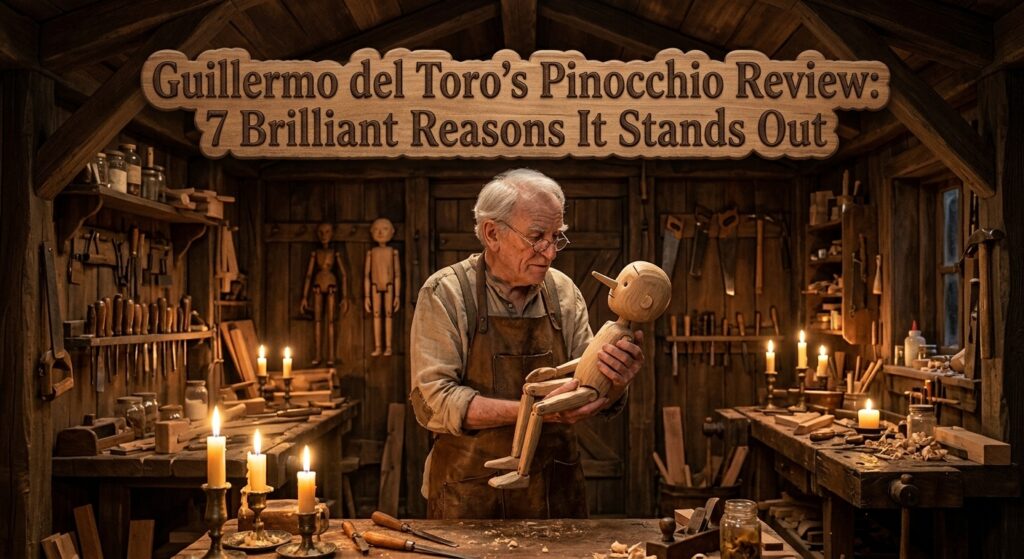
Guillermo del Toro’s Pinocchio review: Redefining stop-motion puppet craftsmanship with breathtaking emotional resonance, dark fairytale themes, and historical weight, our Guillermo del Toro’s Pinocchio review explores how the Academy Award-winning filmmaker co-directed (with Mark Gustafson) a cinematic masterpiece for Netflix. Released in 2022 and maintaining its standing as an indie stop-motion crown jewel (Rated PG / 7+ for kids and families), this film strips away studio clichés to deliver an auteur-driven exploration of grief, fascism, fatherhood, and unconditional love.
In this comprehensive Guillermo del Toro’s Pinocchio review, we analyze how the production balances tactile puppet animation with a thought-provoking, dark fantasy narrative. Readers diving into our Guillermo del Toro’s Pinocchio review will discover why this ShadowMachine and Jim Henson Company co-production appeals equally to animation lovers and cinema purists. Any thoughtful Guillermo del Toro’s Pinocchio review must praise how delicately the story handles the burden of parental expectations and the beauty of imperfection.
As evaluated throughout this Guillermo del Toro’s Pinocchio review, the story unfolds in 1930s Italy during the rise of Benito Mussolini’s fascist regime. Broken by the tragic loss of his young son Carlo during World War I, woodcarver Geppetto drunkenly crafts a wooden boy out of a pine tree in a fit of grief. When a mysterious Wood Sprite grants the puppet life, Pinocchio embarks on a surreal journey where he is coveted by a greedy carnival ringmaster, exploited by military officers, and repeatedly transported to the afterlife ruled by Death.
From eerie encounters with black-furred, coffin-bearing rabbits to high-seas battles inside the cavernous belly of a giant sea monster, the film maintains a haunting, poetic tempo, an achievement we honor in this Guillermo del Toro’s Pinocchio review. As we emphasize throughout this Guillermo del Toro’s Pinocchio review, Gregory Mann, David Bradley, and Ewan McGregor deliver unforgettable vocal performances that anchor the story’s emotional core. In addition, our Guillermo del Toro’s Pinocchio review breaks down how the film equips young viewers with profound lessons on staying true to oneself, accepting loved ones as they are, and embracing life’s fleeting nature.
Whether you are seeking peak stop-motion artistry on Netflix or exploring dark indie animation, this detailed breakdown in our Guillermo del Toro’s Pinocchio review highlights why the feature remains essential viewing. Ultimately, this Guillermo del Toro’s Pinocchio review confirms that Guillermo del Toro and Mark Gustafson delivered an immortal stop-motion classic, making every observation in our Guillermo del Toro’s Pinocchio review valuable for animation fans. Every section of this Guillermo del Toro’s Pinocchio review underscores the puppet’s singular charm, ensuring that our Guillermo del Toro’s Pinocchio review serves as your ultimate guide to this streaming titan.
Guillermo del Toro’s Pinocchio review: Table of Contents
- Quick Facts
- Story and Premise
- Animation and Visuals
- Voice Cast and Characters
- Direction and Writing
- Music and Sound
- Themes and Messages
- What Works Best
- What Could Improve
- Family Viewing Guide
- Final Verdict
- ToonTycoon Rating Table
- Frequently Asked Questions
Quick Facts
| Detail | Information |
| Movie Name | Guillermo del Toro’s Pinocchio |
| Release Year | 2022 |
| Platform / Streaming | Netflix (Rated PG / 7+) |
| Studio | Netflix Animation, Double Dare You, ShadowMachine, The Jim Henson Company |
| Director(s) | Guillermo del Toro, Mark Gustafson |
| Writer(s) | Guillermo del Toro, Patrick McHale |
| Genre | Indie Animation, Stop-Motion, Dark Fantasy, Drama, Family |
| Runtime | 117 minutes |
| Rating | PG / 7+ (For dark thematic elements, scary images, and fantasy action) |
| Main Voice Cast | Gregory Mann, David Bradley, Ewan McGregor, Christoph Waltz, Tilda Swinton, Cate Blanchett, Finn Wolfhard, Ron Perlman |
| Main Characters | Pinocchio / Geppetto / Sebastian J. Cricket / Count Volpe / The Wood Sprite & Death / Candlewick |
Guillermo del Toro’s Pinocchio review: Story and Premise
Set against the grim backdrop of interwar Italy, elderly carpenter Geppetto (David Bradley) lives in perpetual mourning for his son Carlo, who was killed by an accidental bomb drop during World War I. One night, in a drunken outburst of sorrow, Geppetto chops down a pine tree near Carlo’s grave and carves a wooden puppet, wishing for his boy to return.
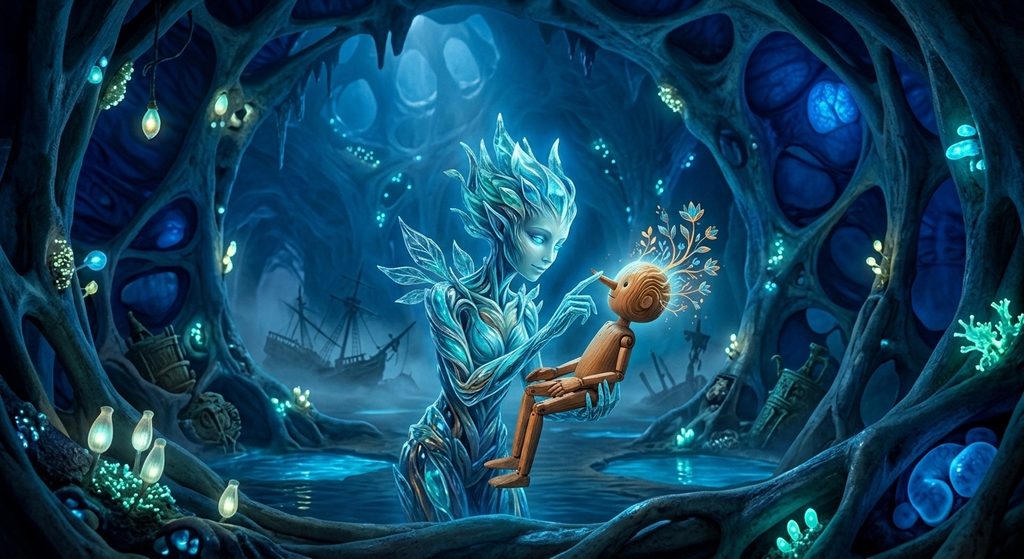
Moved by Geppetto’s pain, the mystical Wood Sprite (Tilda Swinton) breathes life into the puppet, naming him Pinocchio (Gregory Mann). She tasks Sebastian J. Cricket (Ewan McGregor), a refined writer who made his home inside the pine tree’s heartwood, with guiding the boy to act virtuous in exchange for a granted wish. However, unlike Carlo, Pinocchio is loud, boisterous, unfiltered, and deeply curious about the world.
As Geppetto struggles with expecting Pinocchio to be a carbon copy of his lost son, outside forces seek to exploit the immortal wooden boy. The ruthless carnival owner Count Volpe (Christoph Waltz) tricks Pinocchio into a predatory contract, while the town’s fascist Podestà (Ron Perlman) views Pinocchio’s inability to die as the ultimate blueprint for a soldier. Pinocchio must navigate greed, military training camps, death realms, and a giant ocean beast to learn what it truly means to be human and save his father.
Animation and Visuals
ShadowMachine, Mackinnon & Saunders, and The Jim Henson Company achieved a pinnacle of stop-motion artistry:
- Tactile Mechanical Puppetry: The physical puppets feature exposed wooden grains, mechanical joints, and hand-stitched clothing that give every movement weight and realism.
- Gothic Shadow Play & Lighting: Influenced by classic European art and German Expressionism, scenes utilize deep shadows, muted earth tones, and warm candlelight.
- Creature Design Mastery: Tilda Swinton’s dual roles as the Wood Sprite and Death feature haunting, chimera-like designs covered in eyes, feathers, and skeletal horns that feel truly otherworldly.
Voice Cast and Characters
- Pinocchio (Gregory Mann): Mann captures innocence, boundless energy, and heartbreaking sincerity in a breakout vocal performance.
- Geppetto (David Bradley): Bradley infuses the grief-stricken carpenter with raw heartbreak, regret, and ultimate unconditional love.
- Sebastian J. Cricket (Ewan McGregor): McGregor delivers hilarious, theatrical charm as the long-suffering narrator and conscience.
- Count Volpe (Christoph Waltz): Waltz brings sinister, theatrical villainy as the abusive circus manager.
- The Wood Sprite / Death (Tilda Swinton): Swinton gives both cosmic entities ethereal, serene, and haunting authority.
Direction and Writing
Co-directors Guillermo del Toro and Mark Gustafson treat stop-motion animation not as a children’s gimmick, but as an elevated art form. Co-written with Over the Garden Wall creator Patrick McHale, the screenplay boldly critiques authoritarianism and blind obedience. The writing contrasts the “puppets made of wood” who act with free will against the “human puppets” who blindly follow political tyranny.
Music and Sound
- Alexandre Desplat Score: The Oscar-winning composer built the score almost entirely out of wooden instruments (woodwinds, pianos, marimbas, and acoustic strings) to match Pinocchio’s physical nature.
- Original Songs: “Ciao Papa” provides a devastating, beautiful emotional anchor that captures grief and farewell.
Themes and Messages
- Love and Imperfection: Teaches that true love requires accepting people for who they are rather than forcing them into expectations.
- Disobedience as Virtue: Shows that disobeying unjust rules or harmful authority figures is often necessary to do what is morally right.
- Acceptance of Mortality: Explores how life’s beauty comes from its temporary nature, making love and time spent together sacred.
What Works Best
- Unrivaled Stop-Motion Craft: Sets new visual standards for physical puppet animation and environmental detail.
- Profound Narrative Depth: Elevates the classic fable into a mature meditation on grief, death, and fascism.
- Standout Vocal Performances: David Bradley and Gregory Mann create one of the most moving father-son relationships in modern animation.
- Alexandre Desplat’s Wooden Score: The acoustic, wood-driven musical composition enhances every scene seamlessly.
- Bold Character Design: ShadowMachine’s creature concepts stand as some of the most memorable in dark fantasy cinema.
What Could Improve
- Darker Tone for Very Young Toddlers: The presence of war, military camps, and skeletal afterlife spirits may prove too intense for sensitive preschoolers.
- Extended Runtime: At nearly two hours (117 mins), the middle act’s circus and military camp sequences require patient viewing.
Family Viewing Guide
- Recommended Age: 7+ years old. Great for older elementary kids, teens, parents, and stop-motion fans.
- Violence and Action: Fantasy peril, wartime bomb drops, fascist military training, and creature attacks inside a sea monster. No graphic gore, but threats carry real emotional weight.
- Scary or Intense Scenes: The afterlife features blue-skinned skeletal rabbits and the creature Death. Short scenes depict war destruction and death, handled with artistic solemnity.
- Language: Rated PG. Clean dialogue with mild historical insults.
- Positive Messages: Promotes free thought, unconditional family love, honesty, integrity, and embracing individuality.
Final Verdict
ToonTycoon Verdict: Essential Masterpiece
Guillermo del Toro’s Pinocchio is a staggering artistic triumph that stands as one of the greatest stop-motion animated films ever made. Combining jaw-dropping puppet craft, Alexandre Desplat’s score, and a story rich in heart and historical depth, it is an essential indie masterpiece for animation lovers of all ages.
ToonTycoon Rating Table
| Category | Rating |
| Animation & Visuals | 10/10 |
| Story & Writing | 9.7/10 |
| Characters | 9.8/10 |
| Voice & Cast Performance | 9.8/10 |
| Music & Score | 9.6/10 |
| Family & Artistic Entertainment | 9.7/10 |
| Overall ToonTycoon Rating | 9.8/10 |
ToonTycoon Verdict: Essential Masterpiece
Frequently Asked Questions
Is Guillermo del Toro’s Pinocchio suitable for 7-year-olds?
Yes, for most kids 7 and up! While it deals with darker themes like grief and war, its messages about love and standing up for what’s right make it a meaningful watch for families.
Did Guillermo del Toro’s Pinocchio win an Oscar?
Yes! The film won the Academy Award for Best Animated Feature, celebrating its groundbreaking stop-motion craftsmanship.
What animation style is used in Guillermo del Toro’s Pinocchio?
The movie was created using traditional, physical stop-motion puppet animation produced over several years by ShadowMachine and The Jim Henson Company.
How is this version different from the Disney Pinocchio?
Unlike Disney’s fairytale approach, del Toro’s version is set in 1930s fascist Italy and explores deep themes of grief, mortality, free will, and refusing to conform to expectations.