
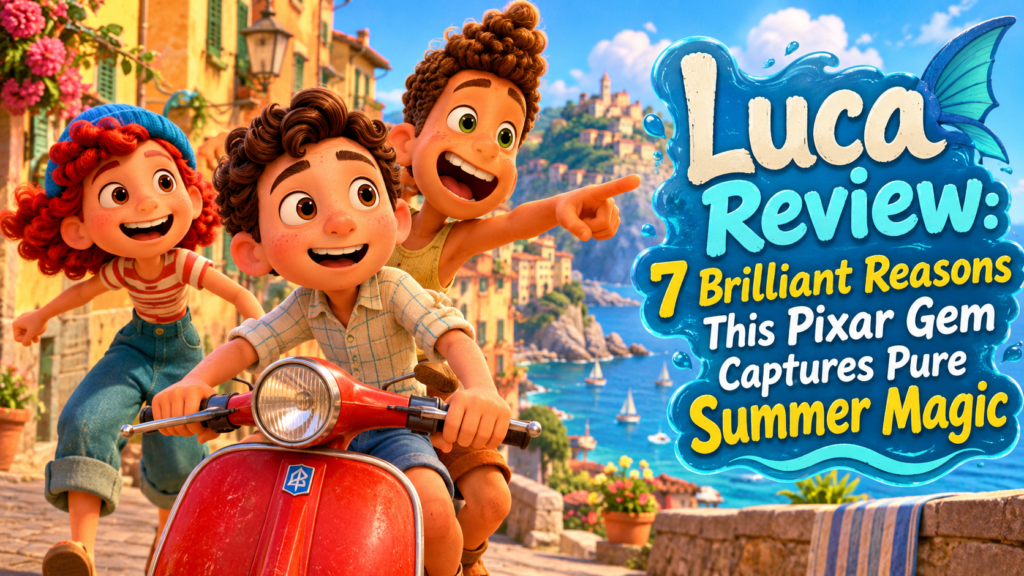
Luca Review:Pixar has built a reputation on cosmic metaphysics, talking toys, and high-stakes existential journeys, which is exactly why Luca feels like such a breath of fresh sea air. Directed by Enrico Casarosa and inspired by his own childhood summers along the Italian Riviera, this 2021 coming-of-age adventure trades universe-saving urgency for the smaller, deeply personal thrill of stepping outside your comfort zone. In our Luca review, we look at how the studio turns a sun-drenched coastal town into the backdrop for an unforgettable story about friendship, curiosity, and finding the courage to be yourself.
Set in the picturesque seaside village of Portorosso, the story follows Luca Paguro, a timid young sea monster whose parents forbid him from ever approaching the surface. Everything changes when he meets Alberto Scorfano, a fearless fellow sea monster who shows him that stepping onto dry land transforms their scaly forms into human boys. Anyone reading a Luca review will quickly recognize the charm of this simple premise: two boys chasing dreams of freedom, gelato, and a shiny red Vespa while hiding a secret that could turn the entire town against them.
Across its breezy 95-minute runtime, the film blends whimsical Studio Ghibli-inspired warmth with Pixar’s signature emotional craft. Whether you are revisiting it on streaming or introducing it to younger kids for family movie night, this Luca review breaks down why its gentle pace, rich visuals, and heartfelt relationships still stand out years after its debut.
Table of Contents
- Quick Facts
- Story and Premise
- Animation and Visuals
- Voice Cast and Characters
- Direction and Writing
- Music and Sound
- Themes and Messages
- What Works Best
- What Could Improve
- Family Viewing Guide
- Final Verdict
- ToonTycoon Rating
- Frequently Asked Questions
- Rank Math SEO Metadata
Quick Facts
| Detail | Information |
| Movie | Luca |
| Release Year / Date | 2021 (June 18, 2021 on Disney+; U.S. theatrical release on March 22, 2024) |
| Studio | Pixar Animation Studios / Walt Disney Studios Motion Pictures |
| Director | Enrico Casarosa |
| Writers | Screenplay by Jesse Andrews & Mike Jones; Story by Enrico Casarosa, Jesse Andrews & Simon Stephenson |
| Producer | Andrea Warren |
| Genre | Animation / Coming-of-Age / Fantasy / Family Adventure |
| Runtime | 95 minutes |
| Rating | PG (for rude humor, language, some thematic elements and brief violence) |
| Box Office & Streaming | ~$51.1 million worldwide box office; over 10.6 billion minutes streamed in 2021 |
| Main Cast | Jacob Tremblay, Jack Dylan Grazer, Emma Berman, Saverio Raimondo, Maya Rudolph, Marco Barricelli, Jim Gaffigan |
| Main Character | Luca Paguro, Alberto Scorfano, Giulia Marcovaldo |
Story and Premise
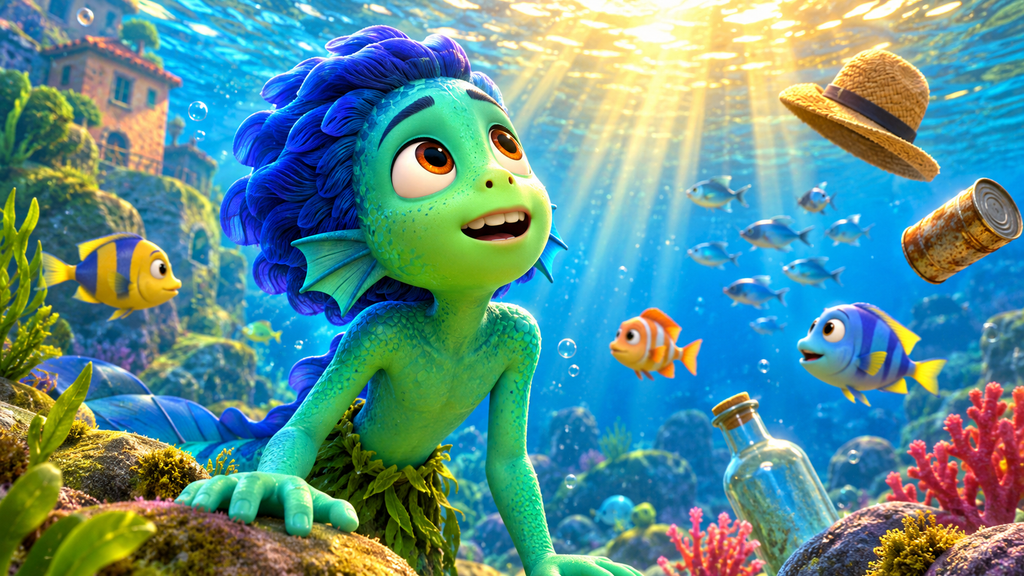
The story begins beneath the waves of the Ligurian Sea, where young Luca Paguro spends his days herding goatfish and obeying his protective parents’ strict rule: never go near the surface, where “land monsters” hunt sea creatures. Luca is dutiful and cautious, yet quietly fascinated by the human trinkets that drift down into his underwater world. As observed in this Luca review, his sheltered routine cracks wide open the moment he crosses paths with Alberto Scorfano, a bold, self-reliant sea monster who lives in an abandoned tower above water.
Once Luca discovers that drying off turns his fins and scales into human skin and hair, the two boys make a run for the nearby human town of Portorosso. Their main objective is pure childhood bliss: win enough prize money in the local Portorosso Cup triathlon to buy a Vespa and travel the world together.
To pull it off, they team up with Giulia Marcovaldo, a fiercely determined local outcast who wants to beat the town’s arrogant reigning champion, Ercole Visconti. The central conflict tightens as Luca’s curiosity expands beyond riding scooters—he begins falling in love with books, astronomy, and school, creating quiet tension with Alberto while a single splash of water threatens to expose their true identity at any second. Every strong Luca review recognizes how naturally those personal stakes escalate without needing a world-ending villain.
Animation and Visuals
Rather than chasing hyper-photorealistic textures, Pixar deliberately infused Luca with a painterly, handcrafted warmth that mirrors how childhood summers live in memory.
- Artistic Style and Color Palette: Under production designer Daniela Strijleva and color & shading art director Chia-Han Jennifer Chang, Portorosso glows with saturated Mediterranean blues, terracotta rooftops, and golden afternoon sunlight. Water shimmers with stylized, layered reflections inspired by classic hand-drawn illustration.
- Character Design: Character designer Deanna Marsigliese gave the cast expressive, slightly caricatured silhouettes—wide eyes, rubbery facial expressions, and lively posture—that make physical comedy pop.
- Seamless Transformations: Instead of treating the shift from sea monster to human like a magic costume swap, animators designed the scales to ripple organically across the skin whenever water hits or dries. That visual detail turns every raindrop, fountain, and glass of water into an instant source of suspense.
- World-Building: Pixar artists traveled to the Italian Riviera to study coastal architecture, cobblestone alleys, and seaside culture, making Portorosso feel lived-in and authentic rather than like a generic postcard.
It is easy to see why any Luca review praises the visual craft here: the animation actively drives both the humor and the emotional vulnerability of the characters.
Voice Cast and Characters
The vocal performances bring genuine warmth, adolescent awkwardness, and comic timing to the screen—a standout strength in our Luca review:
- Luca Paguro (Jacob Tremblay): Tremblay captures Luca’s journey from nervous, rule-following kid to curious dreamer with sincerity, letting his voice crack with excitement and hesitation at all the right moments.
- Alberto Scorfano (Jack Dylan Grazer): Grazer steals scenes with fast-talking bravado, inventing outrageous explanations for human inventions (“silenzio, Bruno!”) while subtly revealing the loneliness hidden beneath his confidence.
- Giulia Marcovaldo (Emma Berman): Berman injects infectious, rapid-fire enthusiasm into Giulia, making her the grounded, book-smart anchor who helps Luca see a wider world.
- Massimo Marcovaldo (Marco Barricelli): Giulia’s towering, one-armed fisherman father looks intimidating at first glance, yet Barricelli’s gruff, understated delivery reveals a gentle giant with a quiet soft spot for the boys.
- Daniela & Lorenzo Paguro (Maya Rudolph & Jim Gaffigan): Rudolph brings fierce maternal determination to Luca’s overprotective mom, while Gaffigan adds dry, lovable deadpan humor as his easily distracted dad.
- Ercole Visconti (Saverio Raimondo): Raimondo plays the Vespa-riding town bully with hilarious, self-absorbed theatricality, turning him into a memorable comedic foil rather than a dark threat.
Taken together, the ensemble gives the movie an effortless chemistry that makes every scene enjoyable, as noted throughout this Luca review.
Direction and Writing
Making his feature directorial debut after his Oscar-nominated short La Luna, Enrico Casarosa guides Luca with an unhurried, deeply personal touch. Working from a screenplay by Jesse Andrews and Mike Jones, the story rejects bloated subplots in favor of small, resonant moments: sharing a plate of trenette al pesto, stargazing on a rooftop, or nursing bruised pride after an argument.
That restraint is both the film’s superpower and its most debated trait. In this Luca review, the screenplay shines brightest when it captures how childhood friendships shift as two best friends grow in slightly different directions. At the same time, viewers expecting the intricate, high-concept twists of Inside Out or Soul may notice that the plot follows familiar coming-of-age beats. Still, the warmth of the dialogue and genuine emotional payoff keep the story engaging from start to finish, reinforcing why this Luca review views its simplicity as a strength.
Music and Sound
Composer Dan Romer crafts a breezy, acoustic-driven score built around accordions, mandolins, strings, and gentle piano melodies that instantly transport you to coastal Italy. Paired with classic Italian pop recordings—including Mina and Edoardo Bennato—the soundtrack sets a nostalgic summer rhythm without ever feeling heavy-handed.
The sound design deserves equal credit in any Luca review: the rhythmic lapping of waves, clattering bicycle wheels on cobblestone streets, and subtle aquatic cues when Luca and Alberto are underwater make Portorosso feel tangibly alive.
Themes and Messages
Beneath its sun-soaked humor, a thoughtful Luca review highlights several meaningful lessons for kids and parents alike:
- Silencing Self-Doubt: Alberto teaches Luca to quiet the anxious inner voice (“Silenzio, Bruno!”) that holds him back from trying new things.
- Growing Apart Without Losing Love: True friendship doesn’t mean staying identical forever; it means supporting the people you care about even when their dreams take them down a new path.
- Acceptance and Prejudice: Both sea monsters and townsfolk fear what they don’t understand, showing how empathy and courage can dismantle old prejudices.
- Letting Children Grow: Luca’s parents learn that keeping their son hidden from every risk also keeps him from discovering who he is meant to be.
What Works Best
- Sun-Drenched, Painterly Visuals: The Mediterranean palette and expressive character animation rank among Pixar’s most inviting visual designs.
- Authentic Childhood Friendship: Luca and Alberto’s bond feels messy, joyful, and emotionally real—a major highlight of this Luca review.
- Giulia and Massimo’s Warmth: Giulia’s infectious curiosity and Massimo’s quiet kindness enrich every scene in Portorosso.
- Dan Romer’s Evocative Score: Acoustic Italian instrumentation gives the film an unmistakable sense of place.
- Low-Stakes, High-Heart Storytelling: Focusing on personal growth instead of apocalyptic spectacle makes the emotional climax land honestly.
- Breezy 95-Minute Pacing: Tightly edited with zero wasted scenes, making it easy for younger viewers to stay engaged.
What Could Improve
- Predictable Plot Arc: As this Luca review notes, seasoned animation fans will spot several coming-of-age beats and misunderstandings coming well ahead of time.
- Lightweight Antagonist: Ercole is funny as a pompous local bully, though viewers wanting a deeper or more complex villain may find him one-note.
- Underexplored Backstories: Giulia’s life outside summer and Alberto’s past with his father are touched on effectively, yet leave room for a bit more depth.
Family Viewing Guide
- Recommended Age: 5+ for family viewing, and 6+ for independent enjoyment. While the MPAA rates Luca PG for rude humor, language, some thematic elements, and brief violence, our editorial guidance notes that its gentle tone and bright visuals make it far milder than many modern action-heavy animated films.
- Violence and Action: Very mild. Includes brief slapstick scuffles, bicycle race spills, and townsfolk brandishing fishing harpoons when sea monsters are mentioned—handled in a cartoonish, non-graphic way.
- Scary or Intense Scenes: Minimal. A giant deep-sea fish startles Luca briefly early on, and moments where Luca and Alberto risk getting splashed in public create gentle suspense rather than genuine fright. Some sensitive kids may feel sad during an emotional fallout between friends.
- Language: Very mild kid-level teasing (“idiot,” “stupid,” “jerk”) and playful Italian exclamations, with no profanity.
- Positive Messages: Strong takeaways on courage, curiosity, overcoming fear, loyalty, and welcoming people who seem different.
(Note: Originally released directly on Disney+ in June 2021 before receiving a special theatrical run in March 2024, streaming and digital rental availability varies by country and platform.)
Final Verdict
To wrap up this Luca review, Pixar’s coastal adventure proves that animated movies don’t need universe-shattering stakes to leave a lasting mark. While its story follows familiar coming-of-age rhythms, Enrico Casarosa’s personal direction, vibrant Italian Riviera visuals, and genuinely endearing trio of young leads make every minute a pleasure. Nominated for Best Animated Feature at the Academy Awards and loved by millions of families on streaming, Luca remains one of Pixar’s most rewatchable comfort movies—earning an enthusiastic recommendation in our final Luca review.
ToonTycoon Rating
| Category | Rating |
| Animation & Visuals | 9.5/10 |
| Story & Writing | 8.4/10 |
| Characters | 9.2/10 |
| Voice Acting | 9.0/10 |
| Music & Sound | 9.1/10 |
| Family Entertainment | 9.4/10 |
| Overall ToonTycoon Rating | 9.1/10 |
ToonTycoon Verdict: Must-Watch Family Favorite
Frequently Asked Questions
What is the main takeaway of this Luca review?
This Luca review finds that Pixar’s 2021 animated feature is a warm, visually gorgeous, and deeply heartfelt coming-of-age story about friendship, curiosity, and stepping past fear.
When was Luca released, and did it play in theaters?
Luca premiered on Disney+ on June 18, 2021 (with theatrical releases in select international markets), and later received a U.S. theatrical release on March 22, 2024.
Who voices the main characters in Luca?
Jacob Tremblay voices Luca Paguro, Jack Dylan Grazer voices Alberto Scorfano, Emma Berman voices Giulia Marcovaldo, Maya Rudolph voices Daniela Paguro, Jim Gaffigan voices Lorenzo Paguro, and Marco Barricelli voices Massimo.
Is Luca appropriate for young kids according to this Luca review?
Yes. Officially rated PG for rude humor, language, some thematic elements, and brief violence, this Luca review recommends it for ages 5 and up due to its gentle tone, bright visuals, and lack of intense villains.
Where can families watch Luca?
Luca is primarily available to stream on Disney+ and for digital purchase or rental on major VOD platforms, though exact availability depends on your country and local licensing.