
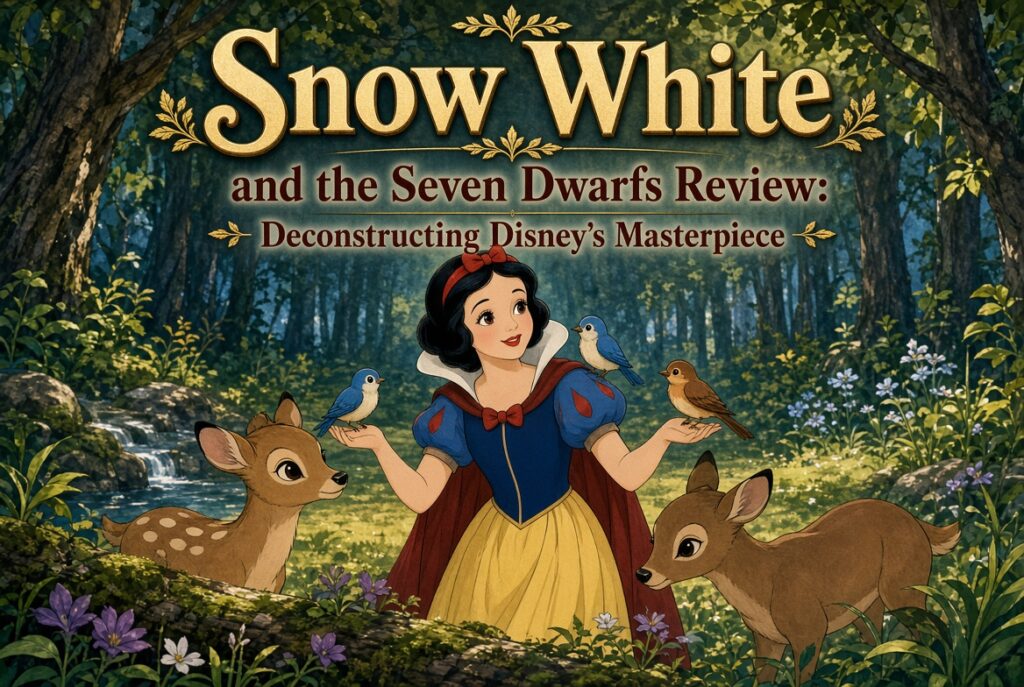
Snow White and the Seven Dwarfs Review: Widely regarded as the holy grail of modern animation history, our Snow White and the Seven Dwarfs review examines how Walt Disney’s 1937 masterpiece shattered industry skepticism to create the world’s first full-length cel-animated feature. Skeptics initially dubbed the production “Disney’s Folly,” predicting that audiences would suffer eye strain from watching bright cartoon animation for 83 minutes. Instead, Snow White and the Seven Dwarfs revolutionized cinema forever, blending emotional storytelling, rich orchestral songs, and groundbreaking technical innovations.
In this comprehensive Snow White and the Seven Dwarfs review, we evaluate how supervising director David Hand and Disney’s legendary “Nine Old Men” elevated animation from cheap theatrical gags into a respected art form. Readers exploring our Snow White and the Seven Dwarfs review will discover why the film’s gothic horror aesthetics, multiplane camera depth, and distinct character personalities remain timeless. Any thorough Snow White and the Seven Dwarfs review must acknowledge its enduring status as a cornerstone of the Golden Age of Animation.
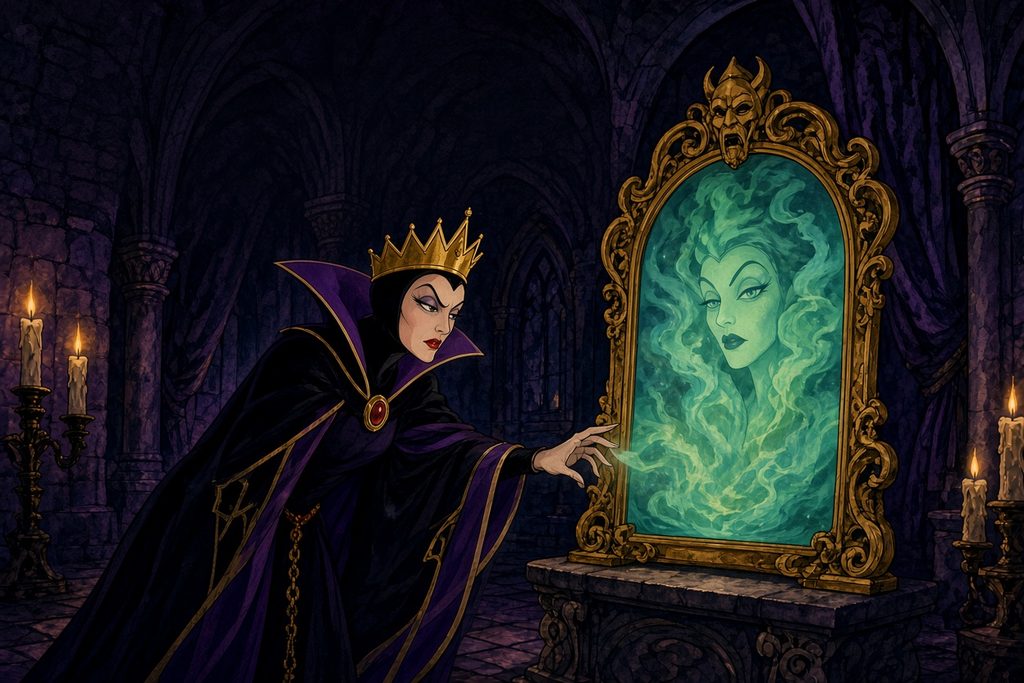
As analyzed throughout this Snow White and the Seven Dwarfs review, the fairy-tale plot follows Snow White, a young princess forced into servitude by her vain stepmother, the Evil Queen. When the Magic Mirror declares Snow White “the fairest in the land,” the Queen orders her execution. Escaping into the haunted forest, Snow White finds refuge in a cozy cottage owned by seven gemstone-mining dwarfs: Doc, Grumpy, Happy, Sleepy, Bashful, Sneezy, and Dopey. This Snow White and the Seven Dwarfs review details how the Queen’s transformation into a terrifying old hag and her poison apple scheme set a high standard for animated villainy.
From the terrifying flight through the dark forest to the joyous “Heigh-Ho” mining sequence, the film maintains a magical rhythm, an achievement we celebrate in this Snow White and the Seven Dwarfs review. As emphasized throughout this Snow White and the Seven Dwarfs review, Adriana Caselotti’s iconic vocal performance gives Snow White pure innocence and warmth. In addition, our Snow White and the Seven Dwarfs review highlights how Frank Churchill and Leigh Harline’s legendary songs continue to charm new generations of viewers.
Whether you are studying film history or revisiting the root of Disney’s legacy, this in-depth Snow White and the Seven Dwarfs review provides all the essential historical and critical insights. Ultimately, this Snow White and the Seven Dwarfs review confirms that Walt Disney created an untouchable classic, making every observation in our Snow White and the Seven Dwarfs review valuable for animation enthusiasts.
Snow White and the Seven Dwarfs Review: Table of Contents
- Quick Facts
- Story and Premise
- Animation and Technical Revolutions
- Voice Cast and Characters
- Direction and Writing
- Music and Sound
- Themes and Messages
- What Works Best
- What Could Improve
- Family Viewing Guide
- Final Verdict
- ToonTycoon Rating Table
- Frequently Asked Questions
Snow White and the Seven Dwarfs Review: Quick Facts
| Detail | Information |
| Film Title | Snow White and the Seven Dwarfs |
| Release Date | December 21, 1937 (Premiere) / February 4, 1938 (General Release) |
| Production Studio | Walt Disney Productions (Distributed by RKO Radio Pictures) |
| Supervising Director | David Hand |
| Adapted From | Schneewittchen (Fairy Tale by the Brothers Grimm) |
| Genre | Animation, Musical, Fantasy, Fairy Tale, Golden Age Classic |
| Runtime | 83 minutes |
| Content Rating | G (Approved for all general audiences) |
| Key Voice Cast | Adriana Caselotti, Lucille La Verne, Roy Atwell, Pinto Colvig, Otis Harlan, Billy Gilbert |
| Main Characters | Snow White / The Evil Queen (Wicked Stepmother) / Doc / Grumpy / Dopey / The Prince |
Snow White and the Seven Dwarfs Review: Story and Premise
A vain and tyrannical Evil Queen wears the crown of a distant kingdom, obsessed with remaining the most beautiful woman in existence. Every day, she consults her enchanted Magic Mirror, asking who is the “fairest one of all”. For years, the mirror names the Queen, until Princess Snow White comes of age and her gentle beauty surpasses her stepmother’s.
Enraged by jealousy, the Queen commands her Huntsman to take Snow White deep into the forest, kill her, and return her heart in a locked iron box. Unable to harm the innocent princess, the Huntsman urges Snow White to flee and never return. Terrified, Snow White runs into the dark woods, where clutching branches and looming shadows transform the forest into a nightmare.
Exhausted, she collapses and wakes up surrounded by friendly woodland animals who guide her to a charming, messy cottage hidden in a clearing. The cottage belongs to seven gem-mining dwarfs who spend their days digging for diamonds in a nearby mountain. Upon returning home, the dwarfs discover Snow White and agree to protect her in exchange for her housekeeping and cooking. However, when the Magic Mirror reveals that Snow White is still alive, the Queen uses dark alchemy to transform into a haggard peddler woman, crafting a poisoned apple to plunge Snow White into the “Sleeping Death”.
Snow White and the Seven Dwarfs Review: Animation and Technical Revolutions
Snow White and the Seven Dwarfs established the technological and artistic foundation for modern feature animation:
- The Multiplane Camera: Invented by William Garity for the Disney Studio, this massive multi-tiered camera allowed artists to shoot multiple layers of artwork at varying distances, creating genuine three-dimensional visual depth in forest and cottage shots.
- Rotoscoping & Realistic Human Motion: Animators like Hamilton Luske used live-action reference footage (featuring dancer Marge Champion) to study realistic weight, cloth movement, and anatomy for Snow White and the Prince.
- Technicolor 3-Strip Process: Disney utilized the cutting-edge Technicolor process, giving the film vibrant, hand-painted color saturation ranging from warm cottage lighting to cold, eerie dungeon hues.
- Subtle Character Acting: Animators gave each dwarf distinct physical mechanics—Doc’s flustered posture, Grumpy’s crossed arms, and Dopey’s wide-eyed, ear-wiggling innocence.
Voice Cast and Characters
- Snow White (Adriana Caselotti): Caselotti infuses the princess with Operatic, classical 1930s vocal tones, bringing gentleness, optimism, and regal charm.
- The Evil Queen / The Witch (Lucille La Verne): La Verne delivers a duality in vocal performance—shifting from cold, stately menace as the Queen to a raspy, cackling terror as the Old Witch.
- Grumpy & Sleepy (Pinto Colvig): Colvig gives Grumpy a rough, stubborn exterior that slowly melts into profound tenderness.
- Doc (Roy Atwell): Atwell provides hilarious, bumbling energy through Doc’s signature spoonerisms and mixed-up speech patterns.
- Dopey (Mute): Communicates purely through pantomime, physical comedy, and floppy ears, creating one of animation’s most beloved mute characters.
Direction and Writing
Under Walt Disney’s personal supervision, supervising director David Hand and sequence directors organized the film around emotional arcs rather than simple gag reels. The writing staff adapted the Brothers Grimm fairy tale by expanding the dwarfs’ personalities from interchangeable background figures into the emotional core of the film. The directors balanced suspense, slapstick cleaning montages, and gothic horror, demonstrating that animated movies could evoke fear, sorrow, and joy in equal measure.
Music and Sound
- Integrated Musical Storytelling: Composers Frank Churchill, Leigh Harline, and Paul Smith made history by writing songs that actively moved the narrative forward rather than pausing the action.
- Iconic Songs: Timeless classics like “Heigh-Ho,” “Whistle While You Work,” “Someday My Prince Will Come,” and “With a Smile and a Song” became major cultural pop standards.
- Symphonic Score: The orchestral backing uses leitmotifs, assigning specific musical instruments to individual dwarfs and dark bass tones to the Queen’s mirror.
Themes and Messages
- Inner Beauty vs. Vain Obsession: Contrasts Snow White’s kindness with the Queen’s self-destructive obsession with external looks.
- Community and Hospitality: Shows how a clean home, warm food, and mutual respect transform strangers into a loving family.
- Light Over Darkness: Demonstrates that innocence and hope can triumph over dark magic and malice.
What Works Best
- Historic Artistic Craft: Beautiful hand-painted watercolor backgrounds evoke European storybook illustrations.
- Masterclass Villainy: The Queen’s terrifying transformation scene remains one of the scariest moments in animation history.
- Unforgettable Character Designs: Each dwarf is instantly recognizable through body language, facial structure, and color coding.
- Timeless Soundtrack: The musical score set the standard for every Disney animated musical that followed.
- Emotional Resonance: Snow White’s funeral scene evokes genuine emotion, proving animation’s power to move adult audiences.
What Could Improve
- Passive Heroine Trait: Modern viewers may find Snow White’s reliance on the Prince to save her slightly dated compared to modern heroines.
- The Prince is Underdeveloped: Prince Florian appears briefly at the beginning and end, serving as a plot device rather than a fully realized character.
Family Viewing Guide
- Recommended Age: 5+ years old. A classic for all generations, though sensitive young children may need reassurance during dark scenes.
- Scary or Intense Scenes: The forest flight sequence (with trees turning into monsters), the Queen’s cauldron transformation, and the thunderstorm cliff climax are genuinely intense.
- Violence and Action: The Huntsman drawing his dagger, a vulture stalking the Witch, and the Witch falling off a cliff during a storm.
- Positive Messages: Promotes generosity, hard work, optimism, kindness to animals, and friendship.
Final Verdict
ToonTycoon Verdict: Essential Masterpiece
Snow White and the Seven Dwarfs is not merely an important historical artifact; it is a timeless cinematic masterpiece. With groundbreaking animation, unforgettable character acting, and a magical soundtrack, Walt Disney’s first feature film remains an essential viewing experience for every film and animation lover.
ToonTycoon Rating Table
| Category | Rating |
| Animation & Technical Innovation | 10/10 |
| Story & Screenplay | 9.2/10 |
| Characters & Vocal Performance | 9.5/10 |
| Music & Orchestral Score | 9.8/10 |
| Historical Legacy & Entertainment | 10/10 |
| Overall ToonTycoon Rating | 9.7/10 |
ToonTycoon Verdict: Essential Masterpiece
Frequently Asked Questions
Was Snow White the first animated movie ever made?
While feature-length animated films existed earlier in film history (such as Lotte Reiniger’s silhouette film The Adventures of Prince Achmed in 1926), Snow White and the Seven Dwarfs was the first full-length feature film made using traditional cel animation, Technicolor, and synchronized sound.
Why was Snow White called “Disney’s Folly”?
Before its release, film critics and industry insiders believed no audience would sit through an 83-minute cartoon, predicting the expensive production would bankrupt Walt Disney’s studio.
Where can I stream Snow White and the Seven Dwarfs?
The original 1937 film is available to stream exclusively on Disney+ in 4K restored quality.