
Transforming a gritty, black-and-white indie comic book into a global Saturday morning phenomenon, our Teenage Mutant Ninja Turtles review examines how Murakami-Wolf-Swenson and Playmates Toys redefined youth culture in 1987. Running for 10 iconic seasons across nearly a decade, this TV-Y7 rated animated series replaced graphic violence with lighthearted ninja action, pizza-loving humor, and an unforgettable brotherhood that captured the imagination of millions of kids worldwide.
In this comprehensive Teenage Mutant Ninja Turtles review, we evaluate how writers David Wise and Patti Howeth softened the source material into a colorful, merchandise-ready powerhouse without losing its charm. Readers diving into our Teenage Mutant Ninja Turtles review will discover why Leonardo, Raphael, Donatello, Michelangelo, and Master Splinter remain timeless heroes across generations. Any thoughtful Teenage Mutant Ninja Turtles review must praise Fred Wolf’s dynamic animation style, Chuck Lorre’s legendary theme song, and the perfect voice ensemble that brought New York City’s sewers to life.
As evaluated throughout this Teenage Mutant Ninja Turtles review, the story begins when four pet turtles are exposed to a glowing alien mutagen in the New York sewers. Under the guidance of Master Splinter—a mutated former ninja master named Hamato Yoshi—the quartet is raised in martial arts and human pop culture. Joined by intrepid Channel 6 news reporter April O’Neil, the brothers constantly clash with the evil Foot Clan. Led by the razor-clad Shredder and the brain-like alien warlord Krang from Dimension X, the villains scheme to power their terrifying mobile fortress, the Technodrome.
From skateboarding through underground pipes to stopping mutant rhinos and warthogs, the series maintains a lively comedic tempo, an achievement we honor in this Teenage Mutant Ninja Turtles review. As we emphasize throughout this Teenage Mutant Ninja Turtles review, voice talents Cam Clarke, Rob Paulsen, Barry Gordon, and Townsend Coleman give distinct vocal identities to each brother. In addition, our Teenage Mutant Ninja Turtles review breaks down how the show pioneered 1980s toy-driven animation while delivering valuable lessons about family unity, resourcefulness, and standing up to bullies.
A deeper look in our Teenage Mutant Ninja Turtles review reveals how the show successfully adapted mature comic themes into accessible family entertainment. As noted in every Teenage Mutant Ninja Turtles review from the era, the series revolutionized cartoon branding. Furthermore, this Teenage Mutant Ninja Turtles review emphasizes how the show’s humor balanced high-stakes sci-fi adventures with grounded brotherly squabbles. Fans reading our Teenage Mutant Ninja Turtles review will appreciate how each turtle’s weapon choice reflects their unique personality. In this Teenage Mutant Ninja Turtles review, we also analyze how the villains added essential comedic relief.
Whether you are revisiting the roots of Turtlemania or introducing young cartoon fans to the 1987 original, this detailed breakdown in our Teenage Mutant Ninja Turtles review highlights why the series remains an essential watch. Our complete Teenage Mutant Ninja Turtles review explores how the legacy of the original cartoon continues to influence modern animation. Ultimately, this Teenage Mutant Ninja Turtles review confirms that the 1987 classic established a lasting legacy, making every observation in our Teenage Mutant Ninja Turtles review valuable for Saturday morning animation fans. Anyone seeking an honest Teenage Mutant Ninja Turtles review will find that the 1987 series holds up remarkably well as a pop-culture landmark.
Teenage Mutant Ninja Turtles review: Table of Contents
- Quick Facts
- Story and Premise
- Animation and Visual Style
- Voice Cast and Characters
- Direction and Writing
- Music and Sound Design
- Themes and Messages
- What Works Best
- What Could Improve
- Family Viewing Guide
- Final Verdict
- ToonTycoon Rating Table
- Frequently Asked Questions
Quick Facts
| Detail | Information |
| Show Title | Teenage Mutant Ninja Turtles |
| Original Run | 1987–1996 (10 Seasons, 193 Episodes) |
| Production Studios | Murakami-Wolf-Swenson (Fred Wolf Films), IDDH, Playmates Toys |
| Developed By | David Wise, Patti Howeth |
| Based On | TMNT Comic Books by Kevin Eastman and Peter Laird |
| Genre | Retro Animation, Superhero, Action, Comedy, Saturday Morning Classic |
| Episode Runtime | ~22 minutes per episode |
| Content Rating | TV-Y7 / PG (Approved for general kid & family audiences) |
| Main Voice Cast | Cam Clarke, Rob Paulsen, Barry Gordon, Townsend Coleman, Peter Renaday, James Avery |
| Main Characters | Leonardo / Raphael / Donatello / Michelangelo / Master Splinter / April O’Neil / Shredder / Krang |
Story and Premise
When four ordinary pet turtles are dropped into the New York City sewers and covered in a mysterious glowing ooze, they undergo a startling mutation into humanoid reptiles. They are discovered and adopted by Hamato Yoshi, a disgraced Japanese ninja master who was also mutated by the ooze into a giant bipedal rat named Master Splinter. Naming his adopted sons after Renaissance artists—Leonardo, Raphael, Donatello, and Michelangelo—Splinter trains them in Ninjutsu while instilling values of discipline, secrecy, and brotherly support.
Emerging from the sewers to grab late-night pepperoni pizzas, the brothers rescue Channel 6 investigative reporter April O’Neil from street thugs. April becomes their human ambassador, helping them track down the criminal empire known as the Foot Clan.
The gang is led by Yoshi’s arch-rival Oroku Saki, known as the Shredder, who has allied himself with Krang—a disembodied alien brain exiled from Dimension X. Operating from the massive, treaded Technodrome fortress, Shredder and Krang employ mutated punk henchmen Bebop and Rocksteady to steal energy sources, build bizarre weapons, and conquer Earth. Equipped with their Turtle Van, Blimp, and trusty weapons, the four brothers ride to the rescue every Saturday morning.
Animation and Visual Style
Producer Fred Wolf and his animation team crafted a brightly colored aesthetic that defined late 80s television:
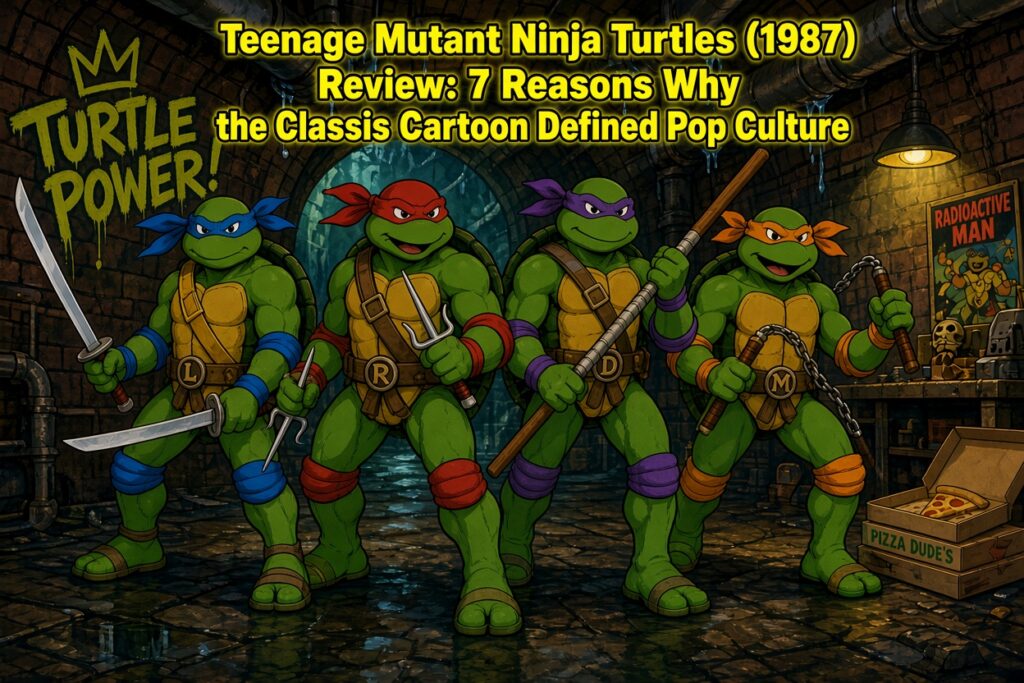
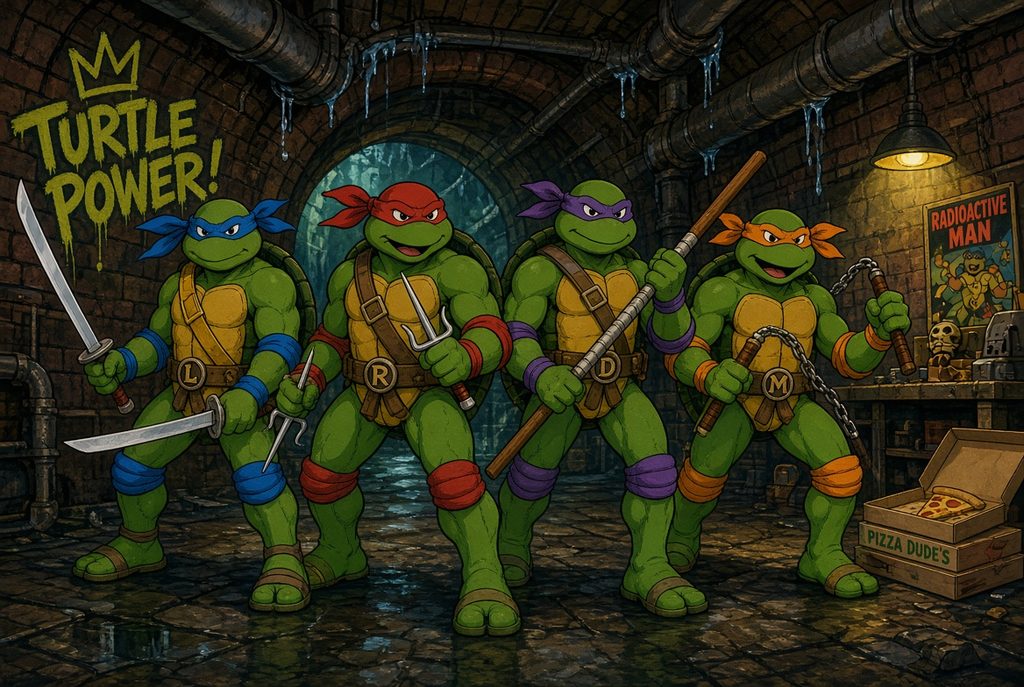
- Distinct Color-Coded Designs: Unlike the original comics where all four turtles wore identical red bandanas, the 1987 show assigned unique bandana colors (Blue, Red, Purple, Orange) and belt-buckle initials, making characters instantly readable for young viewers.
- Kinetic Ninja Choreography: Action scenes feature fluid leaps, staff spins, and acrobatic dodges that emphasize evasive slapstick movement over graphic sword or weapon strikes.
- Gothic Sci-Fi Environments: Blends gritty New York street alleyways and misty sewers with alien tech, glowing portals, and the eye-topped iron dome of the Technodrome.
Voice Cast and Characters
- Leonardo (Cam Clarke): Clarke gives the katana-wielding leader a disciplined, serious, and responsible voice that grounds the team’s operations.
- Raphael (Rob Paulsen): Paulsen brings legendary sarcastic wit, dry fourth-wall breaks, and fiery attitude to the sai-wielding rebel.
- Donatello (Barry Gordon): Gordon infuses the bo-staff-wielding tech genius with warm, nerdy curiosity, making him the gadget builder behind the Turtle Van.
- Michelangelo (Townsend Coleman): Coleman delivers the ultimate California surfer-bro energy, creating iconic catchphrases like “Cowabunga!” and “Booyakasha!”
- Shredder (James Avery) & Krang (Pat Fraley): The Fresh Prince of Bel-Air star James Avery gives Shredder commanding threat mixed with comical frustration, perfectly paired with Pat Fraley’s gurgling alien voice.
Direction and Writing
Head writer David Wise created an episodic formula that relied on fast-paced adventure, sci-fi concepts, and pop-culture satire. The direction balances superhero action with comedy—ensuring that even when the fate of New York hangs in the balance, Michelangelo will find time to order a pizza with anchovies and peanut butter.
Music and Sound Design
- Legendary Theme Song: Co-written by future sitcom giant Chuck Lorre and Dennis C. Brown, the high-energy theme song (“Heroes in a Half-Shell – Turtle Power!”) is universally recognized as one of the greatest TV themes in history.
- Synth-Action Score: Upbeat 1980s synthesizers and electric guitars drive every chase sequence, sewer run, and Technodrome confrontation.
Themes and Messages
- Brotherhood and Unity: Emphasizes that despite different personalities and occasional arguments, family always sticks together.
- Acceptance and Judgement: Shows that true heroes are defined by their actions and character rather than their physical appearance.
- Brainpower and Teamwork: Demonstrates that Donatello’s intellect and Splinter’s wisdom are just as essential to victory as physical martial arts skills.
What Works Best
- Unrivaled Pop-Culture Influence: Established the global template for turtle-mania, action figure lines, and video games.
- Iconic Voice Chemistry: The vocal interplay between the four brothers and Shredder/Krang remains unmatched.
- Memorable Character Roster: Introduced beloved side characters like Casey Jones, Leatherhead, Usagi Yojimbo, and Baxter Stockman.
- Catchy Comedic Rhythm: Packed with memorable catchphrases, dry jokes, and fun fourth-wall breaks.
- Vibrant World-Building: Effortlessly blends street-level crime fighting with high-concept sci-fi portals and alien dimensions.
What Could Improve
- Inconsistent Animation Quality: Outsources across different animation studios caused occasional visual errors and color mistakes in background frames.
- Repetitive Villain Schemes: Later middle seasons occasionally relied on predictable “energy theft” plotlines for Shredder and Krang.
Family Viewing Guide
- Recommended Age: 6+ years old. Perfect for elementary kids, nostalgic parents, and Saturday morning cartoon marathons.
- Violence and Action: Broad cartoon martial arts—swords slice robot Foot soldiers, laser blasts hit walls, and furniture gets smashed. Zero blood or graphic injury.
- Scary or Intense Scenes: Mutations, giant insect monsters, and Krang’s alien android body are handled with broad comedic humor.
- Language: Rated TV-Y7. 100% clean retro dialogue filled with 80s slang (“Bummer!”, “Tubular!”, “Cowabunga!”).
- Positive Messages: Promotes teamwork, protecting your city, listening to elders, and valuing each friend’s unique strengths.
Final Verdict
ToonTycoon Verdict: Essential Retro Classic
The 1987 Teenage Mutant Ninja Turtles series is a milestone in television history. Combining incredible character designs, timeless voice acting, an iconic soundtrack, and endless heart, it set the gold standard for Saturday morning action-comedy animation.
ToonTycoon Rating Table
| Category | Rating |
| Animation & Visual Style | 8.8/10 |
| Story & Comedy Writing | 9.0/10 |
| Characters & Voice Acting | 9.7/10 |
| Music & Theme Song | 9.9/10 |
| Pop Culture & Nostalgia | 10/10 |
| Overall ToonTycoon Rating | 9.5/10 |
ToonTycoon Verdict: Essential Retro Classic
Frequently Asked Questions
Is the 1987 Teenage Mutant Ninja Turtles cartoon suitable for young kids?
Yes! Rated TV-Y7, the 1987 show was specifically rewritten to be kid-friendly, replacing graphic comic violence with light slapstick martial arts, comedic villains, and fun pizza jokes.
Who sang the original TMNT cartoon theme song?
The famous theme song was co-written by television producer Chuck Lorre (creator of The Big Bang Theory) and Dennis C. Brown, sung by James Mandell.
Where can I stream the original 1987 TMNT cartoon?
The classic 1987 series is available to stream on digital platforms like Paramount+, Nickelodeon, and digital storefronts like Prime Video.