
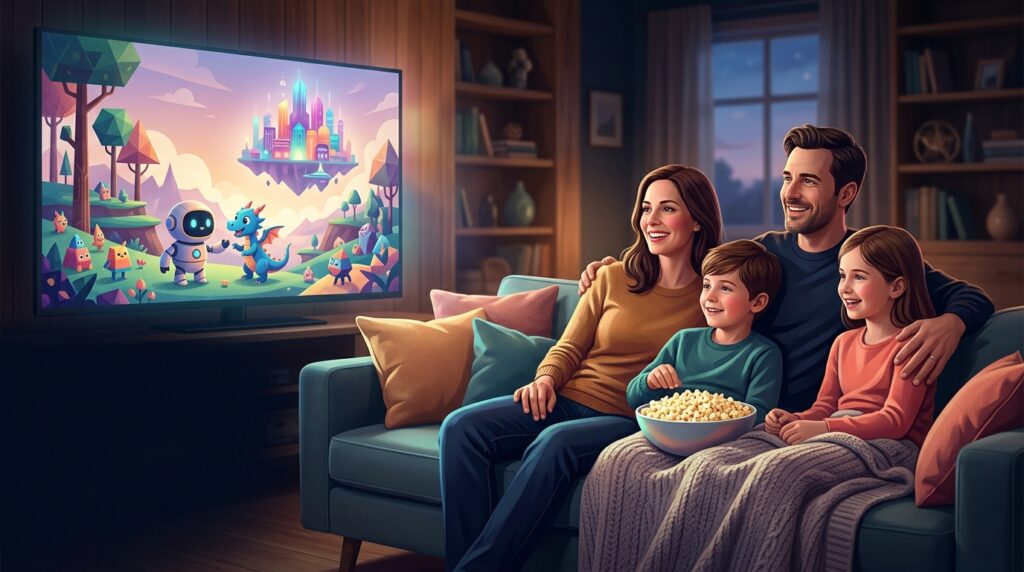
In Family movie night we are bringing , 10 animated movies parents will enjoy watching with Kids sounds wonderful in theory. Everyone settles onto the sofa, the popcorn comes out, and a promising animated film begins. Twenty minutes later, the children are laughing at something involving bodily noises while the adults quietly wonder whether the laundry would be more entertaining.
Fortunately, animated movies have come a long way from stories that rely entirely on bright colours, predictable jokes, and relentlessly cheerful characters. Some of the best films in the genre are clever enough to entertain children while giving their parents something more substantial to enjoy: sharp dialogue, emotional complexity, visual creativity, and jokes that land differently depending on your age.
The trick is finding movies that respect both audiences. Children need adventure, memorable characters, and humour they can understand. Adults appreciate clever writing, meaningful themes, and the occasional joke that goes over a child’s head without making the film inappropriate for them.
For this list, we have selected ten animated movies that offer something for the entire family. From nostalgic hand-crafted animation to inventive modern adventures, these films prove that family entertainment does not have to feel like a compromise.
What Makes an Animated Movie Enjoyable for Parents and Kids?
Before choosing a film, it helps to understand why certain animated movies work so well across generations.
- Two layers of humour: Children enjoy physical comedy and visual surprises, while adults catch the sarcasm, social observations, and clever dialogue.
- Characters with real personalities: The best characters have flaws, ambitions, fears, and relationships that feel believable.
- Themes that grow with the viewer: Friendship, family, ambition, grief, and growing up can mean different things at different ages.
- Distinctive animation: Whether a film uses traditional hand-drawn art, stop-motion, or modern computer animation, a recognisable visual style makes the experience more memorable.
- A story that respects your time: Strong pacing and purposeful storytelling make a film enjoyable for adults without sacrificing the fun children came for.
With those qualities in mind, here are ten films worth adding to your next family movie night.
1. The Incredibles (2004): A Superhero Movie with a Midlife Crisis
Best for: Families who enjoy action, family comedy, and stories about balancing responsibilities.
Pixar’s The Incredibles begins with a wonderfully simple question: what happens when superheroes are forced to live ordinary lives?
Bob Parr, once celebrated as the superhero Mr. Incredible, now struggles with office work, family responsibilities, and the feeling that his best days might be behind him. His wife, Helen, has her own challenges, while their children are discovering powers that make growing up even more complicated.
For children, the film delivers superhero battles, spectacular gadgets, secret identities, and a villain with a memorable grudge. Adults may recognise something more familiar: the frustration of an unfulfilling job, the pressure to provide for a family, and the difficulty of balancing personal ambitions with parental responsibilities.
The humour is particularly effective because it grows naturally from the characters. Bob’s attempts to recapture his glory days are funny, but they also reveal his insecurity. Helen’s determination to protect her family makes her more than a supporting character in her husband’s story.
Why parents will enjoy it: It treats marriage, work, identity, and family life as meaningful parts of the adventure rather than distractions from it.
Family discussion starter: Is being good at something enough reason to pursue it if it affects the people who depend on you?
Parent note: Expect superhero violence, peril, explosions, and some frightening moments. Consider your child’s sensitivity to action and danger.
2. Shrek (2001): A Fairy Tale That Knows Fairy Tales Are Ridiculous
Best for: Families who appreciate sarcasm, fairy-tale references, and playful humour.
Before animated films routinely poked fun at their own conventions, Shrek arrived with an ogre who wanted nothing more than to be left alone in his swamp.
Naturally, his plans fall apart.
The film brings together familiar fairy-tale characters, a reluctant hero, an unconventional princess, and a talkative donkey who has very little respect for personal space. Children can enjoy the silly characters, slapstick, and colourful adventure, while adults discover a steady stream of jokes about fairy-tale clichés, celebrity culture, and the absurdity of judging people by their appearance.
Yet the film’s lasting appeal goes beyond its jokes. Shrek’s gruff exterior hides a character who expects rejection and uses isolation to protect himself. Fiona also challenges the familiar idea that a happy ending must involve becoming someone society considers beautiful.
That gives the story a surprisingly thoughtful message about self-acceptance and the difference between appearance and character.
Why parents will enjoy it: The satire remains entertaining because the film has genuine affection for its characters, even when it is making fun of the stories they inhabit.
Family discussion starter: Why do people sometimes hide their real selves when they are afraid of being rejected?
Parent note: The film contains mild crude humour, some suggestive jokes, fantasy violence, and language that parents may wish to review for younger children.
3. Toy Story (1995): The Childhood Classic That Grows Up with You
Best for: Families who enjoy friendship stories, nostalgia, and timeless adventures.
When Toy Story introduced audiences to a world where toys come alive when humans are not looking, it created a wonderfully imaginative premise. But its real strength lies in the relationship between Woody, Andy’s favourite toy, and Buzz Lightyear, the new arrival who threatens Woody’s position.
Children can enjoy the toy-sized adventure, comic misunderstandings, and the idea that their own toys might have secret lives. Adults may recognise the more uncomfortable emotions underneath the comedy: jealousy, insecurity, fear of being replaced, and the difficulty of accepting change.
Woody is not always noble. He can be possessive and unfair, which makes his eventual growth more meaningful. Buzz, meanwhile, must confront the difference between the identity he believes he has and the reality he faces.
The film also carries a particular kind of nostalgia for parents who watched it growing up. Its original computer animation now has a distinctive period charm, offering a glimpse of an important turning point in animated filmmaking.
Why parents will enjoy it: Its emotional story is simple enough for children to follow but honest enough to resonate with adults who have experienced changing friendships and life transitions.
Family discussion starter: How can you handle feeling jealous when someone new receives attention?
Parent note: There are scenes involving peril, separation, and a frightening toy-like character. Some younger children may find these sequences unsettling.
4. Ratatouille (2007): A Delicious Story About Talent and Taking Risks
Best for: Families who enjoy food, ambition, creativity, and underdog stories.
A rat who dreams of becoming a chef sounds like the setup for a silly animated comedy. In Ratatouille, however, that unusual idea becomes the foundation for a thoughtful story about talent, prejudice, and the courage to pursue an unlikely dream.
Remy has an extraordinary sense of smell and taste, but his ambitions conflict with the expectations of his rat family. His unlikely partnership with Linguini, a young kitchen worker with little culinary ability, gives him an opportunity to demonstrate what he can do.
Children will enjoy the frantic kitchen sequences, secret cooking arrangements, and the comedy of a rat trying to survive in a restaurant. Adults can appreciate the film’s observations about professional ambition, artistic standards, and the way established institutions sometimes dismiss talent because it comes from an unexpected place.
The film’s memorable critic, Anton Ego, also gives the story a deeper dimension. His relationship with food illustrates how a single experience can reconnect someone with memories and emotions they thought they had left behind.
And yes, the food animation is genuinely impressive. It may leave everyone looking for something good to eat afterwards.
Why parents will enjoy it: It celebrates creativity without pretending that talent alone removes every obstacle.
Family discussion starter: Should people be judged by where they come from, or by the quality of what they can do?
Parent note: The film contains kitchen-related peril, chase sequences, and brief moments of threat. It is also likely to make children hungry.
5. Spider-Man: Into the Spider-Verse (2018): A Superhero Film That Breaks the Rules
Best for: Families with older children who enjoy superheroes, music, comic books, and visually inventive storytelling.
Most superhero origin stories follow a familiar formula. A hero discovers new abilities, makes mistakes, and eventually learns what it means to take responsibility. Spider-Man: Into the Spider-Verse uses that structure but gives it a fresh visual language and a more personal emotional centre.
Miles Morales is a teenager trying to understand his place in the world. His journey becomes more complicated when he encounters other versions of Spider-Man from different dimensions, each bringing a different personality, history, and set of problems.
For younger viewers, the film offers spectacular action, funny character combinations, colourful animation, and a soundtrack that gives the story its own energy. Adults can appreciate its comic-book-inspired visual design, playful storytelling, and reflections on identity, expectations, and the pressure to live up to a legacy.
Its central message is particularly valuable: becoming a hero does not require copying someone else’s journey.
The animation deserves special attention. Halftone textures, exaggerated movement, comic-book effects, and different visual treatments make the film feel like a living graphic novel rather than a conventional computer-animated production.
Why parents will enjoy it: It combines genuine emotional development with a bold artistic style that rewards viewers who pay attention to the details.
Family discussion starter: What does it mean to become your own person while learning from people you admire?
Parent note: This film includes sustained superhero violence, intense peril, frightening villains, and emotionally difficult moments. It may be better suited to older or more action-tolerant children.
6. Fantastic Mr. Fox (2009): A Clever Little Film for the Whole Family
Best for: Families who appreciate dry humour, unusual characters, and distinctive stop-motion animation.
Wes Anderson’s Fantastic Mr. Fox is not your typical animated family adventure. Its handmade appearance, carefully arranged compositions, and deadpan dialogue give it a personality that stands apart from mainstream computer animation.
Mr. Fox is a charming but impulsive character who struggles to leave his old habits behind after promising his family a safer life. His desire for excitement leads him into conflict with three farmers, putting his family and community at risk.
Children can follow the chase, animal antics, and clever escapes. Adults may find themselves laughing at the film’s dry delivery, awkward conversations, domestic tensions, and the way the characters treat their personal insecurities as serious matters.
The stop-motion animation is another reason to watch. The textured fur, miniature sets, expressive movements, and deliberately handmade feel give the film a warmth that polished digital imagery does not always reproduce.
Underneath its humour, the story asks whether growing up means abandoning who you are or learning to take responsibility for the consequences of your choices.
Why parents will enjoy it: It trusts the audience to appreciate subtle jokes and characters who are entertaining precisely because they are imperfect.
Family discussion starter: When does following your instincts become selfish if other people have to deal with the consequences?
Parent note: There is peril, hunting-related danger, and some rude humour. Its slower, drier style may appeal more to some children than others.
7. How to Train Your Dragon (2010): An Adventure About Courage Without Cruelty
Best for: Families who love fantasy, flying adventures, friendship, and emotional storytelling.
Hiccup lives in a Viking community where fighting dragons is considered a necessary part of growing up. Unfortunately, he is not particularly suited to the traditional idea of a fearless dragon-slayer.
His life changes when he encounters an injured dragon and begins to understand that the creatures his community fears may be more complicated than anyone realises.
Children will find plenty to enjoy in the flight sequences, dragon designs, humour, and adventure. Adults can appreciate the film’s exploration of empathy, prejudice, parental expectations, and the courage required to question the beliefs of an entire community.
The relationship between Hiccup and Toothless is the heart of the story. Their friendship develops through patience and trust rather than domination. Hiccup learns that understanding a creature is often more useful than trying to defeat it.
The flying scenes also remain remarkably effective, using music, movement, and sweeping landscapes to create a sense of freedom that feels genuinely cinematic.
Why parents will enjoy it: It presents empathy as a form of courage and shows that challenging a harmful tradition can be harder than following it.
Family discussion starter: Can you be brave while refusing to do what everyone else expects?
Parent note: The film includes fantasy battles, frightening creatures, injuries, and emotionally intense scenes. Some children may find the danger upsetting.
8. Inside Out (2015): The Film That Makes Feelings Easier to Talk About
Best for: Families who want entertainment that opens up conversations about emotions and growing up.
Few animated films have found such an imaginative way to explore a child’s inner life. Inside Out turns Riley’s emotions into characters living inside her mind, transforming an abstract subject into an accessible adventure.
Joy wants Riley to remain happy. Sadness seems to complicate everything. Fear, Anger, and Disgust each have their own ideas about keeping Riley safe and comfortable.
Children can enjoy the colourful world inside Riley’s mind and the contrasting personalities of the emotions. Adults may recognise the deeper point: a happy life is not one in which sadness disappears, but one in which different emotions have a place.
The film is especially effective at showing how growing up can change the way people understand their memories, relationships, and sense of identity. Its humour keeps the story engaging without making the emotional material feel like a lecture.
For parents, it can also provide useful language for conversations that are otherwise difficult to begin.
Why parents will enjoy it: It treats emotional development with intelligence and warmth, making the film meaningful for adults as well as children.
Family discussion starter: Why might feeling sad sometimes help us understand what we need?
Parent note: The film includes emotional distress, separation, frightening imaginary scenarios, and moments of sadness. Children experiencing major changes may relate strongly to its themes.
9. Kiki’s Delivery Service (1989): A Gentle Reminder That Growing Up Takes Time
Best for: Families who prefer gentle fantasy, beautiful hand-drawn animation, and stories about independence.
Not every family movie needs a villain threatening the world. Sometimes the most relatable adventure involves a young person trying to figure out how to live independently.
In Studio Ghibli’s Kiki’s Delivery Service, a young witch leaves home to spend a year living on her own. She settles in a seaside town and starts a delivery service using her flying ability. At first, everything feels exciting. Gradually, however, the responsibilities of independence become more complicated.
Children can enjoy the magic, charming characters, flying sequences, and everyday adventures. Adults may connect with Kiki’s struggle to maintain confidence when a skill that once came naturally begins to feel difficult.
The film’s hand-drawn animation gives the town a lived-in quality. Bakeries, streets, coastlines, and ordinary domestic spaces feel inviting without being overly polished. The story finds wonder in everyday life rather than relying on constant spectacle.
It also handles exhaustion and self-doubt with unusual sensitivity. Kiki does not solve every problem by simply trying harder; she has to rest, reconnect with others, and rediscover her motivation.
Why parents will enjoy it: It offers a thoughtful perspective on independence, creative confidence, and the importance of allowing yourself time to grow.
Family discussion starter: What can you do when something you once enjoyed starts to feel difficult?
Parent note: The film includes moments of peril and anxiety, but its overall tone is gentle. It can be a good choice for families looking for a quieter movie night.
10. The LEGO Movie (2014): A Surprisingly Smart Comedy About Thinking for Yourself
Best for: Families who love fast-paced humour, creative play, and stories that question conformity.
At first glance, The LEGO Movie appears to be a feature-length adventure built around a popular toy. Its protagonist, Emmet, is an ordinary construction worker who follows instructions, enjoys routine, and rarely questions the world around him.
Then he is mistaken for an extraordinary figure destined to save everyone.
The film builds a fast-moving comedy around that premise, filled with visual gags, unexpected characters, pop-culture references, and an energetic soundtrack. Children can enjoy the action and the playful world built from LEGO bricks. Adults may appreciate its satire of conformity, consumer culture, workplace routines, and the temptation to believe that every problem has a single correct solution.
Its greatest strength is the way it connects imaginative play with the idea of creativity. The story celebrates both people who follow a plan and people who improvise, suggesting that collaboration is often more valuable than insisting on one approach.
The animation is particularly effective at recreating the texture and movement of LEGO pieces while making the world feel dynamic and expressive.
Why parents will enjoy it: Beneath the rapid-fire jokes lies a warm argument for imagination, independent thinking, and allowing people to contribute in different ways.
Family discussion starter: Is following instructions always the best approach, or are there times when you need to think differently?
Parent note: Expect frequent action, cartoon violence, peril, and rapid visual changes. Some younger children may find the pace overwhelming.
The Best Animated Movies for Family Movie Night: Quick Comparison
Not every film suits every family or every mood. Use this guide to choose the right one for tonight.
| Movie | Best quality | What adults may appreciate | Overall mood |
|---|---|---|---|
| The Incredibles | Superhero adventure | Work-life balance and family dynamics | Exciting |
| Shrek | Fairy-tale comedy | Satire and clever dialogue | Cheeky |
| Toy Story | Timeless friendship | Nostalgia and emotional growth | Heartwarming |
| Ratatouille | Creative ambition | Art, talent, and professional life | Inspiring |
| Into the Spider-Verse | Visual innovation | Identity and comic-book artistry | Energetic |
| Fantastic Mr. Fox | Stop-motion charm | Dry humour and flawed characters | Quirky |
| How to Train Your Dragon | Fantasy adventure | Empathy and challenging prejudice | Sweeping |
| Inside Out | Emotional storytelling | Psychology and growing up | Thoughtful |
| Kiki’s Delivery Service | Gentle fantasy | Confidence and independence | Relaxing |
| The LEGO Movie | Fast-paced comedy | Creativity and conformity | Playful |
Age suitability varies by child, and the notes above are not a substitute for checking a film’s official rating and detailed content guidance.
How to Choose the Right Movie for Your Family
A great film can still be the wrong choice for a particular evening. A child who loves superhero battles might find a slow, gentle fantasy boring, while another may prefer it to anything involving explosions.
Here is a simple way to narrow the list.
If you want everyone laughing
Start with Shrek or The LEGO Movie. Both rely on playful absurdity and layered humour, although their jokes and pacing may suit different ages.
If you want a meaningful conversation afterwards
Choose Inside Out for emotional awareness, The Incredibles for family responsibilities, or How to Train Your Dragon for empathy and prejudice.
If you want to introduce children to animation as an art form
Try Fantastic Mr. Fox for stop-motion craftsmanship, Kiki’s Delivery Service for hand-drawn storytelling, or Spider-Man: Into the Spider-Verse for an inventive comic-book visual style.
If your child is growing more independent
Kiki’s Delivery Service, Toy Story, and Ratatouille all explore change, confidence, and finding your own path in different ways.
If your child is sensitive to frightening scenes
Consider the gentler tone of Kiki’s Delivery Service, while still checking its perilous moments. Some of the superhero and fantasy films on this list contain intense action, frightening villains, or emotionally difficult scenes.
How to Make Family Movie Night More Enjoyable
Choosing the right movie is only half the job. A few small changes can turn ordinary screen time into a shared family experience.
- Let the children have a say. Offer two or three suitable options rather than making the decision entirely for them.
- Skip the lecture. Enjoy the story first. If a meaningful topic comes up naturally, discuss it without turning the film into a classroom lesson.
- Notice different reactions. Ask which character each person liked most and why. Children often notice details adults overlook.
- Keep the phones away. Watching together is more rewarding when everyone is actually present.
- Follow the film with a simple activity. Draw a favourite character, recreate a scene with toys, cook something inspired by the story, or invent an alternative ending.
Most importantly, remember that the point is to spend time together. You do not need to extract a moral lesson from every film or agree that every joke is funny.
Frequently Asked Questions
What is the best animated movie for parents to watch with their kids?
There is no universal winner, but The Incredibles, Toy Story, and Ratatouille are excellent starting points because they combine accessible adventures with meaningful themes and humour that appeals to adults.
Which animated movies have jokes that adults understand better than children?
Shrek, The Incredibles, Fantastic Mr. Fox, and The LEGO Movie all feature layered humour, satire, or dry dialogue. Some jokes may be understood differently depending on a viewer’s age and experience.
Are older animated movies still worth watching with children?
Absolutely. Films such as Toy Story and Kiki’s Delivery Service offer strong storytelling and distinctive animation. Older films may also reflect different cultural attitudes or include scenes that parents want to discuss, so reviewing the content beforehand is sensible.
Which animated movie is best for a calm family evening?
Kiki’s Delivery Service is a strong option for families who enjoy gentle fantasy and everyday adventures. It still has moments of peril, so consider your child’s sensitivities.
How can I tell whether an animated movie is appropriate for my child?
Check the official age rating and read a detailed parental guide covering violence, frightening scenes, language, sexual references, and other relevant content. Consider your child’s maturity and sensitivities, not just their age. Ratings and classifications can vary by country.
The ToonTycoon Verdict: Family Entertainment Should Work for Everyone
The best family movies do not treat adults as unpaid chaperones or children as an audience that can be entertained by anything colourful enough.
They tell stories with personality. They give characters room to make mistakes. They make children laugh while allowing adults to appreciate the writing, artistry, and emotional ideas underneath the adventure.
Whether you choose the family chaos of The Incredibles, the layered comedy of Shrek, the quiet charm of Kiki’s Delivery Service, or the imaginative energy of The LEGO Movie, the real reward is sharing a story that everyone can enjoy in their own way.
So bring out the popcorn, choose a film, and give yourself permission to enjoy the evening too. Family entertainment should not feel like a sacrifice. Sometimes, the best part of watching a children’s movie is discovering that it was made for grown-ups as well.