
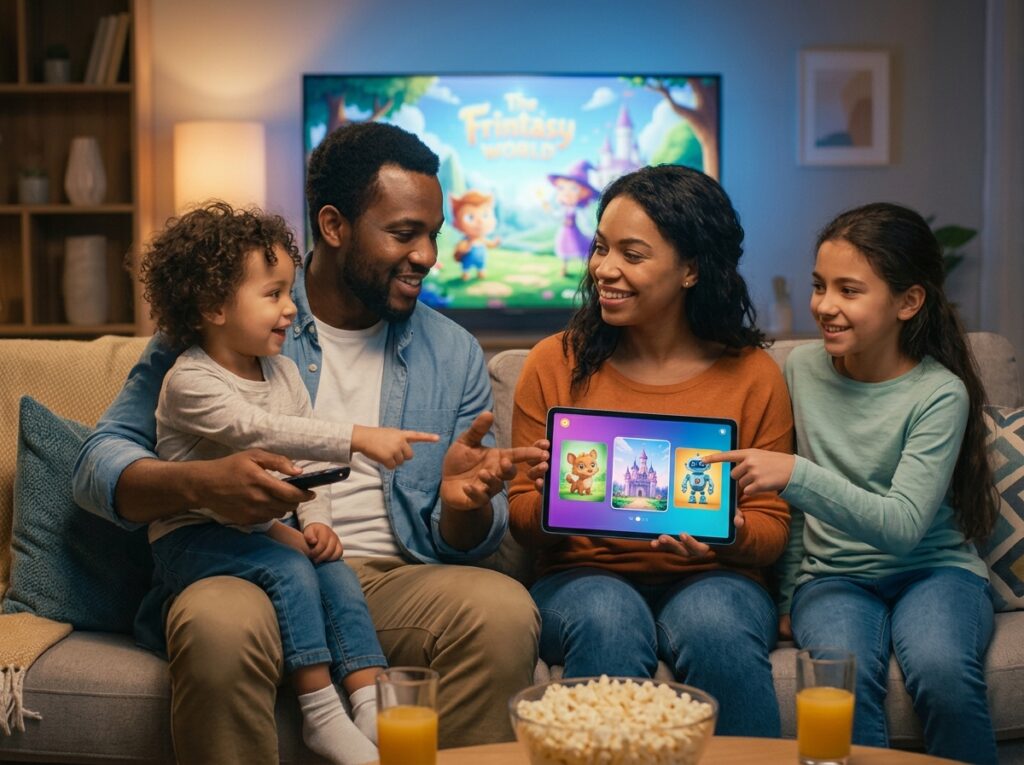
Family movie night sounds simple enough. Pick a film, prepare some popcorn, settle everyone on the sofa, and enjoy a relaxing evening together.
Then reality arrives.
Your four-year-old wants colorful characters, funny animals, and a story that makes sense without too much explanation. Your eight-year-old wants adventure, magic, and a hero to cheer for. Your twelve-year-old may consider anything made for younger children hopelessly boring. Meanwhile, the adults would quite like to watch something that doesn’t feel like a two-hour preschool lesson.
Suddenly, choosing a movie becomes the most dramatic part of the evening.
The good news? A successful family movie night doesn’t require finding a film that every child considers their personal favorite. It requires finding one that gives everyone something to enjoy, without leaving the youngest frightened, the oldest disengaged, or the parents checking the clock.
This ultimate family movie night checklist will help you choose age-appropriate films, manage different attention spans, negotiate competing preferences, and build a dependable rotation of movies your whole household can enjoy.
Why Choosing a Movie for Mixed-Age Kids Is So Difficult
Children between four and twelve may share a home, a snack bowl, and a family surname, but their entertainment needs can be remarkably different.
Younger children often prefer clear storytelling, expressive characters, repetition, and reassuring endings. Older children may be ready for layered plots, clever humor, suspense, and more complicated characters. Some children love fantasy, while others prefer animals, sports, friendship stories, or everyday adventures.
Even children of the same age can respond differently to the same film. One may laugh at a silly monster, while another finds it intimidating. One may happily follow a complicated fantasy adventure, while another loses interest when the story slows down.
That is why age alone should never be the only factor in your decision.
A better approach considers four things together:
- Comprehension: Can the youngest viewers follow the main story?
- Emotional comfort: Are the scary, sad, or intense moments manageable for your children?
- Engagement: Does the film offer enough humor, action, mystery, or emotion to interest older viewers?
- Shared enjoyment: Is there something in the story that the whole family can discuss or appreciate?
The goal isn’t to make every child equally excited about every scene. It’s to choose a film that creates enough common ground for everyone to have a good time.
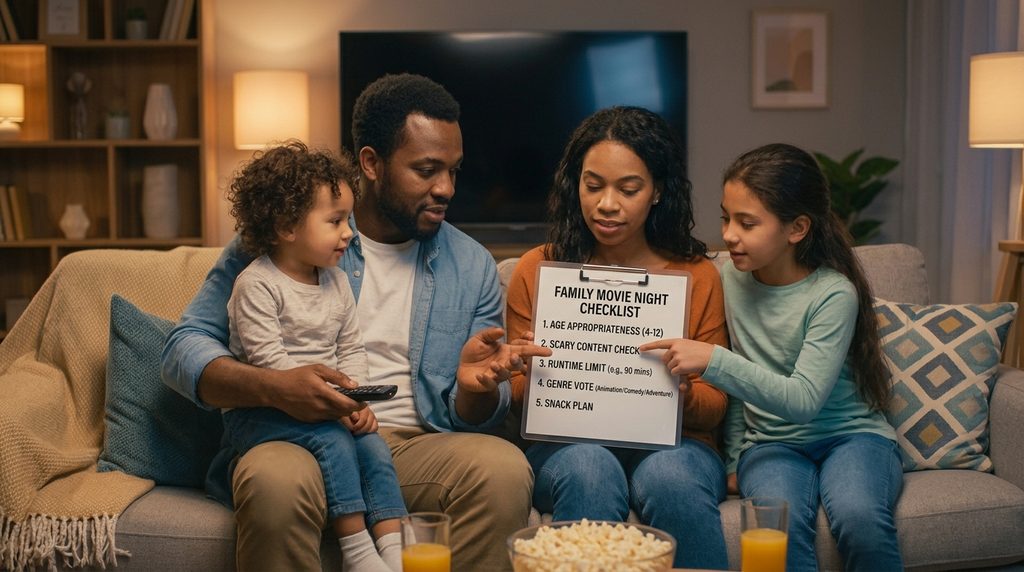
The Ultimate Family Movie Night Checklist
Before pressing play, work through this simple checklist. You don’t need a complicated scoring system or a lengthy family meeting. A few sensible questions can prevent most movie-night disappointments.
1. Check the Age Suitability First
Start with the youngest child, not the oldest.
If your household includes a four-year-old and a twelve-year-old, a film marketed to older children might still work—but only if its content is appropriate for the younger viewer. Equally, a movie suitable for preschoolers may not offer enough depth to keep an older sibling interested.
Look beyond the age printed on a streaming platform. Check the film’s content guidance and consider:
- Frightening creatures, villains, or chase sequences
- Sudden loud noises and intense action
- Death, separation, grief, or family conflict
- Bullying, insults, or humor that younger children may imitate
- Romantic themes, violence, or other material that may not suit your household
A family-friendly label is helpful, but it doesn’t automatically mean that every child will feel comfortable watching the film.
The practical rule: Choose a movie the youngest child can comfortably handle, then look for one with enough wit, adventure, or emotional depth to engage the older children.
2. Match the Runtime to Your Family’s Energy
Runtime can make or break a family movie night.
A long film may be perfectly suitable for a twelve-year-old but exhausting for a four-year-old who has already had a busy day. On the other hand, a very short movie may feel unsatisfying when the older children are ready for a substantial adventure.
Use these ranges as starting points rather than strict limits:
| Youngest child’s age | Suggested starting runtime | What to look for |
|---|---|---|
| 4–5 years | 60–85 minutes | Simple plot, visual storytelling, gentle pacing |
| 6–7 years | 70–95 minutes | Humor, friendship, accessible adventure |
| 8–9 years | 80–105 minutes | Mystery, imaginative worlds, character development |
| 10–12 years | 90–120 minutes | Clever dialogue, layered stories, bigger adventures |
These are practical planning guidelines, not developmental rules. A four-year-old who loves movies may happily watch a longer film, while an older child may prefer something short after a demanding school week.
For mixed-age households, an animated feature lasting approximately 75–100 minutes is often a useful starting point. If the youngest child is tired, shorten the evening rather than insisting that everyone finish the film.
Also remember that a movie’s total runtime isn’t the same as uninterrupted attention. Bathroom breaks, snack refills, and questions about the story are all part of family viewing.
3. Choose the Right Story Type for the Night
Not every weekend calls for the same kind of movie.
On a relaxed Saturday afternoon, children may enjoy an imaginative adventure with a little suspense. On a Friday evening after school, a gentle comedy may be a better fit. If the family has had a difficult week, a reassuring story about friendship and belonging might be more welcome than a film full of peril.
Try matching the movie to the household’s mood.
- Everyone is energetic: Choose a lively comedy or colorful adventure.
- The youngest child is easily unsettled: Look for a gentle story with predictable emotional beats.
- The older children want something substantial: Choose a film with clever humor, meaningful character development, or a mystery.
- Everyone is tired: Prefer a shorter, familiar favorite over a complicated new release.
- You want a conversation afterward: Pick a story about courage, fairness, friendship, or making difficult choices.
The best family movie isn’t necessarily the most popular title. It’s the film that fits the people sitting in your living room tonight.
4. Watch the Trailer Before the Family Vote
Trailers are useful for identifying a film’s general tone, visual style, and pacing. They can also reveal whether the movie looks too intense or too childish for your particular group.
However, trailers don’t tell the whole story. A brief montage may emphasize action while hiding a sad subplot, or make a gentle movie appear more frightening than it actually is.
Before putting a title on the shortlist, check a trusted parental guide or detailed content review. If your child is sensitive to particular themes, look specifically for information about those elements.
Avoid relying on a single online rating. A film that receives a high overall score may still contain a scene that is upsetting for your youngest viewer.
5. Give Every Child a Voice Without Giving Everyone a Veto
The biggest mistake families make is allowing movie selection to become a competition in which the loudest child wins.
Instead, make participation part of the process.
Each child can nominate one film, provided it meets the family’s age-suitability rules. Parents then narrow the nominations to two or three acceptable options. The family votes from that shortlist.
This approach gives everyone a sense of ownership without allowing one person’s enthusiasm to override another child’s comfort.
For younger children, show simple picture choices rather than asking them to evaluate several long descriptions. Older children can explain why they recommend a film, but they should also be expected to consider their siblings’ needs.
Remember: Everyone deserves a voice, but no one is entitled to get their favorite movie every week.
The Family Movie Night Compromise System
If choosing a movie regularly turns into an argument, create a system before the next movie night. A little structure makes compromise much easier.
The Three-Choice Method
Parents select three films that are all suitable for the youngest child. Each offers a different appeal—for example, comedy, adventure, and fantasy.
Every child votes for one option. If there’s a tie, the family uses a simple tie-breaker: the youngest child chooses between the tied options this week, and another child gets the privilege next time.
The important part is consistency. A fair system works better when everyone understands the rules before the disagreement begins.
The Rotating Picker
Give each child a turn choosing the movie from a parent-approved shortlist.
A rotation might look like this:
| Movie night | Who chooses? | Family responsibility |
|---|---|---|
| Week 1 | Youngest child | Choose from suitable options |
| Week 2 | Middle child | Consider everyone’s interests |
| Week 3 | Oldest child | Pick a film suitable for all |
| Week 4 | Parent or family vote | Try something new together |
Adjust the order to suit your household. The purpose is not mathematical fairness; it’s helping children learn that shared activities sometimes involve taking turns and considering other people.
The Two-Out-of-Three Rule
Ask each child to identify two things they’d enjoy in a movie. One may want animals and humor. Another may want action and mystery. The youngest may want bright animation and a happy ending.
Look for a film that satisfies at least two of the family’s main preferences while remaining appropriate for everyone.
This turns the question from “Which movie do you want?” into “What kind of experience can we all enjoy?”
Save the Almost-Perfect Choice
Sometimes the group can’t agree on a film that everyone genuinely wants to watch. That’s normal.
Keep a shared list of movies that were interesting but didn’t quite win the vote. A film rejected this week may become the obvious choice next month when the family’s mood changes.
Not every movie has to be a unanimous favorite. Sometimes a fair compromise is enough.
10 Animated Movies Worth Considering for Mixed-Age Family Movie Night
Animated films can be particularly useful for mixed-age families because they often combine visual humor, imaginative worlds, memorable characters, and themes that adults can appreciate differently from children.
The following titles offer a starting shortlist. They aren’t universally suitable for every four-to-twelve-year-old, so check the content and tone of each film before choosing it for your family.
1. My Neighbor Totoro
Best for: Families seeking a gentle, imaginative story.
This beloved animated film follows two young sisters as they explore a new home and encounter mysterious woodland spirits. Its appeal lies in atmosphere, curiosity, and the wonder of childhood rather than constant action.
Younger viewers may enjoy its creatures and magical discoveries, while older children and adults can appreciate its quiet storytelling and emotional warmth.
Before you watch: Consider whether themes of family illness and uncertainty may be upsetting for your child. Its gentle pace may also be less appealing to children who prefer nonstop action.
2. Finding Nemo
Best for: Families who enjoy adventure, humor, and a strong emotional story.
A clownfish crosses the ocean to find his missing son, creating a journey filled with colorful characters, funny encounters, and genuine tension.
Younger children may enjoy the sea creatures and visual comedy. Older viewers can connect with the story’s themes of independence, trust, and parental anxiety.
Before you watch: The opening family tragedy, frightening sea creatures, and moments of peril may be difficult for sensitive children.
3. Toy Story
Best for: Families interested in friendship, teamwork, and imaginative play.
What happens to toys when their owners leave the room? This imaginative premise becomes a story about jealousy, loyalty, insecurity, and learning to work together.
Children can enjoy the characters and physical comedy, while adults may appreciate the clever dialogue and emotional complexity.
Before you watch: Some scenes involving threatening toys, separation, or danger may frighten younger viewers.
4. The Incredibles
Best for: Families whose older children want action and adventure.
A family of superheroes must work together while navigating everyday family tensions. The film mixes action, comedy, and a story about belonging and responsibility.
Its layered humor and energetic pacing can appeal to older children and adults, while its colorful superhero premise may attract younger viewers.
Before you watch: The film contains substantial action, peril, and frightening situations. It may be a better fit for some school-age children than for a sensitive four-year-old.
5. Ratatouille
Best for: Families who enjoy food, creativity, and following an unusual dream.
A rat with an extraordinary sense of smell wants to become a chef in Paris. The story blends visual comedy with a thoughtful message about talent, ambition, and judging others fairly.
Younger viewers may enjoy the kitchen chaos and expressive animation, while older children and parents can appreciate its ideas about creativity and perseverance.
Before you watch: Check whether chase scenes, animal-related situations, or the story’s moments of tension are comfortable for your youngest viewer.
6. Paddington
Best for: Families who appreciate kindness, gentle humor, and charming characters.
Although primarily a live-action family film with a computer-animated bear, Paddington deserves consideration alongside animated family favorites. Its humor, warmth, and story of a newcomer finding a home can appeal across age groups.
Younger children may enjoy Paddington’s mishaps, while older viewers and adults can appreciate the wordplay and themes of kindness, acceptance, and community.
Before you watch: Some chase sequences, threatening characters, and perilous situations may require consideration for sensitive viewers.
7. The LEGO Movie
Best for: Families who enjoy fast-paced humor and imaginative storytelling.
This energetic adventure uses a world built around construction toys to explore creativity, individuality, and the value of thinking beyond instructions.
Its visual jokes and quick pace may appeal to older children and adults, while younger viewers may enjoy the colorful action and familiar toy-like world.
Before you watch: The fast editing, noisy action, and frequent peril can be overwhelming for some younger children.
8. Kiki’s Delivery Service
Best for: Families looking for a hopeful story about growing up.
A young witch moves to a new town and starts a delivery service as she learns to become independent. The film focuses on confidence, friendship, work, and finding your place in the world.
Younger children may enjoy the flying and magical details, while older children can relate to Kiki’s uncertainty and growing independence.
Before you watch: The slower pace and moments of emotional difficulty may require patience from children who prefer more action.
9. Zootopia
Best for: Families ready to discuss fairness, stereotypes, and teamwork.
In a city populated by anthropomorphic animals, a determined rabbit police officer teams up with a fox to solve a mystery. The story combines comedy and detective-style plotting with themes of prejudice and assumptions.
Older children and adults may appreciate the social commentary, while younger viewers can follow the animal characters and central mystery.
Before you watch: The film includes suspense, threatening scenes, and some frightening moments. Consider your child’s comfort with these elements.
10. The Mitchells vs. the Machines
Best for: Families who enjoy chaotic comedy and stories about family relationships.
A family road trip turns into a wildly exaggerated technological adventure. Beneath the visual gags and energetic action is a story about communication, accepting differences, and learning to appreciate one another.
Older children may connect with its technology references and humor, while adults may recognize the family tensions beneath the comedy.
Before you watch: The fast pace, robot attacks, and intense action may be too much for some younger or sensory-sensitive children.
How to Choose From This List
Rather than treating all ten films as equally suitable, group them by the experience you want.
| If your family wants… | Consider starting with… |
|---|---|
| Gentle fantasy | My Neighbor Totoro |
| Emotional adventure | Finding Nemo |
| Friendship and humor | Toy Story |
| Superhero action | The Incredibles |
| Creativity and ambition | Ratatouille |
| Warm, gentle comedy | Paddington |
| Fast-paced visual humor | The LEGO Movie |
| A quieter coming-of-age story | Kiki’s Delivery Service |
| Mystery and thoughtful themes | Zootopia |
| Energetic family comedy | The Mitchells vs. the Machines |
These are suggestions, not guarantees of suitability. Use parental guides, local age classifications, and your own knowledge of your children to make the final decision.
Build a Family Movie Night That Works for Everyone
The movie itself is only part of the experience. A thoughtful setup can help children of different ages settle in, enjoy the story, and avoid turning the evening into a battle over snacks, seats, or screen time.
Prepare the Environment
Make the room comfortable without turning it into a sensory obstacle course.
- Keep the volume at a comfortable level.
- Allow children who are sensitive to sound to sit farther from the speakers.
- Offer familiar snacks and water before the film starts.
- Let children bring a cushion or blanket if it helps them relax.
- Keep the lighting comfortable rather than making the room completely dark if a child finds darkness unsettling.
Avoid unnecessary distractions, but don’t expect every child to sit perfectly still throughout the movie. A quiet movement break or a quick bathroom visit is better than making the experience stressful.
Set Expectations Before Pressing Play
Explain the basic plan in a few sentences: which film you’re watching, whether there will be a break, and what the family will do if someone becomes frightened or loses interest.
For younger children, this predictability can make the evening feel safer. Older children also benefit from knowing that the family has agreed on the plan.
Most importantly, let children know that they can tell you if something feels too scary. They shouldn’t be mocked or pressured to prove that they’re brave.
Keep Snacks Simple
You don’t need an elaborate menu to make movie night special.
Popcorn, fruit, sandwiches, homemade pizza, or a favorite family snack can be enough. If you have children of different ages, choose foods that are safe for each child’s developmental stage and any dietary needs.
Letting each child select one snack from a few available options is another easy way to give everyone a little ownership without adding another family debate.
Make Room for a Conversation
After the credits, ask one or two questions:
- Which character did you like most, and why?
- What was the funniest part?
- Was there a moment when someone made a good or bad decision?
- What would you have done differently?
Younger children may answer with a favorite character or a simple description. Older children may discuss motives, fairness, or the ending. Adults can join in without turning the conversation into a school lesson.
If nobody wants to talk, that’s fine too. Sometimes the best ending to a family movie night is simply enjoying the shared experience.
What If a Child Loses Interest Halfway Through?
A child getting restless doesn’t automatically mean you chose the wrong movie. They may be tired, hungry, overstimulated, or simply not in the mood for that particular story.
Try a quick check-in before making a decision.
If the child is comfortable but bored, offer a quiet activity that doesn’t disturb others, such as drawing on paper or holding a soft toy. If the child is frightened, pause and provide reassurance. If they’re exhausted, it may be better to stop and try again another day.
Forcing everyone to finish a movie at all costs can teach children that shared entertainment is something to endure rather than enjoy.
You can also agree in advance that family movie night includes a single optional break. This gives younger viewers a predictable opportunity to move around without repeatedly interrupting the film.
The Family Movie Night Checklist: Save This for the Weekend
Use this final checklist before choosing your next film.
- Age suitability: Have I checked the content for the youngest viewer?
- Emotional comfort: Are the frightening, sad, or intense scenes manageable for my children?
- Runtime: Does the film fit our available time and energy?
- Shared appeal: Is there something in it for both younger and older children?
- Family input: Have the children had a fair chance to express their preferences?
- Content check: Have I reviewed more than the trailer or general age label?
- Comfort: Are snacks, seating, volume, and lighting ready?
- Expectations: Does everyone know the plan and feel comfortable speaking up?
- Flexibility: Are we willing to pause or stop if the film isn’t working?
- A positive ending: Have we left room to enjoy the experience rather than judge it?
If most of these boxes are checked, you’re in a good position for a successful evening. No checklist can guarantee that every child will love every movie, but it can help you make a thoughtful choice.
Frequently Asked Questions
What is the best movie length for children aged 4 to 12?
For many mixed-age families, a film lasting around 75–100 minutes is a useful starting point. Shorter films may suit tired younger children, while older children may enjoy longer adventures. Adjust the choice to your children’s attention, comfort, and experience rather than relying on age alone.
How can I choose one movie when my children have completely different tastes?
Start by establishing age-suitability rules, then ask each child to nominate a film. Narrow the choices to two or three options that meet the family’s needs, and let the children vote. A rotating picker can also prevent the same child from dominating the decision every week.
Are animated movies always suitable for younger children?
No. Animation is a visual medium, not an age rating. Animated films can contain frightening villains, violence, bereavement, suspense, and emotionally intense scenes. Check detailed parental guidance before choosing a movie for a sensitive or very young viewer.
Should parents let children stop watching if they become scared?
Yes. If a child becomes distressed, pause the film and listen to their concerns. Offer reassurance and decide whether to continue, skip a scene where practical, or stop watching. Children should not be shamed for being frightened.
What if my older child says the movie is too childish?
Give the older child a meaningful role in selecting from age-appropriate options. Look for films with clever humor, interesting characters, mysteries, or deeper themes. Explain that family movie night is a shared activity, so the goal is to find a film that works reasonably well for everyone—not to satisfy only the oldest viewer.
How often should families have movie night?
There is no ideal frequency for every household. Weekly, fortnightly, or occasional movie nights can all work. Choose a rhythm that fits your schedule and makes the experience feel enjoyable rather than obligatory.
The Best Family Movie Night Is About More Than the Film
When children range from four to twelve, choosing one movie will never be a perfect science. Their interests, confidence, energy levels, and emotional needs will change from week to week.
That’s why the most useful family movie night checklist isn’t simply a list of titles. It’s a way to make decisions that consider everyone in the room.
Check age suitability. Keep runtime realistic. Give every child a voice. Choose a film with more than one kind of appeal. And remember that a successful evening doesn’t depend on keeping every child glued to the screen until the final credit.
Sometimes the magic is in the movie. Sometimes it’s the popcorn, the laughter, the questions, or the child who ends up cuddled beside a parent during a slightly scary scene.
Choose thoughtfully, compromise fairly, and let family movie night become a tradition your children remember for the right reasons.
Because the best film is not necessarily the one everyone would choose alone. It’s the one that helps everyone enjoy being together.