
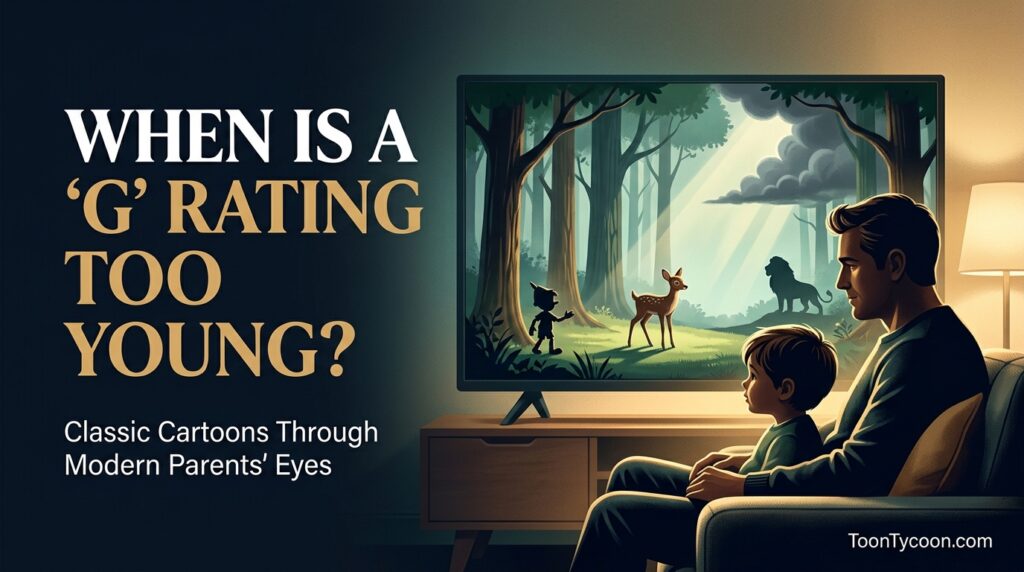
G-rated movies for toddlers are often seen as the safest option for family movie night, but a film rated for general audiences can still be surprisingly intense for little viewers—and knowing what to look for helps parents make smarter choices before pressing play.
There is something special about sharing childhood favorites with your children. The songs, memorable characters, colorful animation, and familiar stories can make a family movie night feel like a bridge between generations. For many parents, introducing a toddler to Bambi, Pinocchio, or The Lion King seems like an easy decision. After all, these are beloved animated classics, and they carry the familiar G rating.
But then comes the moment that changes everything.
A forest fire fills the screen. A beloved parent disappears from the story. A frightening villain appears in the shadows. Suddenly, the cheerful family movie has become an emotional experience your child may not be ready to process.
This is why selecting G-rated movies for toddlers requires looking beyond the official rating tag.
A G rating generally indicates that a film is suitable for general audiences under the classification system used by the Motion Picture Association in the United States. However, it does not guarantee that every scene will be comfortable for every age group, particularly toddlers who are still developing their understanding of danger, loss, and make-believe.
Ultimately, the question is not simply whether a classic cartoon is appropriate in general. When evaluating G-rated movies for toddlers, the real key is whether your particular child is emotionally ready for what happens on screen.
What Does a G Rating Actually Tell Parents?
The G rating is reassuring, but it is easy to misunderstand what it means.
It is a content classification, not a developmental assessment. It does not certify that a film is suitable for every child from infancy onward, nor does it promise that the story contains no frightening moments, intense conflict, or sadness.
A movie can avoid graphic violence, strong language, and adult subject matter while still containing scenes that are emotionally overwhelming for a very young viewer.
Consider the difference between these two experiences:
- A character falls into a pond, gets wet, and emerges smiling. The situation is resolved quickly, and the danger is easy to understand.
- A young animal watches its mother die, becomes separated from familiar surroundings, or faces a threatening predator. The danger may be conveyed through music, expressions, silence, and prolonged suspense.
Neither scene necessarily requires explicit violence to create a powerful emotional reaction. For a toddler, the second experience may be far more difficult to process.
Parents should also remember that rating systems differ across countries. A G classification in one system should not automatically be treated as equivalent to a specific age recommendation elsewhere.
The key lesson: A rating helps identify the broad content category, but parents still need to consider the story’s emotional intensity, pacing, and suitability for their child’s developmental stage.
Three Classic Animated Movies That Deserve a Second Look
Classic animation often tells sophisticated stories through beautiful visuals and memorable music. That artistic quality is one reason these films remain popular. It is also why their more unsettling moments can catch parents off guard.
1. Bambi: When a Gentle Nature Story Becomes a Story About Loss
Bambi is often remembered as a tender film about woodland animals, friendship, and growing up. Its soft visual style can make it appear like an obvious choice for very young children.
<PRIVATE_PERSON>
Yet the film includes one of the most emotionally powerful moments in classic animation: Bambi loses his mother after a hunter appears in the forest.
The scene is not graphic, but its emotional impact is unmistakable. The danger, the sudden separation, and the realization that his mother is not returning can be deeply upsetting. Later scenes involving fire, fleeing animals, and predators add further tension.
For a preschooler who understands separation but is still learning how to interpret death, this story may raise difficult questions. A toddler may not fully understand the distinction between a fictional animal’s death and the possibility of losing a parent in real life.
What parents should consider: If your child becomes distressed when a caregiver leaves the room, is frightened by realistic danger, or struggles with stories involving separation, preview the film before introducing it.
You can also choose to wait until your child is better able to discuss sadness and loss. There is no need to rush a childhood classic simply because you enjoyed it at the same age—or remember watching it when you were young.
2. The Lion King: A Musical Adventure With a Powerful Death Scene
The Lion King offers humor, catchy songs, colorful characters, and an uplifting journey toward courage and responsibility. It is easy to focus on the playful adventures of Simba, Timon, and Pumbaa when deciding whether to show it to a young child.
However, the death of Mufasa is a major emotional turning point.
The stampede, the immediate danger, Simba’s desperate attempts to reach his father, and his discovery afterward create a sequence that can be distressing even without graphic imagery. Scar’s manipulation of Simba adds another layer of emotional complexity.
Older children may begin to understand grief, guilt, and deception through the story. Toddlers, on the other hand, may primarily experience the scene as a frightening event in which a beloved character disappears and does not return.
The film also contains threatening hyenas, confrontations, and moments of suspense that may feel intense to children who are sensitive to loud sounds or menacing characters.
What parents should consider: Watch the film yourself before a first viewing with a very young child. Think about whether your child is ready to see a character die and whether you feel comfortable explaining what happened afterward.
If the answer is no, save the movie for later. The songs will still be there when your child is ready.
3. Pinocchio: A Whimsical World With Surprisingly Dark Moments
Disney’s Pinocchio is a classic tale about honesty, temptation, courage, and the desire to become a real boy. Its fantastical setting may seem appealing to children who love puppets and magical adventures.
But the film’s atmosphere can shift quickly from playful to frightening.
Pinocchio encounters manipulative adults, threatening situations, and characters whose intentions are not always easy for a young child to understand. Pleasure Island, in particular, turns a seemingly exciting adventure into something unsettling as the boys are transformed into donkeys. Monstro the whale adds another prolonged sequence of danger and suspense.
For toddlers, the combination of unfamiliar imagery, frightening transformations, and characters behaving unpredictably may be more confusing than entertaining.
What parents should consider: Pay attention not only to frightening images but also to the story’s underlying ideas. Does your child understand that a character can make a mistake without becoming a bad person? Can they distinguish a magical transformation from something that could happen in real life?
These questions do not mean a child must understand every theme before watching a movie. They simply help parents decide whether a film will be an enjoyable adventure or an unnecessarily stressful experience.
Why Toddlers Experience These Movies Differently
Adults often revisit old films through the lens of nostalgia. We remember the songs, the humor, the characters we loved, and the feelings associated with watching them as children.
Young viewers do not necessarily share that perspective.
Toddlers are still learning to understand emotions, anticipate what might happen next, and distinguish fictional danger from real-world threats. Their reactions also vary considerably: one child may laugh at a cartoon villain while another becomes frightened by the same character.
Several factors explain why a classic animated film can feel more intense to a young viewer than it does to an adult.
They May Not Understand That a Character Is Safe
Adults know that the animated animal will not actually die and that the frightening scene will eventually end. Young children may become absorbed in what they see without consistently applying that understanding.
Even when a child knows that a movie is pretend, the fear or sadness it creates can still feel real.
Music and Sound Can Increase Tension
Animation communicates emotion through more than dialogue. Dramatic orchestral music, sudden loud noises, dark lighting, and fast-moving action can make a scene frightening even when nothing graphic is shown.
Some children react more strongly to sound and suspense than to the images themselves.
They May Struggle to Understand Death and Separation
The meaning of death develops gradually as children grow. A toddler may ask whether a character will come back, expect a dead character to return in the next scene, or worry that something similar could happen to someone they love.
These reactions are not necessarily signs of a lasting problem. They are reasons to respond with reassurance and age-appropriate explanations.
Their Emotional Recovery Takes Time
A frightening scene may be over in seconds, but a young child can continue thinking about it afterward. They may mention it at bedtime, become reluctant to enter a dark room, or ask repeated questions.
Parents should not assume that a child who sits quietly throughout a film has understood or comfortably processed everything they watched.
The Modern Parent’s Pre-Viewing Checklist
Before introducing a classic animated movie to a toddler or preschooler, take a few minutes to evaluate it yourself.
Use this checklist as a practical starting point.
- Check the official rating and content notes. Look for descriptions of frightening scenes, violence, death, or other potentially upsetting material.
- Watch the trailer carefully. Trailers can reveal tone and intensity, but they may omit the film’s most distressing scenes.
- Read a detailed parental guide. Search for specific scene descriptions rather than relying only on a star rating or a general recommendation.
- Preview the full film when possible. Pay particular attention to parental deaths, separation, transformations, predators, fires, and prolonged suspense.
- Consider your child’s temperament. Think about their responses to loud sounds, separation, unfamiliar characters, and emotionally intense stories.
- Check the runtime. A long film can be tiring for a toddler, even when its content is otherwise appropriate.
- Plan to watch together. Your presence gives your child an opportunity to ask questions, seek reassurance, or take a break.
- Have an alternative ready. Choose a gentler film or a short episode if the original selection proves too intense.
A few minutes of preparation can prevent a family movie night from turning into an experience everyone would rather forget.
A Simple Framework for Choosing the Right Film
Instead of relying on age ratings alone, consider three questions: Is the content appropriate? Is the emotional intensity manageable? Is your child developmentally ready for the themes?
| Consideration | Signs to look for | What parents can do |
|---|---|---|
| Content | Threats, death, frightening transformations, or peril | Check scene-specific parental guides and preview the film |
| Emotional intensity | Prolonged suspense, loud sounds, distressing music, or frightening imagery | Choose a gentler alternative or watch together |
| Developmental readiness | Difficulty understanding separation, pretend danger, or loss | Wait until the child is ready to discuss the themes |
| Viewing stamina | Long runtime, slow pacing, or extended periods of tension | Choose a shorter film or divide viewing into manageable sessions |
| Individual sensitivity | Nightmares, persistent fears, or strong reactions to similar stories | Follow the child’s cues and adjust future selections |
There is no universal age at which every child becomes ready for Bambi, The Lion King, or Pinocchio. These are judgment calls that depend on the individual child and the specific film.
For a toddler, a gentle, dialogue-light short may be a better starting point than a feature-length classic. For an older preschooler who enjoys dramatic storytelling and can discuss difficult emotions, a carefully chosen classic may become a meaningful shared experience.
The goal is not to eliminate every difficult feeling from children’s entertainment. It is to introduce those feelings at a pace children can manage, with an adult available to help them make sense of what they see.
What to Do When a Movie Frightens Your Child
Even the most careful parent cannot predict every reaction. A scene that seems harmless to an adult may unexpectedly frighten a child.
If that happens, the best response is simple: pause the movie and listen.
1. Acknowledge the Feeling
Avoid dismissing the fear with statements such as, “It’s only a cartoon” or “There’s nothing to be scared of.”
Instead, try saying, “That scene looked scary. I’m here with you.”
This reassures the child that their feelings are taken seriously without suggesting that the fictional danger is real.
2. Explain What Happened in Simple Language
Use short, truthful explanations that match your child’s understanding.
For example, if a character is separated from a parent, you might explain that the character is sad because someone they love is gone. If your child asks whether the same thing will happen to your family, respond calmly and honestly without making promises about events you cannot control.
Avoid lengthy explanations that introduce more frightening possibilities than the child has asked about.
3. Let Your Child Decide Whether to Continue
Some children will want to resume the movie after a short break. Others will want to stop entirely.
Both responses are acceptable. There is no need to finish a film simply because the family has already started watching it.
4. Watch for Lingering Distress
A child may bring up a scene later or ask repeated questions about a character. Offer reassurance and answer calmly.
If distress persists, affects sleep, or develops into ongoing fears, take a break from similar content and consider seeking guidance from a qualified child-development professional if needed.
Most importantly, do not turn a child’s fear into a test of bravery. There is plenty of time to revisit the film when they feel more prepared.
How to Introduce Classic Animation Without Losing the Magic
Parents do not need to choose between protecting their children and sharing the films they love. A thoughtful introduction can preserve the joy of classic animation while respecting a child’s emotional readiness.
Start with gentler stories. Look for films and short animations with reassuring resolutions, limited peril, and simple emotional themes.
Choose the right moment. Avoid introducing an unfamiliar, potentially intense film when your child is exhausted, already upset, or close to bedtime.
Watch actively rather than passively. Sit with your child, explain confusing moments when appropriate, and pay attention to their reactions. Shared viewing can turn a difficult scene into an opportunity for conversation.
Do not use nostalgia as the deciding factor. A film’s place in your own childhood does not determine whether it is suitable for your child’s current stage of development.
Remember that waiting is a valid choice. You can save a beloved movie for a birthday, a school holiday, or simply a time when your child is better prepared for its themes.
And if a film contains a particularly distressing sequence, it is reasonable to choose a different movie rather than treating exposure to difficult content as a developmental milestone.
The Bottom Line: A Rating Is a Starting Point, Not a Parenting Decision
Classic animated films remain beloved for good reasons. Their stories can teach courage, kindness, responsibility, friendship, and resilience. Their emotional depth is often part of what makes them memorable.
But those same qualities can make them more intense than their ratings initially suggest.
When deciding whether to introduce Bambi, The Lion King, Pinocchio, or another childhood favorite, look beyond the label. Consider the scenes your child will encounter, the emotions those scenes may evoke, and the support they will have while watching.
A G rating can tell you something useful about a film’s general content classification. It cannot tell you whether your toddler is ready to watch a parent die on screen, witness a frightening transformation, or sit through a prolonged scene of danger.
That judgment belongs to the adults who know the child best.
The most successful family movie night is not necessarily the one featuring the most celebrated classic. It is the one in which everyone feels comfortable enough to enjoy the experience together.
Before you press play, ask yourself one final question: If this scene frightens my child, am I prepared to help them understand it?
If you are unsure, preview the film first. The magic of a childhood classic is worth sharing—but it is worth sharing at the right time.