
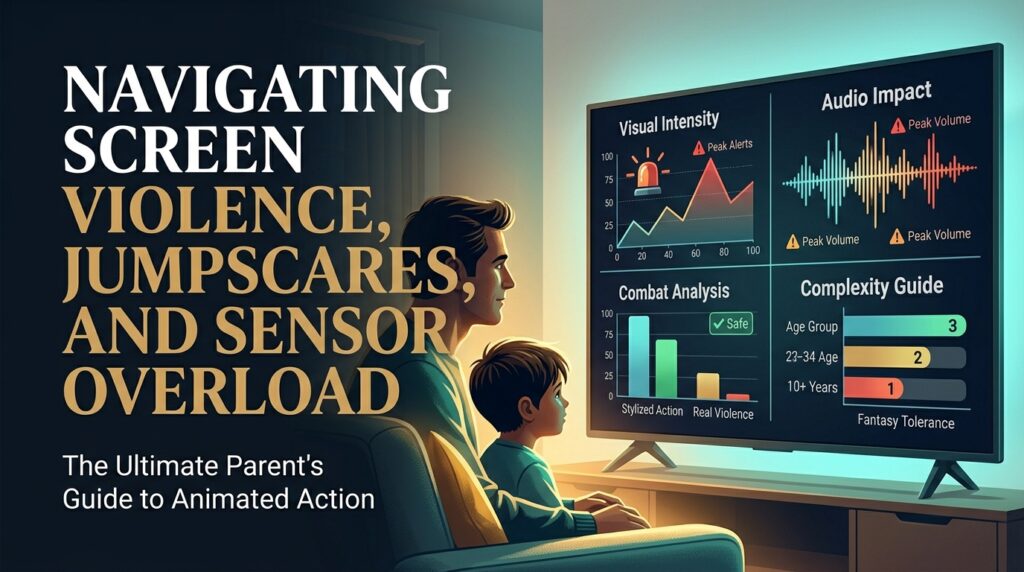
Navigating screen violence and jumpscares has become one of the most unexpected challenges for modern parents. As animated filmmaking continues to reach cinematic heights, today’s blockbusters offer visual storytelling and complex narratives that rival live-action features. However, for parents, determining whether a PG-rated (or even a G-rated) animated film is appropriate for a young child has become increasingly difficult.
While modern animated action films rarely depict graphic real-world blood, they frequently rely on high-octane visual stimuli, rapid frame-rate shifts, immersive surround sound, and deep psychological peril. For toddlers and young children whose sensory and emotional processing systems are still developing, these elements can easily lead to anxiety, distress, or sensory overload.
This guide provides an evidence-backed, practical framework to help parents evaluate screen intensity, anticipate sensory triggers, and master the art of navigating screen violence and jumpscares without relying on vague rating tags or spoiling the plot.
Table of Contents
- Understanding the Sensory Gap: Modern vs. Classic Animation
- Visual Intensity, Kinetic Editing, and Motion Fatigue
- Sound Engineering: Auditory Stings, Sub-Bass, and Jumpscares
- Fantasy Violence vs. Emotional Peril: Categorizing Content
- Age-by-Age Developmental Readiness Guide
- Practical Strategies for Parents Before and During Movie Night
1. Understanding the Sensory Gap: Modern vs. Classic Animation
To understand why modern animated features affect children differently than older cartoons, it helps to analyze how animation production has evolved.
Traditional 2D hand-drawn animation typically moved at 12 to 24 frames per second on flat planes with fixed visual perspectives. Soundtracks were predominantly orchestral or dialogue-driven, with audio engineered for basic television speakers or standard mono/stereo theater setups.
Modern CGI and hybrid animation, by contrast, utilize virtual 3D camera rigs that mimic live-action blockbusters. Directors employ sweeping aerial movements, rapid cuts, chromatic aberration, and dynamic lighting effects. Combined with multi-channel surround sound and sub-bass audio engineering, today’s animated action creates a highly immersive—and at times, overwhelming—sensory environment.
Breakdown of Primary Sensory Stressors
| Stressor Category | Specific Triggers | Examples in Modern Films |
| Visual Stressors | Chromatic aberration, high-contrast strobing, flashing lights, rapid kinetic cuts, and dynamic camera swings. | Multiversal portals in Spider-Man: Into the Spider-Verse |
| Auditory Stressors | High-frequency audio stings, siren effects, dynamic range surges (quiet-to-loud spikes), and low-frequency sub-bass. | The Prowler’s siren theme in Spider-Verse |
2. Visual Intensity, Kinetic Editing, and Motion Fatigue
When evaluating whether a film might overstimulate your child, kinetic editing—the pace, visual contrast, and framing frequency of battle scenes—is a crucial factor.
Visual Stress Factors in Animated Features
| Visual Element | Common Technical Examples | Impact on Young Viewers |
| Glitching & Chromatic Aberration | Multiversal distortions (Spider-Man: Into the Spider-Verse) | Causes visual disorientation, eyestrain, and mental fatigue |
| High-Contrast Strobing | Energy blasts, portal activations, lightning flashes | Triggers sensory overstimulation and nervous system arousal |
| Fast Multi-Angle Cuts | High-speed martial arts sequences (Kung Fu Panda) | Makes spatial orientation difficult for young children |
| Dark & Shadowy Color Palettes | Underground villain lairs, night-time battles | Heightens tension, fear of the unseen, and atmospheric dread |
Key Concepts to Watch For
- Frame-Rate Manipulation (“Animating on Twos”):Stylized movies often alternate frame rates between the hero and the background to create artistic contrast. For children under six, this visual stuttering requires additional cognitive effort to process motion smoothly.
- Rapid Panel & Perspective Shifts:Transitions that mimic comic-book panels or rapid split-screens force the eyes to dart across the screen constantly, accelerating visual fatigue.
Parent Observation Rule: If your child regularly covers their eyes, squints, or turns their body away from the screen during high-energy video games or fast-paced television commercials, high-octane animated movies are likely to trigger sensory overload.
3. Sound Engineering: Auditory Stings, Sub-Bass, and Jumpscares
Distress during movie night is often driven by audio design rather than visual content. Sound engineers intentionally use specific frequency ranges and volume spikes to induce instinctual fear responses.
1. Acoustic Jumpscares & Auditory Stings
Audio stings are sudden, harsh sounds that signal immediate danger. A prime example is the mechanical, siren-like motif that accompanies The Prowler in Spider-Man: Into the Spider-Verse. This high-frequency sound creates an instant feeling of dread before the character physically moves or attacks.
2. Dynamic Range Surges
Modern cinematic audio mixes feature a wide dynamic range. A scene may drop to near-silent whispers, only to explode milliseconds later into loud, low-frequency sound effects (explosions, roars, or collapsing structures). This sudden shift triggers an involuntary startle reflex in young children.
3. Sub-Bass Vibrations
In theaters or home setups equipped with dedicated subwoofers or soundbars, low-frequency sounds produce actual physical vibrations in the room. For toddlers who cannot fully distinguish between screen fantasy and real physical danger, feeling the floor or couch vibrate during a villain’s entrance can trigger a fight-or-flight stress response.
4. Fantasy Violence vs. Emotional Peril: Categorizing Content
Not all animated action carries the same psychological weight. Understanding the difference between comedy-driven slapstick and high-stakes emotional peril helps parents determine what their child can comfortably handle.
| Feature Element | Slapstick / Kinetic Action (e.g., Kung Fu Panda) | High-Stakes Peril (e.g., Spider-Verse, The Last Wish) |
| Combat Style | Martial arts comedy, physical stunts, exaggerated knockbacks. | Realistic combat mechanics, laser fire, mechanical weaponry, urban destruction. |
| Physical Consequences | Characters shake off long falls, bounce back instantly, or joke after impact. | Characters sustain visible fatigue, bodily harm, permanent loss, or grief. |
| Villain Profile | Larger-than-life anthropomorphic figures balanced with humor. | Shadowy, monstrous, or existential figures (e.g., representations of death or betrayal). |
| Atmospheric Tone | Bright, vibrant color palettes with light-hearted musical cues. | Dark, high-contrast environments with tense, minor-key orchestral scoring. |
5. Age-by-Age Developmental Readiness Guide
Child development specialists emphasize that a child’s response to screen violence depends heavily on their ability to distinguish make-believe from reality and regulate sensory input.
Developmental Progression Overview
- Ages 2–4 (Low Sensory Threshold): Cannot distinguish fantasy from reality; relies on simple, bright visual and audio cues.
- Ages 5–7 (Developing Distinction): Begins to understand “make-believe,” but remains vulnerable to dark atmospheres and loud audio jumpscares.
- Ages 8+ (Complex Narrative Processing): Fully understands fantasy combat rules; can handle high-speed editing, multi-layered storylines, and emotional stakes.
Ages 2–4: Early Sensory Stage
- Sensory Tolerance: Very Low.
- Cognitive Understanding: Cannot distinguish screen fantasy from physical reality.
- Recommendation: Stick to gentle, slow-paced titles with warm lighting, predictable storylines, and consistent audio levels. Avoid high-octane action, intense villain entrances, or dark environments.
Ages 5–7: Transitional Processing Stage
- Sensory Tolerance: Moderate.
- Cognitive Understanding: Beginning to understand “make-believe,” but still susceptible to visceral fear from scary character designs or sudden jumpscares.
- Recommendation: Suitable for slapstick martial arts action (Kung Fu Panda) and light superhero adventure, provided parents are present to contextualize loud audio stings and villain introductions.
Ages 8–10: Active Engagement Stage
- Sensory Tolerance: High.
- Cognitive Understanding: Fully understands fantasy combat rules and can track complex, fast-paced kinetic editing.
- Recommendation: Ready for multiversal storylines (Spider-Verse), higher stakes, and stylized comic-book action. Discussion may be needed around emotional themes like grief, identity, or mentorship loss.
6. Practical Strategies for Parents Before and During Movie Night
Instead of relying solely on MPAA ratings (G, PG, PG-13), parents can use these practical, non-spoiler strategies to curate safe and enjoyable viewing experiences:
Before Pressing Play
- Consult Detailed Content Guides: Use non-profit media review platforms (such as Common Sense Media or Does The Dog Die) to review specific sensory triggers, sound warnings, and scary scene timestamps without reading full plot spoilers.
- Listen to the Soundtrack First: Previewing a film’s score on a streaming platform can reveal whether the movie relies heavily on intense, dark, or jarring auditory themes.
- Establish an “Escape Hatch”: Remind young children before the movie starts that it is always okay to pause the film, lower the volume, cover their eyes, or take a short break in another room.
Managing Sensory Input at Home
- Adjust Audio Settings: Enable “Night Mode” or “Reduce Loud Sounds” on your TV or receiver to compress the dynamic range, keeping dialogue audible while capping sudden volume spikes.
- Keep Room Lights On: Watching high-contrast, strobing action in a dark room accentuates visual stress. Keeping soft ambient lighting on reduces eyestrain and maintains a connection to the physical world.
- Use Physical Comfort Tools: Weighted blankets, noise-dampening headphones, or holding a favorite stuffed animal can help children self-regulate during tense cinematic moments.
Frequently Asked Questions (FAQs)
1. Why is navigating screen violence and jumpscares so important for young children?
Young children and toddlers have developing nervous systems and cannot always distinguish animated fantasy from real-world danger. When navigating screen violence and jumpscares, parents need to account for sensory overstimulation, low-frequency audio rumbles, and sudden visual flashes, which can trigger fight-or-flight stress reactions or bedtime anxiety even in PG-rated films.
2. How can parents start navigating screen violence and jumpscares without spoiling movie plots?
You can practice navigating screen violence and jumpscares without plot spoilers by checking detailed content breakdown sites like Common Sense Media or Does The Dog Die. These platforms highlight specific sensory triggers, sudden loud audio stings, and scary scene timestamps while keeping major storyline twists intact.
3. What audio settings help when navigating screen violence and jumpscares at home?
When navigating screen violence and jumpscares during family movie night, enable “Night Mode,” “Dialogue Enhancement,” or “Reduce Loud Sounds” in your TV or soundbar settings. This compresses the dynamic range, keeping quiet conversations clear while capping sudden loud volume spikes and heavy sub-bass vibrations.
4. What is the difference between fantasy violence and emotional peril in animated movies?
Fantasy violence usually involves slapstick martial arts, comedic physical stunts, and quick recovery without lasting harm (like in Kung Fu Panda). Emotional peril involves serious stakes, character grief, mentor loss, or shadowy, realistic villain threats (like in Spider-Verse). Understanding this distinction makes navigating screen violence and jumpscares much easier for parents assessing age appropriateness.
5. At what age can children handle modern animated action blockbusters?
While every child develops at their own pace, children under 5 generally struggle with fast visual cuts and intense sound design. Between ages 6 and 8, kids can handle light action with parental guidance. By age 9 or 10, most children are fully equipped for navigating screen violence and jumpscares in high-octane superhero and fantasy features.