
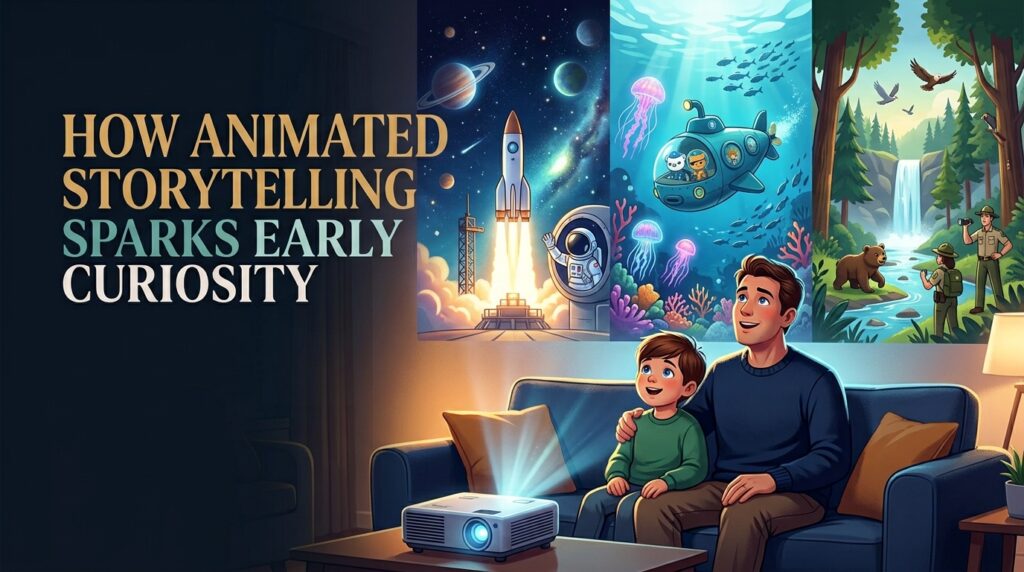
How animated storytelling sparks early curiosity in young minds has become one of the most powerful catalysts for early childhood STEM education. Long before children encounter formal science textbooks or classroom lectures, vibrant animated series introduce them to the complexities of marine ecosystems, the mechanics of space exploration, and the wonder of wildlife conservation.
When pre-K and primary school children watch enthusiastic characters explore deep-sea trenches or calculate rocket trajectories, scientific inquiry shifts from an abstract academic subject into a thrilling real-world adventure.
Table of Contents
- The Developmental Science: Why Narrative Animation Works
- Building Lifelong Scientific Habits in Early Childhood
- Curated STEM Toons by Scientific Domain
- Parent Discussion Prompts for Active Screen Time
- Frequently Asked Questions (FAQs)
- Summary and Key Takeaways
1. The Developmental Science: Why Narrative Animation Works
Child development research consistently demonstrates that early learners absorb scientific concepts most effectively through narrative structures. Young brains are hardwired to make sense of the world through stories rather than isolated facts.
When an animated narrative presents a problem—such as a damaged sub-aquatic research vessel or a stranded migrating species—it models the Scientific Method in a natural, engaging format:
- Observation: Characters notice an unusual environmental pattern or animal behavior.
- Hypothesis Formation: The team brainstorms potential causes based on biological or physical adaptations.
- Controlled Experimentation: The characters test specialized tools or strategies in real time.
- Reflection & Synthesis: The crew reviews what succeeded, reinforcing core scientific vocabulary and ecological principles.
By embedding these cognitive steps into compelling storylines, animated series help children normalize trial, error, and critical thinking long before their first formal laboratory experiment.
2. Building Lifelong Scientific Habits in Early Childhood
Quality educational animation does more than hold a child’s attention—it acts as an springboard for hands-on, offline exploration. Research shows that well-designed science shows nurture three foundational habits in pre-K and primary school viewers:
| Scientific Habit | Animated Mechanism | Real-World Application |
| Active Observation | Close-up visual framing of animal traits, planetary orbits, or mechanical levers | Noticing biological patterns in local park ecosystems and backyard wildlife |
| Vocabulary Acquisition | Memorable songs and recurring terminology (bioluminescent, trajectory, habitat) | Confident, accurate use of scientific terms during daily conversations |
| Environmental Stewardship | Storylines centered on wildlife rescue, reef restoration, and ecosystem balance | Developing genuine empathy for living organisms and conservation ethics |
3. Curated STEM Toons by Scientific Domain
Here is a practical, domain-specific guide to high-impact animated series designed to build early scientific literacy for pre-K through early primary school viewers.
Marine Biology & Oceanography
- Top Pick: Octonauts
- Core Disciplines: Marine ecosystems, aquatic conservation, animal behavior, and underwater exploration.
- Why It Works: Operating from an undersea base, a crew of animal explorers responds to marine emergencies around the globe. Each episode blends teamwork with factual marine biology, concluding with a recap song that highlights the featured creature’s real-world adaptations and ecological niche.
Wildlife Conservation & Zoogeography
- Top Pick: Wild Kratts
- Core Disciplines: Zoology, evolutionary adaptations, food webs, and habitat preservation.
- Why It Works: Combining live-action field observations with animated adventures, the Kratt brothers utilize specialized “Creature Power Suits” to replicate real animal abilities—such as a cheetah’s acceleration or a gecko’s lamellae grip. Children learn why specific anatomical features evolved for survival.
Astronomy & Space Exploration
- Top Pick: Ready Jet Go! / Miles from Tomorrowland
- Core Disciplines: Solar system physics, planetary conditions, gravity, atmosphere, and space technology.
- Why It Works: By following young space explorers traveling between planets and stars, these shows translate complex astrophysics into relatable neighborhood adventures. Key concepts like zero gravity, orbital mechanics, and atmospheric pressure are communicated through accessible visual metaphors.
Engineering, Physics & Applied Mechanics
- Top Pick: Blaze and the Monster Machines / Rusty Rivets
- Core Disciplines: Elementary physics, friction, trajectory, simple machines (levers, pulleys), and structural design.
- Why It Works: Characters directly address the audience to explain physical forces like momentum, magnetism, and buoyancy, encouraging viewers to predict outcomes and solve engineering challenges alongside the characters.
4. Parent Discussion Prompts for Active Screen Time
To transform passive screen consumption into an active, co-viewing learning experience, use these targeted discussion prompts during or immediately after an episode:
Biology & Nature Prompts
- “Which Creature Power or special physical adaptation helped the animal solve its problem today?”
- “What kind of habitat did that creature live in, and how is it different from the environment in our neighborhood?”
Astronomy & Space Prompts
- “Why did the characters float around when they turned off their artificial gravity?”
- “How is the atmosphere or weather on that planet different from what we experience on Earth?”
Engineering & Mechanics Prompts
- “Which simple machine or tool did they build to fix their vehicle, and how did it work?”
- “What do you think would happen if they built that bridge using a different material?”
5. Frequently Asked Questions (FAQs)
How animated storytelling sparks early curiosity in science compared to traditional books?
Understanding how animated storytelling sparks early curiosity comes down to multi-sensory engagement. Animation combines visual movement, auditory cues, and emotional character arcs, making abstract concepts—like planetary orbits or deep-sea pressure—immediately tangible for young minds.
Are educational animated shows effective for pre-K children?
Yes. When designed with strong pedagogical foundations, educational shows model problem-solving and scientific inquiry. Understanding how animated storytelling sparks early curiosity helps parents select shows that emphasize real-world vocabulary, observation, and empathy rather than pure fast-paced entertainment.
How can parents prevent passive viewing during animated STEM shows?
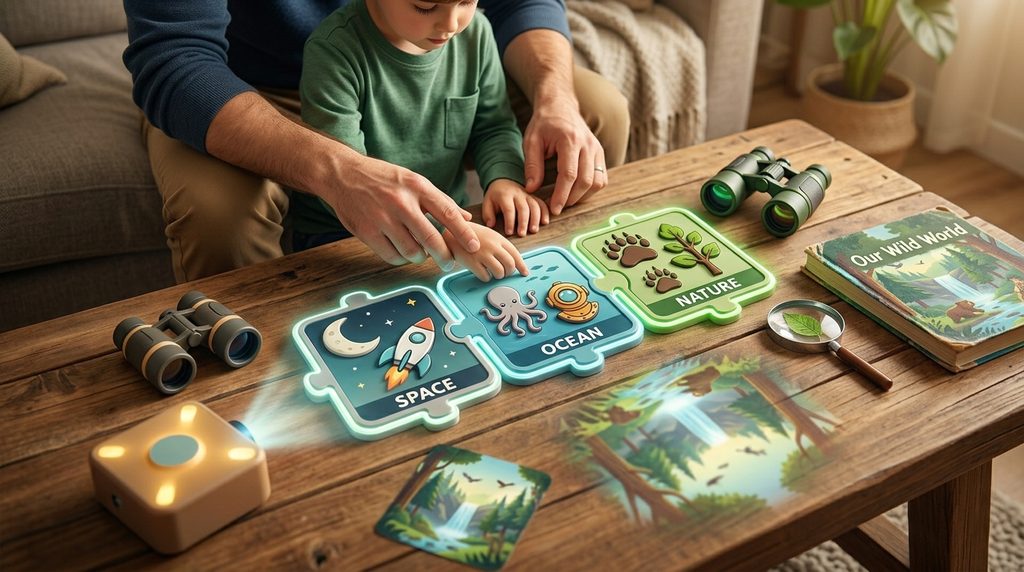
Parents can maximize learning by practicing active co-viewing. Asking open-ended questions during key moments directly leverages how animated storytelling sparks early curiosity, bridging screen concepts with real-world backyard observations.
What age is best to introduce STEM-focused animated cartoons?
Children as young as 3 to 4 years old (pre-K) benefit significantly from gentle, narrative-driven science shows like Octonauts or Ready Jet Go!. These titles build early curiosity in space, ocean life, and nature without inducing sensory fatigue.
6. Summary and Key Takeaways
Understanding how animated storytelling sparks early curiosity empowers parents to turn screen time into an enriching, educational tool. By curating high-quality science animation and pairing it with thoughtful post-show discussions, you can foster a lifelong passion for discovery across biology, astronomy, and engineering.