
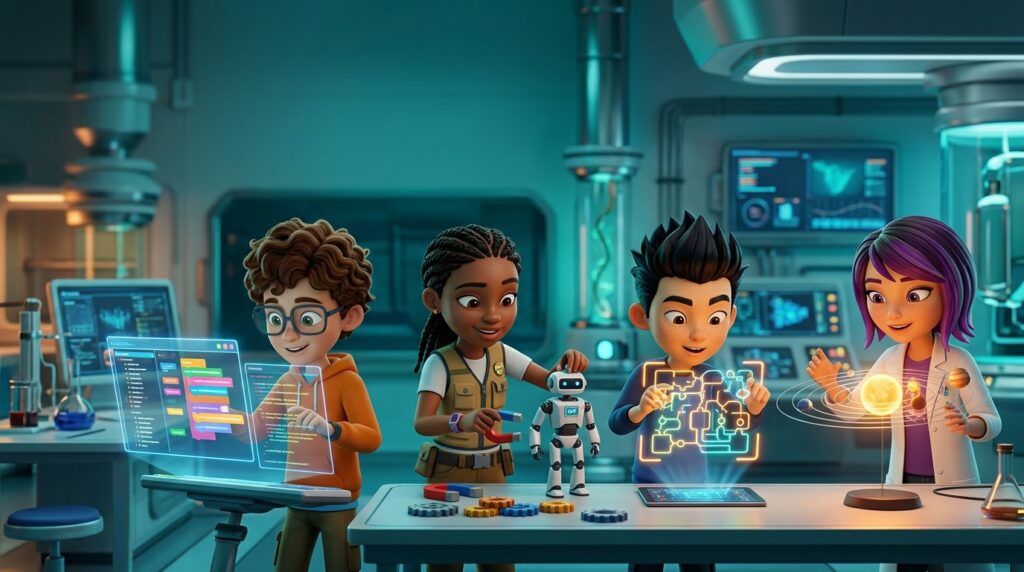
What if your child’s next favourite and best animated shows could spark an interest in coding, engineering or physics without feeling like another school lesson?
For parents of tweens, finding worthwhile screen time can be a challenge. Children between roughly 9 and 12 are often ready for more complicated ideas, but they still want entertaining characters, clever jokes, mysteries and stories that reward their curiosity. The right animated series can combine all these elements, turning an ordinary episode into a starting point for real learning.
The trick is choosing shows that do more than throw scientific words into a script. The best educational cartoons encourage children to predict outcomes, test ideas, recognise patterns, solve problems and question how things work.
This guide explores seven animated shows that introduce STEM concepts through adventure and storytelling. Some focus on mathematics and logical reasoning, others explore scientific investigations and engineering, while a few offer useful foundations for computational thinking.
One important distinction: watching a show about coding is not the same as learning to write code. These series can build curiosity and problem-solving habits, but practical experiments, coding exercises and hands-on projects help turn that interest into real skills.
What Makes an Animated Show Worthwhile for STEM Learning?
Before choosing a series, consider what your child can actually learn from it.
- Problem-solving: Do characters identify a problem, examine the available information and try possible solutions?
- Scientific thinking: Does the story encourage observation, prediction, experimentation and evidence-based conclusions?
- Logical reasoning: Must characters recognise patterns, follow sequences or work out why something happened?
- Engineering: Do they design, construct, test or improve a solution?
- Real-world application: Can your child connect the episode to something they can build, calculate, investigate or program?
A show does not need to teach every STEM subject to be valuable. A series that develops strong mathematical reasoning may be more useful for a particular child than one that mentions coding without explaining it.
1. Cyberchase — Best for Mathematical Logic and Problem-Solving
Best for: Tweens who enjoy puzzles, mysteries and challenges that require a clever solution.
Cyberchase follows three children—Jackie, Matt and Inez—who enter cyberspace and work with their digital companion, Digit, to stop the villain Hacker. Their adventures revolve around problems that cannot be solved by guesswork alone.
The series is particularly well suited to children who enjoy working out how a solution fits together. Mathematical concepts become part of the adventure rather than isolated exercises.
PBS KIDS describes Cyberchase as a programme designed for children around ages 8–11, using mystery, humour and action to encourage mathematical reasoning and confidence. Its supporting activities extend the learning through games and practical challenges. Read the official PBS KIDS guide.
What can children learn?
- Pattern recognition and logical deduction.
- Number relationships and mathematical reasoning.
- Organising information with charts, graphs and maps.
- Breaking a complicated problem into manageable steps.
- Working collaboratively and evaluating possible solutions.
Try this after an episode
Ask your child to explain the solution before revealing the ending of a puzzle. What information mattered? Which clues were distractions? Could another solution work?
Then create a small challenge of your own, such as finding the shortest route through a grid or arranging objects according to a set of rules.
ToonTycoon verdict: One of the strongest choices for building logical thinking. Although it is not a programming course, the reasoning it encourages is useful when children begin learning algorithms and computational thinking.
Watch or explore: Cyberchase on PBS KIDS.
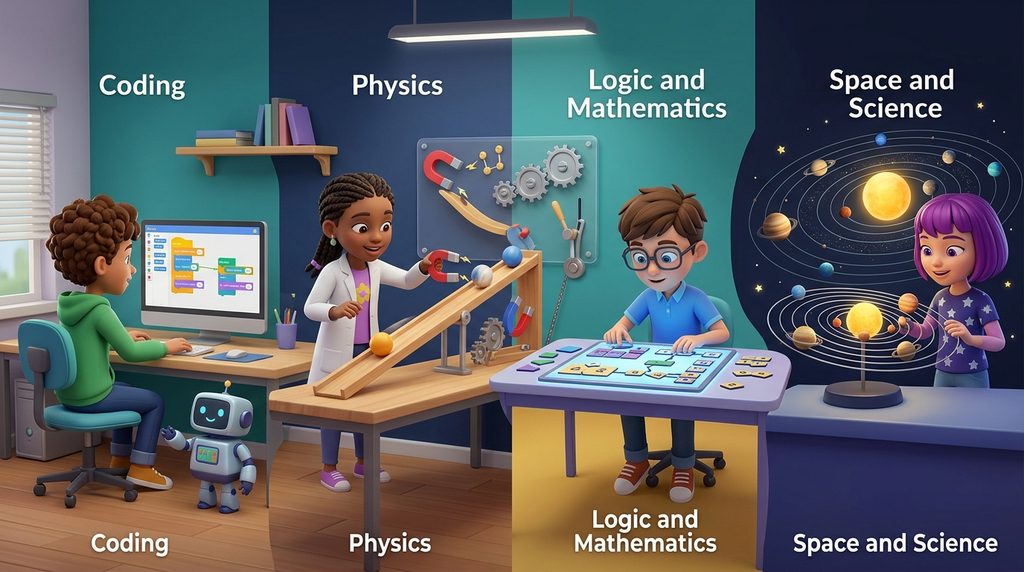
2. Ada Twist, Scientist — Best for Scientific Investigation
Best for: Curious children who constantly ask why things happen and how everyday objects work.
In Ada Twist, Scientist, a young investigator and her friends explore questions about the world around them. Ordinary situations become mysteries that the characters attempt to understand through observation, investigation and creative thinking.
Netflix describes the series as following Ada and her friends as they investigate questions and put their discoveries into action. Its stories encourage curiosity, teamwork and an interest in scientific explanations. See Netflix’s official series page.
What can children learn?
- Asking questions that can be investigated.
- Making observations and identifying useful evidence.
- Developing explanations for everyday phenomena.
- Exploring cause and effect.
- Understanding that an unsuccessful attempt can provide useful information.
Episodes touch on scientific ideas such as evaporation and chain reactions, although the complexity of the explanation varies.
Try this after an episode
Choose a safe household phenomenon and ask your child to investigate it. For example, compare how quickly equal amounts of water disappear from two different locations.
Before beginning, ask them to predict what will happen. Record the observations and discuss possible reasons for the result.
The important lesson is not getting every prediction right. It is learning how to ask a useful question and check an explanation against evidence.
ToonTycoon verdict: A good introduction to scientific thinking. Older tweens may want to take the ideas further with more detailed experiments and explanations.
Watch or explore: Ada Twist, Scientist on Netflix.
3. The Magic School Bus — Best for Science That Connects to Real Life
Best for: Children who want to understand the human body, space, ecosystems and the physical world.
The Magic School Bus turns classroom science into extraordinary adventures. Ms. Frizzle takes her pupils into environments that would otherwise be difficult to observe directly, from microscopic worlds to the human body and distant places in space.
The original series and the later The Magic School Bus Rides Again offer different versions of this educational adventure, but both use imaginative journeys to introduce scientific concepts.
What can children learn?
- Basic biology and how living systems function.
- Ecosystems and the relationships between organisms.
- Astronomy and the scale of the universe.
- Earth science and environmental processes.
- Cause-and-effect relationships in natural systems.
The show’s greatest advantage is its ability to make abstract ideas visible. Children can find it easier to discuss a process when they have a memorable visual representation of it.
However, cartoon adventures sometimes simplify or exaggerate scientific processes for storytelling. The visuals should be treated as an introduction, not a substitute for a reliable textbook or scientific source.
Try this after an episode
Ask your child to draw a diagram explaining one process from the episode. They could illustrate how food travels through the digestive system, how a food chain works or how water moves through the environment.
Then compare the drawing with a trustworthy educational resource and correct any misconceptions together.
ToonTycoon verdict: An excellent starting point for broad scientific curiosity, especially for children who learn well through visual storytelling.
4. Ready Jet Go! — Best for Space, Astronomy and Physics Foundations
Best for: Children interested in planets, rockets, gravity and the science behind space exploration.
Ready Jet Go! follows children who encounter scientific questions through their friendship with Jet Propulsion, an alien who introduces them to astronomy and the physical world.
The series makes space science approachable by connecting large concepts to questions children can understand: Why does the Moon change appearance? What makes a planet different from a star? How do objects move in space?
What can children learn?
- The Solar System and the characteristics of planets.
- Earth’s rotation and its relationship to day and night.
- Basic ideas about gravity and motion.
- Observational astronomy and asking scientific questions.
- The difference between an observation and an explanation.
Although the programme is not a formal physics course, it can give children useful starting points for understanding how the universe works.
Try this after an episode
Use a lamp and a ball to demonstrate how light illuminates a spherical object. Move the ball around the lamp and ask your child to predict what the illuminated portion will look like from different viewpoints.
This simple model can help explain phases of the Moon, provided you also discuss the limits of the demonstration.
ToonTycoon verdict: A strong choice for space enthusiasts. For older tweens, pair the show with sky observations, astronomy software or more advanced science reading.
5. The Fixies — Best for Engineering and Everyday Technology
Best for: Children who enjoy gadgets, machines and discovering how things work.
The Fixies is an animated series about tiny characters who live inside and maintain everyday devices. Its stories revolve around household appliances, electronics, mechanical systems and the problems that arise when technology malfunctions.
The premise gives children a reason to look beyond a device’s outer casing and ask what happens inside it.
What can children learn?
- Basic mechanical and electrical concepts.
- The purpose of components in everyday devices.
- Cause and effect in simple systems.
- The importance of maintenance and troubleshooting.
- The difference between a symptom and its possible cause.
The educational value comes from the questions the episodes encourage. A child might begin wondering how a speaker produces sound, why a fan rotates or what a battery does.
The show should not be treated as a repair manual. Real devices can contain dangerous electrical components, and cartoon demonstrations should never replace safe, adult-supervised instruction.
Try this after an episode
Choose an unplugged, safe object such as a manual pencil sharpener or a simple hand-operated mechanism. Ask your child to identify its parts, describe what each part does and explain how the object produces its result.
For an older tween, introduce a simple engineering challenge: design a paper mechanism that moves a small object from one position to another.
ToonTycoon verdict: Particularly useful for encouraging engineering curiosity and helping children recognise the technology hidden in everyday life.
6. Numberblocks — Best for Patterns, Sequences and Mathematical Foundations
Best for: Children who benefit from visual mathematics, including tweens who want to strengthen their foundations.
Numberblocks brings numbers to life through animated characters whose appearances and actions illustrate mathematical relationships.
Although the series is aimed primarily at younger children, it can still be useful for older learners who need a clearer visual understanding of numbers, arithmetic and patterns.
What can children learn?
- Number composition and decomposition.
- Addition, subtraction and multiplication foundations.
- Number sequences and recurring patterns.
- Relationships between quantities.
- Early mathematical reasoning.
Its major strength is making abstract quantities visible. Instead of treating a number as a symbol on a page, children can see how quantities combine or separate.
For a tween, however, simply watching the episodes may be too basic. The value comes from using the visual ideas to tackle more challenging questions.
Try this after an episode
Ask your child to find different ways to make 24 using whole numbers. They might explore multiplication pairs, factor combinations or several additions that produce the same total.
Then extend the task: can they explain why a particular number has more factors than another?
ToonTycoon verdict: Not the most age-targeted option for tweens, but a helpful supplementary resource for visual learners or children who need to revisit mathematical foundations.
7. StoryBots — Best for Broad Science Questions and Research Curiosity
Best for: Children who enjoy varied topics and want accessible introductions to scientific questions.
The StoryBots franchise, including Ask the StoryBots, explores questions about the human body, nature, space, technology and everyday phenomena. Its combination of animation, humour, music and short explanations can make unfamiliar ideas approachable.
The series is particularly useful when a child has a question that seems simple but leads to a surprisingly complicated scientific explanation.
What can children learn?
- Introductory concepts from biology, physics and astronomy.
- Scientific vocabulary and general knowledge.
- How a question can lead to a search for evidence.
- Connections between science and everyday experiences.
- Curiosity about subjects they might want to investigate further.
As with other educational cartoons, the depth of learning depends on the episode. Some explanations are necessarily simplified, so older tweens should be encouraged to verify interesting claims using reliable educational resources.
Try this after an episode
Ask your child to write down three facts they remember and one question the programme did not fully answer.
Use that unanswered question as the starting point for a short research task. Ask them to find a reliable source, explain the evidence and summarise the answer in their own words.
ToonTycoon verdict: A flexible option for encouraging broad scientific curiosity. It works best when the episode becomes the beginning of a deeper investigation.
Which Animated STEM Show Should Your Tween Watch First?
Different shows serve different learning goals. Rather than trying to watch every series, begin with the one that matches your child’s current interests.
| Show | Strongest learning area | Best starting point |
|---|---|---|
| Cyberchase | Mathematics, logic and problem-solving | Puzzles and mystery-solving |
| Ada Twist, Scientist | Scientific investigation | Everyday questions and experiments |
| The Magic School Bus | Biology, Earth science and general science | Visual explanations of natural processes |
| Ready Jet Go! | Astronomy and physics foundations | Space, planets and motion |
| The Fixies | Engineering and technology | How everyday devices work |
| Numberblocks | Number sense and mathematical patterns | Visualising quantities and number relationships |
| StoryBots | Broad science knowledge | Questions about the world |
For tweens specifically interested in coding, start with Cyberchase for algorithmic thinking and structured problem-solving, then move into a practical coding environment such as Scratch or Python.
None of these seven shows should be presented as a complete coding curriculum. They provide different foundations that can make later technical learning more engaging.
How to Turn an Animated Episode Into a Real STEM Lesson
The most effective approach is to make viewing interactive without turning every episode into homework.
Step 1: Ask a question before watching
Invite your child to predict how the characters might solve the problem. This encourages them to think actively rather than simply wait for the answer.
Step 2: Pause at the problem
When the characters face a challenge, ask what information they have and what they still need to discover.
Step 3: Let your child explain the solution
Ask them to describe the reasoning in their own words. An explanation reveals more about their understanding than simply recognising the correct answer.
Step 4: Try a real-world version
Use paper, household objects, a simple science experiment or a coding project to recreate the underlying idea safely.
Step 5: Extend the learning
If the episode sparks an interest in algorithms, try a programming exercise. If it raises a physics question, explore a demonstration. If it involves mathematics, create a more challenging puzzle.
A useful rule is to let the child’s curiosity determine the next step. Not every episode needs a formal activity, and enjoyment remains a legitimate reason to watch a show.
Can Animated Shows Really Teach Children to Code?
They can introduce ideas that are useful in programming, but they generally cannot replace actual coding practice.
Computational thinking involves breaking problems into smaller steps, identifying patterns, designing procedures and checking whether a solution works. These habits appear in many mathematical and scientific challenges, including those featured in Cyberchase.
Writing code requires additional practice. Children must learn how to express instructions in a programming language, use variables and control structures, debug mistakes and test their programs.
Parents can build a useful progression:
- Watch an episode that involves a logical problem.
- Ask the child to describe the solution as a sequence of instructions.
- Express those instructions as a flowchart or pseudocode.
- Recreate the idea using Scratch or a beginner-friendly Python project.
- Test the solution and improve it when something goes wrong.
This progression connects entertainment with practical skills without pretending that a television episode alone makes a child a programmer.
Frequently Asked Questions
Which animated show is best for teaching coding to tweens?
Among the seven recommendations, Cyberchase is a strong starting point for logical reasoning, sequences and structured problem-solving. It is not a coding course, so combine it with hands-on programming activities for actual coding practice.
Which cartoons teach physics?
Ready Jet Go! introduces astronomy and basic physical concepts, while The Magic School Bus explores a broader range of scientific subjects. Both can spark useful questions that parents and children investigate further.
Are educational cartoons suitable for 10- to 12-year-olds?
Many are, although some series are aimed at younger audiences. Tweens may benefit most when parents extend simpler episodes with more advanced questions, experiments, puzzles or programming challenges.
Does watching STEM cartoons improve problem-solving skills?
Well-designed educational programmes can model useful reasoning and encourage interest in academic subjects. However, the benefits depend on the content, the child’s engagement and opportunities to apply the ideas. Watching alone does not guarantee mastery of a skill.
How much educational screen time should parents allow?
There is no single duration that suits every child. Consider the child’s age, sleep, physical activity, schoolwork, social life and overall screen habits. A useful goal is to make educational viewing one part of a balanced routine rather than treating it as a replacement for hands-on learning.
The ToonTycoon Verdict
The best educational cartoons do not make children feel as though they are sitting through another lesson. They give them a problem worth solving, a mystery worth investigating or a scientific question they cannot stop thinking about.
For mathematical reasoning, start with Cyberchase. For scientific curiosity, try Ada Twist, Scientist. For engineering and technology, explore The Fixies. Space enthusiasts may enjoy Ready Jet Go!, while The Magic School Bus and StoryBots provide broader introductions to science. Numberblocks can help strengthen mathematical foundations through visual storytelling.
But the real educational opportunity begins when the episode ends.
Ask a question. Test an idea. Build something. Write a small program. Let your child discover that the world beyond the screen is just as interesting as the animated one.
At ToonTycoon.com, we believe the most worthwhile screen time does more than entertain children. It gives them a reason to think, experiment and keep learning.